
Potato Beetle Profile
Ecology is a science that is really quite easy to understand at the base levels, and one which would do everybody and the planet a lot of good if it was taught more widely.
Everything we do has an impact on our ecology and there are few single species of animal who can trigger discussions at all levels of ecology better than the potato beetle.
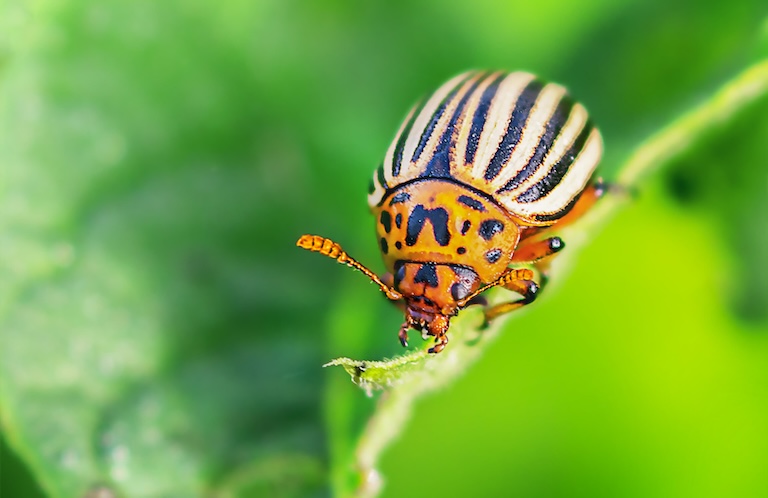
Potato Beetle Facts Overview
| Habitat: | Mostly in farm fields and open grasslands |
| Location: | North America from Colorado to Mexico; some in Europe and Asia |
| Lifespan: | One year |
| Size: | 6–11 mm (0.24–0.43 in) |
| Weight: | 50–170 mg |
| Colour: | Brown heads, with creamy white shells and lateral black stripes |
| Diet: | Potatoes |
| Predators: | Predatory insects, birds |
| Top Speed: | slow |
| No. of Species: | 1 |
| Conservation Status: | Not Listed |
Beetles are powerful animals. They make up more than half of all insect species, they clean up our poo, the Egyptians thought they were magic, they can do it all. So, it’s not all that surprising that one of the most powerful emblems of ecology is a beetle. And a pretty small and boring* one at that.
This beetle just wants to go about its day eating potato leaves, which is something few animals, including humans, can do. But it’s so good at this, it has triggered a cascade of global effects, including climate change.
*pun intended, even though this beetle doesn’t bore
Interesting Potato Beetle Facts
1. They’re leaf beetles
It seems that almost everything with six legs is a beetle. It’s estimated that there could be upwards of 2 million beetle species, and they are already thought to form 40% of all arthropod species and 25% of all animal species in total.
That means if you have four people in a room, chances are one of them is a beetle. They are just that prolific. So, when you hear that the potato beetle is one of a family of over 35,000 species, this hopefully seems a bit less of a shock.
Leaf beetles are some of the most ecologically important animals on the planet, at least and especially to our species. And they’re in an order that really encapsulates everything we need to take seriously about ecology.
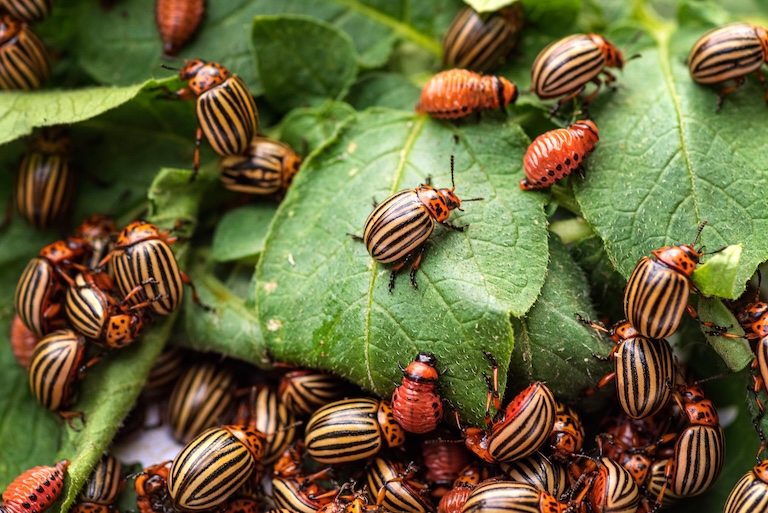
2. They’re in good company
Leaf beetles are members of the Cucujiformia suborder of beetles, which is also where ladybirds live! This group of beetles is split quite starkly between folivores and the carnivores, and obviously leaf beetles are on the former team.
But carnivores are equally important, and ladybirds are the natural predator of the potato beetle. In a balanced system the two groups would be pitted against one another and both sides would have healthy populations.
Unfortunately, we’ve gone and ballsed things up a bit.
3. They’re part of the ecosystem.
The potato beetle evolved in the presence of a horde of terrors just as devastating to their kind as the ladybirds are. So they adapted by reproducing with gusto. These are what’s known as R-strategists when it comes to breeding, the R standing for “Really quite a lot”. It’s a way of ensuring a lucky few will survive by using the rest as cannon fodder.
Females can lay 500 eggs in a 4-week sitting, and these are spotted under potato leaves. It may take up to two weeks for the eggs to hatch, but in ideal conditions they can emerge in just 4. When it’s warm, they grow faster, but to grow, they must eat. They pupate, become sexually mature, mate, and restart this cycle in as little as 21 days.
This is a beetle in a hurry, and mimics the human approach to uncontrolled multiplication, which is, in the same way, a relic from a more dangerous past. Because on the potato beetle’s farms, there are far fewer predators around, and so this breeding strategy becomes a bit of a problem. These species were never designed to survive in such huge numbers, but with rampant pesticide use, they have thrived. Already able to eat toxic potato leaves, they have also developed tolerances to all the chemicals we’ve thrown at them.
Now, they’re a bit of a pest. 1
4. They’re fond of Solanaceae plants
The Solanaceae family of plants is commonly called the nightshades and this is an infamous group for containing plants like the deadly nightshades, Brugmansia, Datura, and other very toxic (and hallucinogenic) plants. But it also contains a huge number of things we eat: potatoes, tomatoes, aubergines (eggplants), peppers and tree tomatoes are all members of this family, too. And many animals can’t eat them!
But potato beetles can. So, we find ourselves with an ecological competitor. And what our species has historically done when faced with a competitor is carpet bomb the entire environment.
In fact, this tiny beetle has driven the pesticide industry forward in leaps and bounds, and this is, to a wider degree, a terrible thing. Because as Jeff Goldblum says, “Life, uh, finds a way.”
And the potato beetles have racked up tolerances to countless chemical pesticides we’ve thrown at them, resulting in new and more potent ones being manufactured.
So, pests like this have also driven the organic farming movement, which is a far more sustainable, yet still flawed approach.
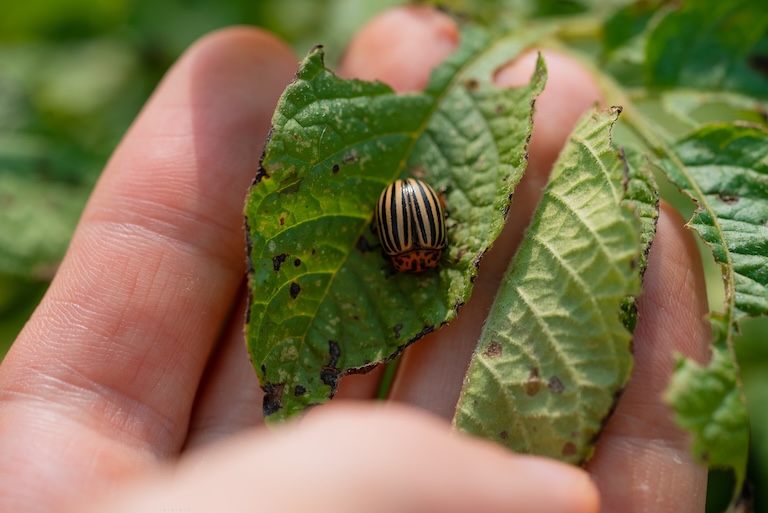
5. Straw and neem
The solution to a cluster of these little buggers in your organic garden is the same as the name for a fictional pub in an upper-middle-class borough: Straw and Neem!
Straw can be used to mulch the ground around the plants, and this not only restricts weeds but also creates a viable habitat for the enemies of potato beetles: lacewings. These pretty little flying creatures are voracious predators in their larval stages, and will devour the potato beetle’s babies before they can reach maturity.
As mentioned, another player in this community is the often-misunderstood ladybird. These cow-like harbingers of summer may look humble, but are also armoured slaughterers of anything smaller than themselves.
So, lacewings and ladybirds, or (as they’re called in potato beetle land) ladybugs, are a great deterrent. But there is also neem oil, which is a common pesticide used on organic crops, and this messes with the hormones of various pest species to stop them from reproducing. Of course, this will also kill all the beneficial insects like ladybirds and lacewings, and brings us to the topic of organic pesticides. 2
6. Organic farming
“Organic” agriculture is rife with greenwashing, misunderstandings of ecology and expensive, small foodstuffs. There’s a lot to criticise about it, and there’s a long way for the certification to go before it’s trustworthy to the wider community, but the ethos behind it is sound: work with nature, not against it.
So, “organic pesticides” seems to be a bit of an oxymoron, as there is always collateral damage to any destructive system that is put in place. But pesticides, even organic ones, need to be a last resort in organic farming, and behavioural changes should always do the heavy lifting.
This means that crop rotation, sanitation, timing and building barriers are the focus of a successful organic farm, and according to the USDA National Organic Program (NOP), these are not just desired but required for certification.
But more than this, we are really putting all of our potatoes in one basket with agriculture, and a longer-term and more transferable solution to sustainable agriculture in general involves being a bit more adventurous with our diets. 3
7. We can eat other things too
We rely on fewer than 200 crop species, yet tens – perhaps hundreds – of thousands of edible plants exist, so our diet isn’t limited by nature, but by imagination. 15 crops produce 90% of our food, and just three – rice, wheat and maize – make up two thirds of that.
Estimates put the number of species of plants that we could be growing, but aren’t, somewhere between 30,000 and 300,000.
Conversely, the potato beetle feeds on very little besides potatoes, which makes our drive to eradicate it a bit unreasonable, when you think about it. Removing a pest doesn’t just protect crops, it strips food from the species that eat it, many of which pollinate other plants we depend on, or feed the animals that do.
Pests aren’t just invaders, they’re participants in a system with trillions of moving parts. Trying to eliminate them outright risks destabilising the very system that sustains us. Long-term food security must come from increasing the players, balancing the ecosystem, and promoting biodiversity.
So instead of vast potato monocultures, mixing crops with trees and other plants can disrupt uncontrollable pest outbreaks and support a wider web of balanced life, including our own. We don’t need to give up potatoes, but we do need to branch out a bit.
We are part of the system, whether we like it or not. Remove one brick and the whole house can topple. The solution, then, when the potato beetle is gnawing at our foundations, is to add more bricks. 4
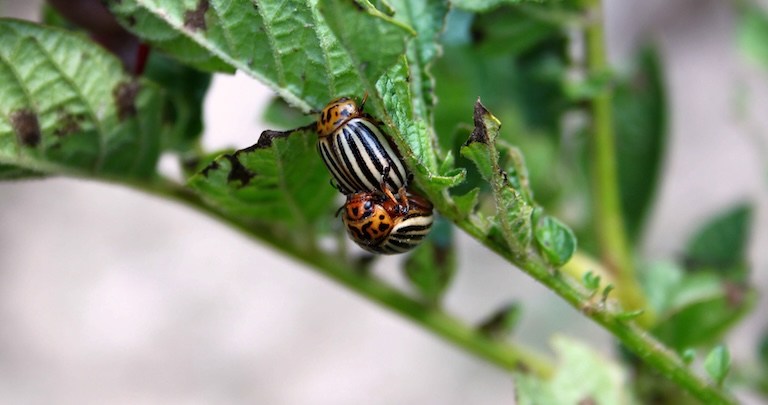
Potato Beetle Fact-File Summary
Scientific Classification
| Kingdom | Animalia |
| Phylum | Arthropoda |
| Class | Insecta |
| Order | Coleoptera |
| Family | Chrysomelidae |
| Genus | Leptinotarsa |
| Species | decemlineata |
Fact Sources & References
- , “Colorado Potato Beetle Management”, UK Department of Entomology.
- , “How to Get Rid of Potato Bugs In Your Garden”, Solutions Pest & Lawn.
- Eric Sideman, Ph.D (2003), “Potato Beetle”, Maine Organic Farmers and Gardeners.
- John Warren (2016), “The Secret Sex Lives of Crop Plants”, Project Syndicate.