
Porcelain Crab Profile
South Park warned us about crab people all the way back in 2003. Around fifteen years later, it became clear that crabs are indeed taking over. In the 200 million years or so since OG crabs emerged, various other entities have followed suit, and porcelain crabs are some of the prettiest.
They have yet to take over the world, but they do make an adorable and docile addition to a marine ecosystem, whether in the wild or in an aquarium.

Porcelain Crab Facts Overview
| Habitat: | Benthic marine |
| Location: | Worldwide except the Arctic and Antarctic Oceans |
| Lifespan: | 2 to 5 years in captivity |
| Size: | Usually no more than around 5 cm or 2 inches |
| Weight: | Not recorded |
| Colour: | Highly variable. Many plain greens and browns, many other bright blues, reds, greens, and patterned |
| Diet: | Primarily filter feeders of plankton and marine snow |
| Predators: | Fish, birds, larger crustaceans |
| Top Speed: | Not recorded |
| No. of Species: | 4700+ |
| Conservation Status: | Not Listed |
Porcelain crabs are relatives of other misnamed crustaceans like the squat lobster and the hermit crab, and are not true crabs. But they are some of the most crab-like of the imitators, and carry some impressive weaponry at the front end.
But these are not fighters by nature and prefer to hide their delicate – and often stunningly pretty – bodies from trouble, gently filtering plankton and other nutrients out of the water from beneath a rock or anemone.
Interesting Porcelain Crab Facts
1. They’re not crabs!
There’s a popular meme (so younger people tell us) that everything is becoming crabs, and this refers to a process known as carcinization, which is the apparent tendency for arthropods in the ocean to develop very crab-like features over evolutionary timeframes.
This is a real thing! Sort of. They’re not becoming crabs, but they are using the same evolutionary strategies to navigate their environments, and this often involves claws, hard shells, sometimes sideways skuttling, and those flappy crab tails that fold under the body.
But this isn’t a novel concept, it’s just a marine version of convergent evolution, which is the tendency for organisms to be carved into their respective body plans by their external environments. We see it on land, too, but in the ocean, it’s what results in the name “crab” being applied to lots of unrelated animals.
All this is to say that porcelain crabs aren’t true crabs. They look like crabs, they behave like crabs, but they are more closely related to hermit crabs (who aren’t crabs, either) and squat lobsters *(who aren’t lobsters)1.
2. There are loads of them
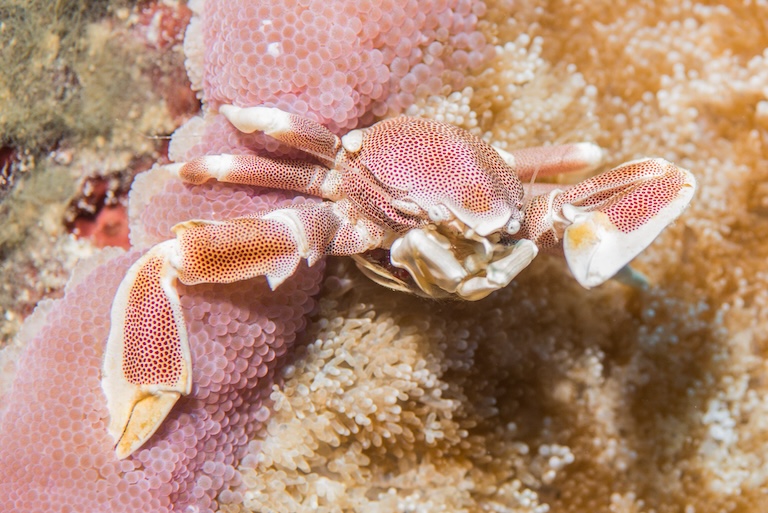
Porcelain crabs and squat lobsters are the closest relatives to one another, and both of these comprise a superfamily together. Each has its own family, though, with the porcelain crabs belonging to the Porcellanidae family, and forming over 30 genera of crab-like animals, with around 4700 species described.
They resemble their relatives the squat lobsters, but are flatter, and we’ll come back to that shortly. They also come in all kinds of colours, and many stunning variations of hues and patterns.
These are incredibly pretty crabs, or at least, they can be – some are covered in algae or just plain boring, but the pretty ones really are exceptional. They have relatively large claws, too, and are some of the most crab-looking non-crab animals you can find.
There’s an important note to be made here, though. This family is not considered to be monophyletic, meaning it doesn’t contain all of the evolutionary links in the group2.
They’re not quite as ancient as true crabs, but they’re not far off it.
3. They’re ancient.
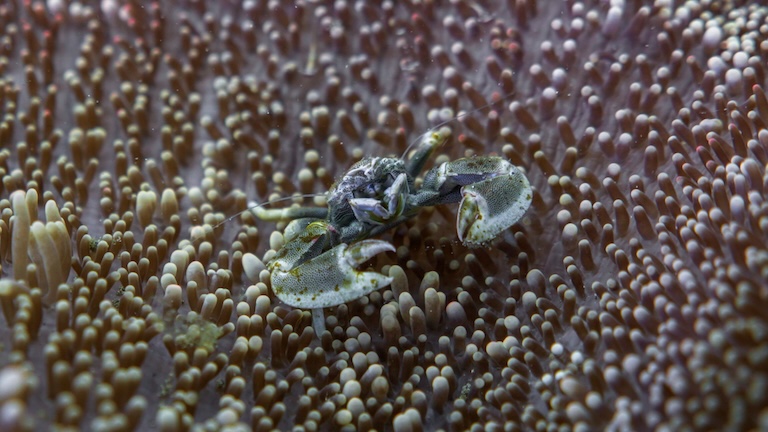
Porcelain crabs appear in the fossil record sometime in the Late Jurassic, around 150 million years ago. This was about 50 million years after true crabs showed up, but still a remarkably long time to wait for a bus.
So, porcelain lobsters have had a tremendous amount of time to diversify and expand from what researchers believe was an origin in the Indo-West Pacific region, into a near global distribution, with the exception of the polar waters.
4. They’re squat
As we mentioned, these decapods belong to a very diverse family of over 4,000 species of crab-like creatures. And as we mentioned, these creatures aren’t true crabs, but they relate closely to another group of animals also erroneously labelled crabs: hermit crabs.
This group also contains the hairy stone crab, which looks remarkably like a porcelain crab too. But all three of these groups, as similar as they appear, evolved this body form independently, through that process of “carcinization” we spoke of earlier.
Perhaps unsurprisingly, then, porcelain crabs share a similar state of vulnerability with their hermit crab cousins, and this is actually how they get their name.
While hermit crabs compensate by squatting inside discarded mollusc shells, porcelain crabs simply hide under rocks or anemones and pop out with their frilly bingo wings to filter nutrients out of the water.
As such, they’re not only flat and vulnerable, they’re also quite delicate if ever found outside their protective abodes3.
5. They’re delicate
Porcelain crabs have some mighty pincers at the front end, but they’re not as tough as they look. This is a group of crabs that have the delicate body of a hermit crab with none of the borrowed real estate for protection.
They are shy and delicate creatures, despite their intimidating snips, and will often go as far as to jettison a whole limb to get out of trouble. Thankfully, they also have little issue growing one back, and it’s usually recovered in the next moult or two.
6. They’re prissy.
Most decapods, as the name suggests, have ten feet. The first two are typically morphed into those infamous armoured nipple clamps, but the remaining four pairs are used to scuttle sideways across the sand.
Porcelain crabs have very decent nipple clamps of their own, but they only scuttle on three pairs of legs, keeping the spare second pair as cleaning and feeding tools.
7. They make decent “pets”
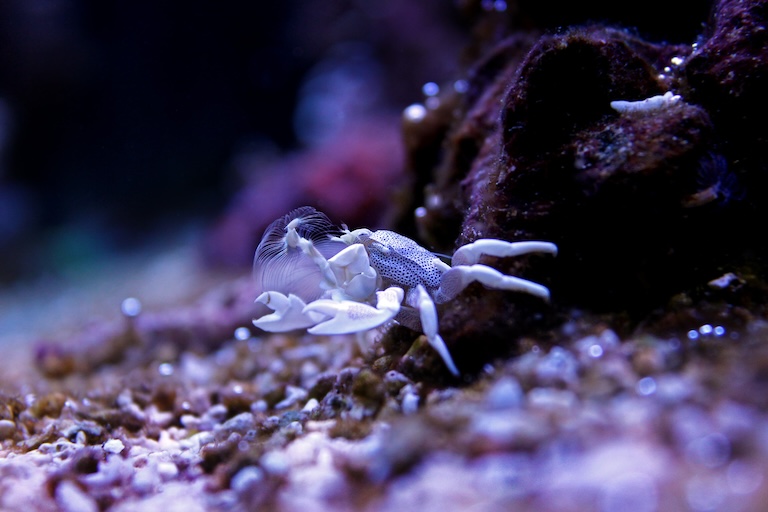
Being filter feeders, they don’t threaten to eat tankmates, and being that there are so many absolutely stunning species, these ‘crabs’ make excellent additions to a tranquil and well-balanced marine aquarium.
They’re small, too, which means they’re well suited to smaller set-ups, such as the 40 litre nano-reef tanks. Of course they will also thrive in larger setups, and will provide protection for resident anemones in exchange for somewhere to hide.
Porcelain Crab Fact-File Summary
Scientific Classification
| Kingdom | Animalia |
| Phylum | Arthropoda |
| Class | Malacostraca |
| Order | Decapoda |
| Family | Porcellanidae |
| Genus | 30 genera |
| Species | Over 4,700 |
Fact Sources & References
- Erik (2025), “This Flat Porcelain Crab is No Crab”, Notes From The Road.
- “Porcellanidae Haworth”, World Register od Marine Spieces.
- Gerhard & Richter (Year), “Phylogenetic systematics of the reptantian Decapoda”, Scence Direct.