
Polyphemus Moth Profile

Polyphemus Moth Facts Overview
| Habitat: | Deciduous hardwood forests, orchards, urban areas, and wetlands |
| Location: | Widespread across the US and southern Canada |
| Lifespan: | Usually around 3 months, sometimes up to a year |
| Size: | 15 cm (6 in) |
| Weight: | Not recorded |
| Colour: | Various shades of brown from light to rufous, with blue, black and yellow-ringed eye spots |
| Diet: | Mostly elm and birch leaves |
| Predators: | Wasps, ants, squirrels, raccoons |
| Top Speed: | |
| No. of Species: | |
| Conservation Status: |
Interesting Polyphemus Moth Facts
1. They’re Saturniids
Butterflies and moths belong to an order of insect called Lepidoptera. While they’re colloquially separated, there’s not really a meaningful taxonomic difference, and while butterflies are a monophyletic clade of their own, “moths” are basically what you call everything else.
And there’s a lot of everything else. Butterflies make up around 18,000 species, which is already quite significant, but moths species number around ten times this much. There are around 120 families of moth, and one of these is known for being enormous and quite pretty.
One of the largest moths known is the Atlas moth, which grows to 30 cm across. Likewise, the Hercules moth has an even larger wing area, and both of these belong to the family Saturniidae, which as it happens, is where we find the Polyphemus Moth.
Members of this family are found all over the world, even in the UK, but the majority are large, good-looking, New World moths, and in this regard, the Polyphemus moth is not very unusual.

2. A North American Cyclops
While not as gargantuan as the largest of its kind, the Polyphemus moth sports a respectable 15 cm of wingspan and brings with it the stunning colouration that it’s family is known for.
The name, Polyphemus, comes from Greek mythology and refers to the man-eating giant cyclops from Homer’s Odyssey. This is a nod to the giant eye spot on each wing, but since there are two wings on the butterfly, seems a bit of a miscount.
Regardless, this butterfly has similar appetites for leaves as its namesake did for Odysseus.
3. A Very Hungry Caterpillar
Pretty much all members of the Saturniid family follow the same reproductive routine. Males find females using their fluffy, club-like antennae, which pick up on chemical pheromone messages in the air.
They’re usually found around willow and birch, but sometimes among Prunus trees and others. More or less anywhere with plentiful deciduous hardwood foliage is good enough, and after mating the female will get to work laying eggs under leaves, while the male tries to fit in a few more pairings with local females before he drops dead.
Caterpillars will hatch within two weeks and they will eat. In the first eight weeks of its life, this little caterpillar will consume 86,000 times its bodyweight in food. That’s roughly the same accomplishment as the average human eating 33 blue whales. In under two months.
They’re really making the most of it, since after they pupate and emerge into their beautiful adult forms, they won’t be able to eat any blue whales at all. 2

4. Adults don’t eat
The caterpillars will munch on leaves almost non-stop until they pupate. But once they do, they morph into a fully mature moth, and this moth is cursed with a mouth that doesn’t work.
Adult Polyphemus moths have vestigial mouths, and they’re more or less useless as a result. So, they rush to breed just as much as they rushed to eat when they were youngsters. Because within a day or two, they’ll run out of energy and die.
5. They can be bred in captivity
This is a natural part of the moth’s lifecycle, and one that has been in play for hundreds of thousands of years at least, so they do know what they’re doing.
But with human development affecting all wildlife, and most of it negatively, it’s useful to know how to look after species in captivity in case we have to rescue them for a bit while we find them a place to live in the wild again.
And for this species, that has been no trouble at all. They’re said to be easy to breed, at least by entomologists who know a thing or two about moths. This is good! Because moths are increasingly affected by light pollution.
6. Light pollution is more than a nuisance
A lot of people complain about light pollution in the context of losing the beautiful night sky views we once had. This is a sad opportunity cost to being able to stay safe at night, but it’s one of the least significant drawbacks of the growing brightness of our nights.
Animals like the Polyphemus moth become thoroughly disoriented by night time lights, and this well-known phenomenon results in many of them being eaten or failing to find a mate. This is a continuous theme across the range for this species, and is no doubt detrimental to their success, but the good news is, for this species, at least, they’re not in too much trouble just yet.
7. But they’re doing ok in the wild
All of this is a problem for many species, including the Polyphemus moth. But so far, it hasn’t seemed to have put a significant dent in their populations to any worrying dergee.
In fact there are no serious threats to this species known yet, though light pollution and parasitism are the two potential problems noted by the IUCN.
One potential threat to keep an eye on, though, is the parasitoid tachinid fly Compsilura concinnata, whose introduction to the Americas might put pressure on the native moths.
Still, for now, the Polyphemus moth remains a charismatic giant of least concern in North America. 3
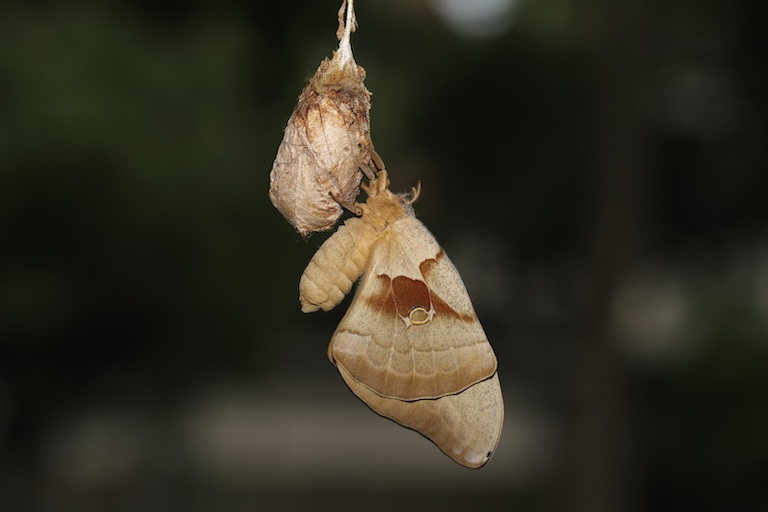
Polyphemus Moth 3Fact-File Summary
Scientific Classification
| Kingdom | Animalia |
| Phylum | Arthropoda |
| Class | Insecta |
| Order | Leopidoptera |
| Family | Saturniidae |
| Genus | Antheraea |
| Species | polyphemus |
Fact Sources & References
- Author Name (Year), “Article Name”, Publication.
- Louisa Perry (2019), “Is ‘The Very Hungry Caterpillar’ Unusually Hungry for a Caterpillar? ”, Journal of Interdisciplinary Science Topics.
- Walker (2020), “Polyphemus Moth”, IUCN RedList.