
Pollock Profile
Much of what science knows about fish comes from playing with our food. The fishing industry exposes the secrets of the deep in great detail, but it does so with all the delicacy of using a hammer to a baby bird.
As such, the fish most able to avoid our nets are the ones we least know how to look after. The humble pollock is just such a fish, and may well hold some of the keys to better protecting our coastal habitats.
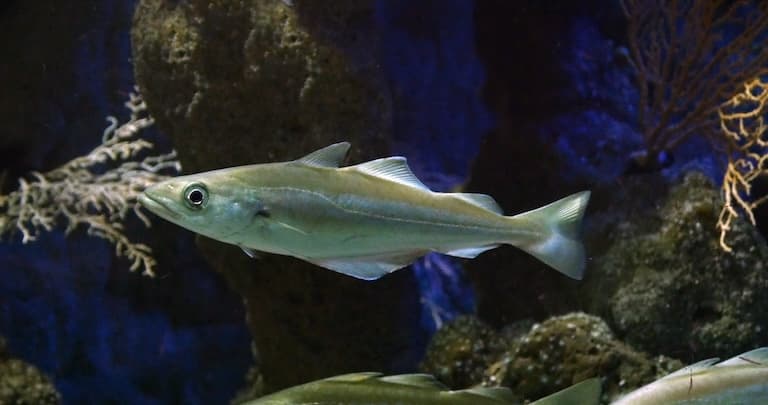
Pollock Facts Overview
| Habitat: | Marine, varied depths and conditions, mostly open waters |
| Location: | North Atlantic |
| Lifespan: | 25+ years |
| Size: | Up to 130 cm (51 inches) long |
| Weight: | Up to 5 kg (11 lb) average, max 18.1 kg. |
| Colour: | Brown-green on the back, paler towards the front |
| Diet: | Fish, molluscs, crustaceans |
| Predators: | Seals, sea lions, whales, dolphins, and other large bony fish; humans. |
| Top Speed: | Not recorded |
| No. of Species: | 2 |
| Conservation Status: | Least Concern |
Pollock, sometimes spelled pollack, goes by many other names as well. This is, historically, a significant source of seafood for people all over the Northern Hemisphere, though today it’s mostly caught by mistake. It’s still popular as food, and while its juveniles mostly escape our nets, they are running out of places to hide.
Beneath the waves, though, these solitary, complicated fish have a variable relationship with the codfish and likely a very important role in the ecosystem as a result. While we have wiped out the largest of them, the smaller ones appear to be doing a good job of avoiding annihilation, though the lack of data is cause for concern.
Interesting Pollock Facts
1. There are two species
Pollock, sometimes called pollacks, come in two varieties. Both are members of the same genus, Pollachius, and appear to be its only members.
The European pollock is the type species, Pollachius pollachius, and the default pollock, though in the US it’s referred to as the European pollock. Other local names include lythe and pollack, the latter of which seems to be the old British spelling. This species is most commonly found in Northern Europe, in waters like the North Sea and the northeastern North Atlantic.
Then there’s Pollachius virens, its only relative1. This one is sometimes called the coalfish, saithe, or Boston blue, and has a range that overlaps with P. pollachius but there was once a third, American pollock, known as the Alaska pollock, which still technically exists but has been moved out of the genus and into its own.
This is still a member of the same family, Gadidae, which they all share with the cod, but is no longer a true pollock. In fact, it’s now classed as a cod itself. This may explain the family feud that cods and pollocks appear to be having, but more on that later.
2. They’re mostly shallow water fish
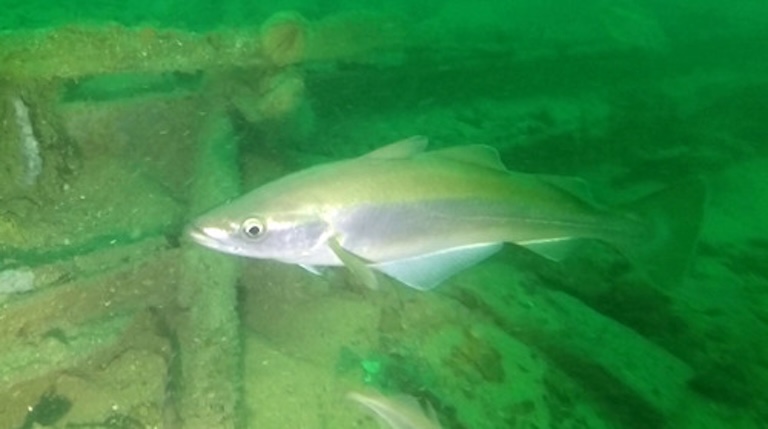
Pollock are considered bento-pelagic species, which is marine biology jargon for “bottom-surface”. This sounds confusing at first, but where the water is shallow, the sea bed and its surface layers are quite close together, and this is the zone in which pollock and other shallow, coastal species are often found.
Pollocks typically swim about the sea bed at depths of around 30 to 100 metres, and will go as far as 200 m deep, but anything beyond this gets very dark, and these fish seem to prefer the well-lit (pelagic) zone.
They prefer rocky substrates for places to hide, which keeps them both out of reach of trawlers and researchers, so their ecological role is less understood than many of the easier-to-catch fish2.
3. They kill cod
As we mentioned, pollock and cod share the same family, but this is not a very loving family, and despite the fact that cod reach some very large proportions, the pollock do their best to prevent this from happening by eating them all while they’re young. Pollocks are one of the main predators of juvenile cod, but this creates a vendetta among the two species.
Pollocks are medium-sized predatory fish and one of their sources of food is juvenile codfish. Unfortunately, for the pollock, the cods that get away then grows to be much larger than it does and seek immediately to return the favour.
A large cod can grow to more than a metre long, and will happily suck up a passing pollock, so the two groups have a very complicated relationship.
4. They’re solitary
We typically think of fish as moving around in large shoals, but there are many species that prefer to be alone, and pollocks are two of them. Outside of spawning season, when there’s a necessity to be around one another, these fish spend most of their time entirely solitary, growing up fast, and maturing over around 8 to ten years.
The generation length of pollocks – that is, the time it takes for a population to replace itself – is estimated to be around 7 years, and the maximum age of the fish has been recorded as 15 years, which is pretty mid-range for marine fish.
And it all begins with cuddies.
5. Cuddies and podlies
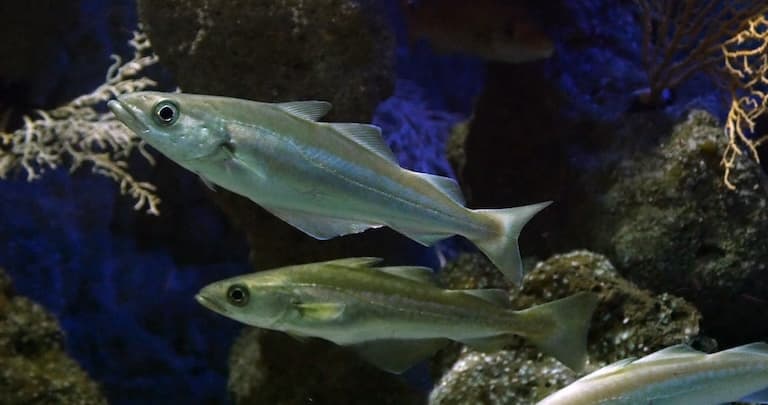
Fishermen have a lot of time to think, and they often use it to come up with funny names for fish. Juvenile pollock are commonly referred to as cuddies or poddies in the Northern UK, and harbour pollock elsewhere.
These young pollocks are often golden in appearance, quite different from the silvery-grey of their parents. They have a larval stage of around three months, during which time they grow to a mere 3 cm long. After this, they migrate down into that dark zone we mentioned earlier, beneath 200 metres, where they’re hard to spot.
They’ll stay here until they’re about 2 years old, and then enter their forever homes in the offshore bentho-pelagic zones where they will hopefully mature if they don’t get swallowed.
They’re edible fish, and are sometimes targeted on purpose, but far more often, for this elusive, solitary animal, they’re pulled up by mistake3.
6. They’re possibly over-fished by mistake
All sorts of fishing styles pull up pollock as by-catch. In fact, there is no international fishery listed that specifically targets it, yet pollock shows up regardless, as a by-product of the indiscriminate nature of our species’ attack on the ocean.
Though it primarily comes up by accident, the species is readily eaten, at least, and is therefore valuable to fisheries, despite not being directly targeted. Historically, too, this was a very important food fish, as evidenced by the plethora of local names for it.
And, like many animals around us today, our impact on their populations has made them shrink.
7. They used to be a lot bigger
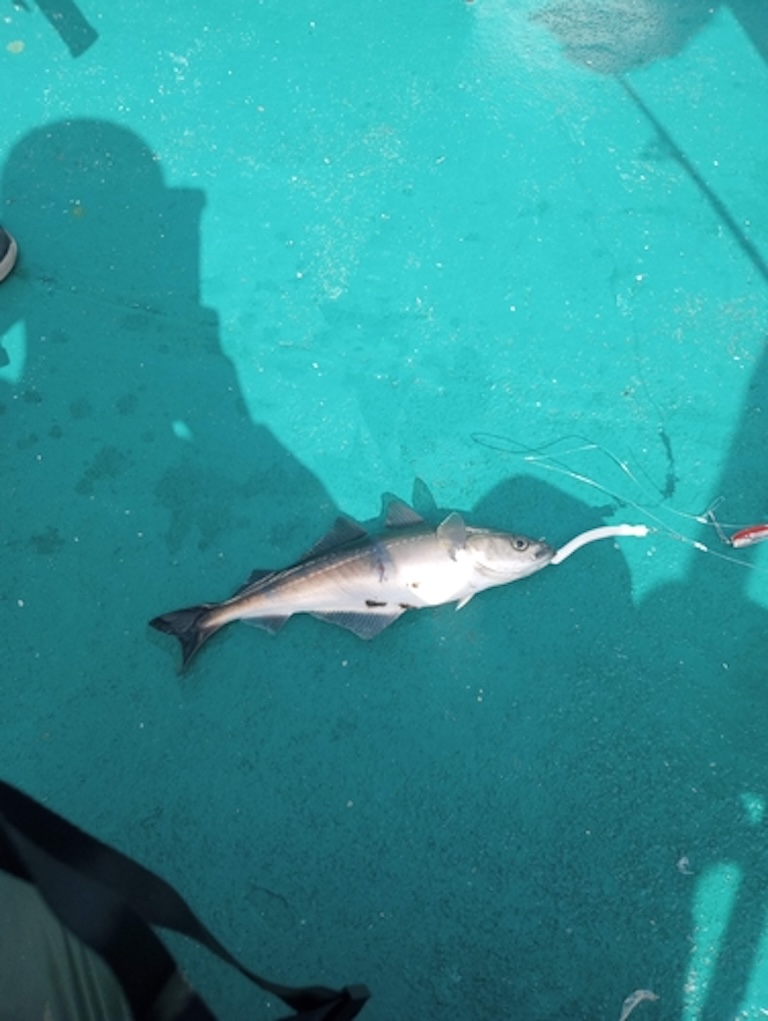
Pollock used to be much larger. The largest ever recorded was over 18 kg in weight. Today, more commonly, they’re around 5 kg when pulled up, and this isn’t an evolutionary adaptation but simply a product of our pressure on the species, preventing them from ever growing to full size4.
Animals never have a fixed role in an ecosystem, and their position and impact changes as they mature. So, removing the large individuals can be akin to removing a species entirely. It creates a niche to be occupied by other species, and disrupts and weakens the ecosystem as a whole.
The habitats of the juvenile pollock are under attack, and this might also contribute to the reduction in size of the pollock, but as the research is limited on these species, it’s hard to know how to protect them, specifically.
Assessments and the primary literature referenced in them are sorely out of date, and the future of the pollock remains uncertain. As of now, the IUCN lists only one species, as Least Concern5.
Pollock Fact-File Summary
Scientific Classification
| Kingdom | Animalia |
| Phylum | Chordata |
| Class | Actinopterygii |
| Order | Gadiformes |
| Family | Gadidae |
| Genus | Pollachius |
| Species | P. pollachius and P. virens |
Fact Sources & References
- Regents of the University of Michigan (2025), “Pollachius virens”, Animal Diversity Web.
- Fernandes et al (2014), “Pollachius pollachius”, The IUCN Red List of Threatened Species 2014.
- Cargnelli (1968), “Essential fish habitat source document. Pollock, Pollachius virens, life history and habitat characteristics ”, National Oceanic and Atmospheric Administration.
- Thomas Neeson (2006), “Pollachius virens ”, Animal Diversity Web.
- Cook et al (2013), “Pollack”, The IUCN Red List of Threatened Species 2014.