
Polish Lowland Sheepdog Profile
The Huns brought many things to modern Europe. They’re indirectly responsible for Cologne Cathedral, the word “vandalism,” and the Dulux dog. Because the rampaging Huns triggered a complete cataclysm across Europe, scrambling the status quo and sparking a new era of vying empires to follow the Romans. But most relevant to this publication was their introduction of a new breed of dog whose shaggy roots would spread as wildly as the Huns, all the way up to Scotland.
Settling primarily in what is now Poland, this Hunnic dog created a recognisably shaggy-coated, intelligent working dog called the Polish Lowland Sheepdog, or the Polski Owczarek Nizinny (PON).
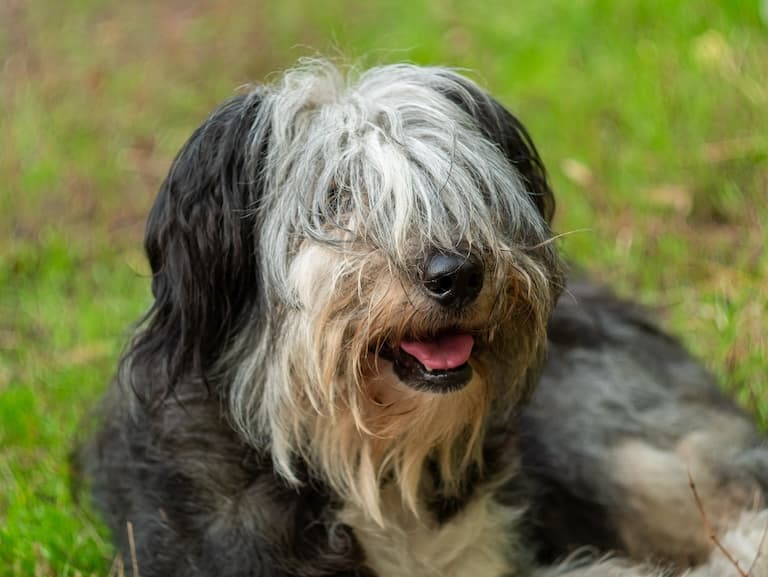
Polish Lowland Sheepdog Facts Overview
| Habitat: | Domestic |
| Location: | Mostly Poland, but worldwide |
| Lifespan: | Around 12 years |
| Size: | 45–50 cm (18–20 in) tall |
| Weight: | Up to 23 kg (50 lb) |
| Colour: | White base; often with brown or black head, saddle and rear legs |
| Diet: | Dog food |
| Predators: | None |
| Top Speed: | Not reported |
| No. of Species: | 1 |
| Conservation Status: | Not threatened |
The Polish Lowland Sheepdog is a strange tail (get it) of an ancient breed with a glorious history and a lasting legacy, but one whose modern representatives are somewhat… runty.
This dog stems from Hunnic breeds, mixed with the ancient Polish breeds, but ironically, it was an equally rampaging lunatic that almost wiped the out in WW2. And since then, their family tree has become a bit of a straight line. Still, their wits and charisma haven’t dropped off too sharply, and these dogs remain popular as both pets and traditional herders.
Interesting Polish Lowland Sheepdog Facts
1. They’re herders.
It’s no coincidence that so many sheepdogs have this fluffy, sheep-like appearance. Guardian breeds, in particular, are often selected to look a lot like sheep, and this serves two main purposes: it allows the dogs to run about among the flock without triggering too much panic, and it also makes it hard for predators to identify the dogs from a distance and sneak in elsewhere to steal a sheep.
The Polish lowland sheepdog, then, is a woolly-looking fluffball and for good reason. But it’s not a guardian; as the name suggests, these were originally bred as herding dogs, and still serve this purpose today. And so, like other herding breeds, they are subtly coloured with patches of dark fur so that they can still be picked out by the flock as the authorities and navigators, while being harder to avoid by any potential predators.
These are mid-sized all-rounders: they’re relatively smart, agile and intelligent working dogs with a whole bunch of fluff. And they owe it to the Huns.
2. Huns
As the Roman empire did its best foreshadowing of the USA and collapsed under its own hubris, Asian invaders rampaged through Europe. Before the infamous Mongols, it was the Huns, who contributed to the accelerated decline of the empire and brought their dogs with them.
When they got to Poland, or whatever Poland was in those days, their dogs bred with the local breeds (possibly the Puli), and this is said to be the origin of the Polish sheepdog. They were bred as an all-rounder: able to navigate the flocks in the daytime and defend them with force at night. By the 1500s, they had made it to Scotland, and it’s their genes that contribute to the bearded collie’s unusual appearance1.
In Polish, they’re known as Polski Owczarek Nizinny, or PON for short.
3. They have a dense coat
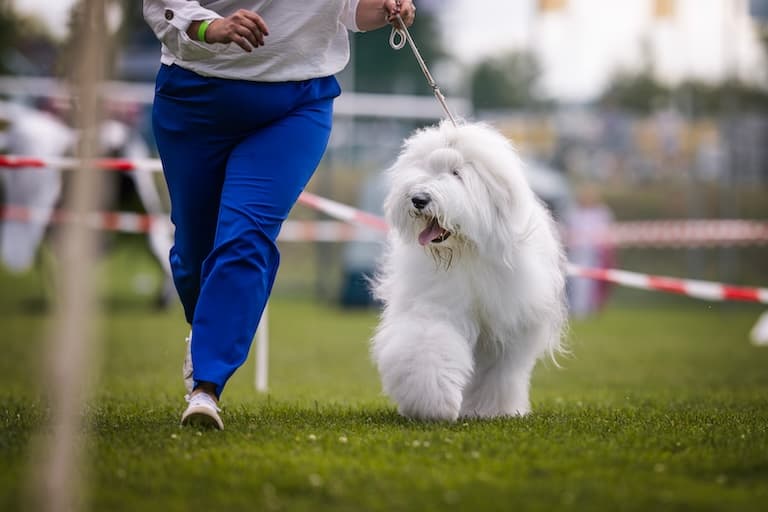
Like the bearded collie, Polish sheepdogs have that characteristic shaggy, thick coat. The breed standard now demands this from its PONs, describing its hair as harsh, long and thick. Its whole body should be covered in a long, straight coat like this, but apparently, “A slight wave is permissible”.
But disregarding some arbitrary arbiters’ definition of what a dog is, this coat traditionally serves a purpose. It is thermally insulated, but also fully waterproof, and evolved to prevent the skin from getting wet at all, at least from rain – jumping into the neighbour’s pond may not be covered by this guarantee2.
4. They change colour
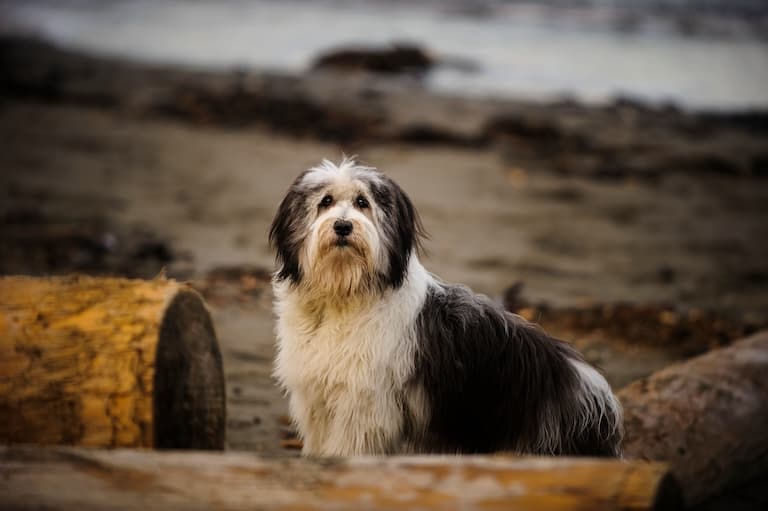
These dogs come in various colours, usually a variation of white or grey with darker patches. In young dogs, this colour is vibrant and rich, but gradually fades as they age, like the crown coverage of an animal blogger.
This is down to a greying gene in the dogs, and is a dominant genetic trait, common in many breeds. This is not the same genetic mechanism as greying in humans, but is similarly a sign of maturity and grace, so should not be scoffed at!3
5. They almost went extinct
Poland lost a lot in the Second World War, to put it mildly. One of its lesser-known casualties was the entirety of the Polish Lowland Sheepdog population – with a tiny exception4.
Dr. Danuta Hryniewicz, a Polish vet, considered her PON Smok to be the epitome of the breed (but don’t all dog owners think that!), and it is said that it was this dog who sired the ten surviving litters of PON’s in the ’50s from which all modern PON’s descend.
Anyone with a rudimentary understanding of why cousins shouldn’t marry will rightfully furrow their brows at this, and while it might not be strictly true that all PONs come from Smok, genetic research supports that there are five key ancestors responsible for almost 80% of the genes of modern PONs and this is a concern.
Sure enough, PON’s are as inbred as an Essex constabulary and are therefore prone to more genetic abnormalities than the average. The fact that they are born without tails, though, seems unrelated.
6. They don’t have tails
PONs often don’t come with tails in the standard model, but this isn’t a given, and thankfully, the Kennel Club doesn’t demand it. Traditionally, their tails would have been docked, and it seems that ancient breeding practices have selected for those born without tails, long before they all started breeding with their family members.
This was a change in the breed standard to stop disgusting people chopping off their tails in order to register their dog with the club (this practice is now banned in Europe in general).
Some are born with a stump, others with a full, waggable appendage. And all are accepted!
7. PONS as pets?
It’s hard to come by a source of dog breed info that talks badly about a breed. Whether this is wishful optimism or just because dogs are so universally awesome, is unclear.
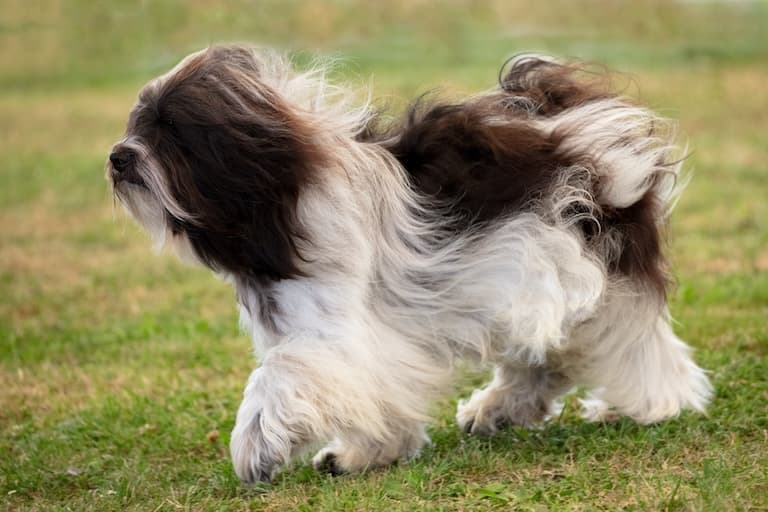
The Polish Lowland Sheepdog is described as smart, friendly and confident, but when did you ever read about a breed being annoying, shitty and stupid?5
Still, PONS seem to be quite well known for their intelligence, loyalty, and affectionate nature, and they’re working dogs, so this tracks. Their history as guard dogs makes them alert and useful as an early warning system, too.
Reports are that they’re good with kids and house pets if socialised in time, which is pretty standard, but their intelligence comes with the added perk of stubbornness, present in anything with its own mind.
This is a breed whose personality doesn’t appear to have been too badly affected by decades of incest, though their hips and eyes may be6.
Polish Lowland Sheepdog Fact-File Summary
Scientific Classification
| Kingdom | Animalia |
| Phylum | Chordata |
| Class | Mammalia |
| Order | Carnivora |
| Family | Canidae |
| Genus | Canis |
| Species | lupus (familiaris) |
Fact Sources & References
- “Polish Lowland Sheepdog”, American Kennel Club.
- “The Polish Lowland Sheepdog Club of Wales and the West of England”, Official UK Kennel Club.
- Karen (2026), “Why is Your Young Dog Going Grey?”, Kinship.
- Paula & Ottmar, “Genetic Variability in Polish Lowland Sheepdogs Assessed by Pedigree and Genomic Data”, National Library of Medicine.
- “Polish Lowland Sheepdog Breed Guide”, Scrumbles.
- “Polish Lowland Sheepdog”, American Kennel Club.