
Pine Weevil Profile
For some mysterious reason, weevils were a much bigger part of the social consciousness in the ‘90s, at least in the UK. This is perhaps down to the infamy gained by agricultural pests such as the grain and vine weevils, but as significant as they are to people who grow crops, they are miniscule imitations of the real thing. For any budding entomologist plucking insects out of the garden in the ‘90s it was the enormous pine weevil that ruled the roost. And it still is!
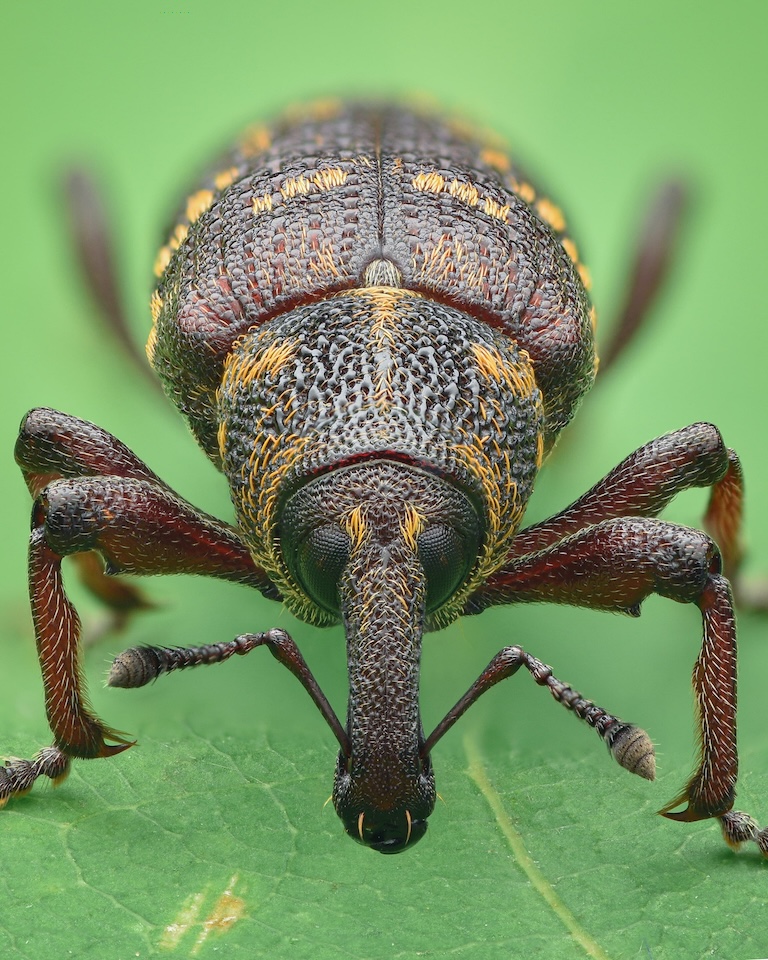
Pine Weevil Facts Overview
| Habitat: | Softwood forested areas |
| Location: | Eurasia: From the UK to Russia, China and Japan, and some in southern Europe. |
| Lifespan: | Usually 2 years, but likely up to 5 years, possibly longer |
| Size: | 10–13 mm (0.39–0.51 in), not including their long snout |
| Weight: | Around 120 mg |
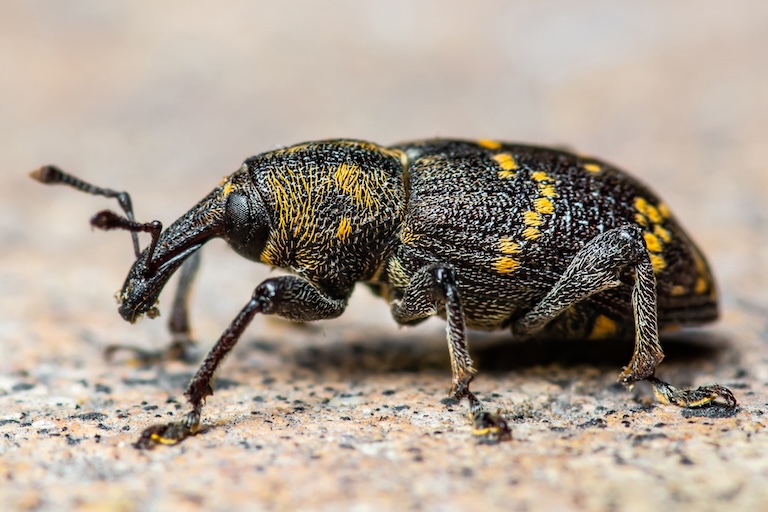
| Colour: | Dark brown with patches of yellow or light brown. Legs sometimes deep red |
| Diet: | Plant matter, primarily from conifers, also some deciduous |
| Predators: | Birds, hedgehogs, parasitoid wasps, predatory flies, and insect-eating nematodes |
| Top Speed: | Slow |
| No. of Species: | 1 |
| Conservation Status: | Not Listed |
The human approach to agriculture has been one that truly illuminates our simian nature. We like food, we destroy forest, we grow food. Insect like food, we kill everything, poison the earth, pollute the waterways and make growing food harder.
It has taken decades of research and the hoarse voices of a multitude of screaming ecologists to even begin to impart the idea that perhaps, if we just let some other things grow, too, we’d get more of what we want with less destruction from pests and we might still be able to drink clean water in 50 years.
The pine weevil is a perfect mascot for this. They are a pest of conifers, which is a crop we like, and since mass spraying with insecticide doesn’t seem to have helped us get our trees off them, we are having to resort to rebuilding the ecosystem instead.
Interesting Pine Weevil Facts
1. They’re beetles!
If you’re looking at an insect on land, chances are good that it’s a beetle. Beetles make up half of all insect species recorded, and almost a quarter of all animal species known!
Beetles are an enormous order of insect, and weevils are a subcategory of beetle, grouped into a superfamily known as Curculionidae. They are closely related to ladybirds, though unlike those specific little murder cows, weevils are almost exclusively herbivorous. There are some exceptions (which should be a required caveat for any and every generalisation about beetles), but the pine weevil isn’t one of them.
Where it is exceptional, however, is in its size.

2. They’re huge
Before we get too excited, it’s useful to remember that size is always relative, and beetles do indeed get a lot bigger than the pine weevil, but as far as weevils go, this is a giant. The vast majority of weevils are around 5mm long or smaller still, and there are almost 100,000 species of weevil described, so the pine weevil, with its monstrous dimensions of up to 1.3 cm, is really quite enormous for its taxonomic ranking.
When you add the pointy nose to this length you get another few milimetres to boot, and this appendage is one of the most recognisable features in most weevil species.
As you might expect, it’s for jabbing into things.
3. They’re suckers
Like a heavily-augmented American actress, the pine weevil devours plant matter by jabbing into it with its pointy face.
The adults eat bark, phloem and cambium, the latter being a layer between the phloem and xylem that high school biology teachers refuse to acknowledge.
While the bark is there precisely to buffer against this sort of thing, the cambium is a rather delicate and important layer in which plant cells get their reproductive instructions, so damaging this can cause a lot of harm to the plant.
The damage caused by a single, 120 mg beetle on a large conifer is negligible; the harm caused by enormous swarms of them on newly emerging saplings can be a very serious problem! 1
4. They’re serious pests
The main breeding ground for pine weevils is the decaying stumps of felled trees. From there, the grubs mature into adults, who then feed on the emerging young trees while they’re sprouting from the old stumps.
There can be up to 150,000 adults in every 10,000 m2 or hectare, and in a strong swarming season they can destroy up to 80% of a commercial crop of conifers.
Typically, this issue is addressed with poison: spray insecticide everywhere and hope for the best. But this comes with other issues such as the tremendous collateral damage to other insects and the inevitable runoff into waterways to continue the destruction there as well. In fact, one study identified 730 tonnes of industrial pesticides being drained into waterways worldwide.
So, fixing this problem requires more than the agricultural equivalent of napalming entire villages – it requires a bit of synergy with the natural world. 2 3
5. So many other things also work
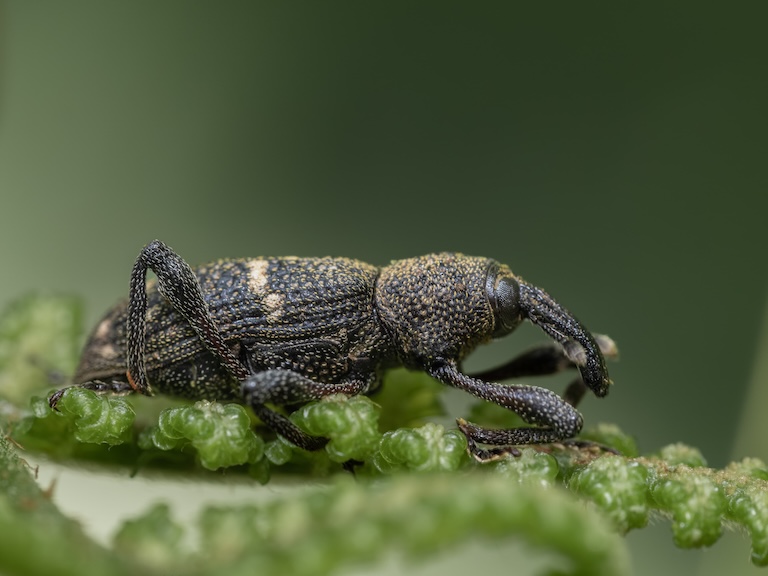
The Hylobius Research Fund proposes 6 points of attack against the pine weevil infestation: Physical barriers, biocontrol (natural predators), lower-toxicity pesticides, breeding of genetically stronger species of tree, better-prediction of swarming seasons, and creating an action plan for the whole sector with all of this in mind.
It’s also becoming obvious that trees given artificial fertilisers to make them grow faster appear to be favoured by the weevils, which suggests that a growth practice that’s more in line with nature could help.
All over the world, intensive agriculture is reaching a plateau, whereby fertilisers have peaked, pests are forming resistances to pesticides, and crops are no longer exponentially yielding more each year. This is unsustainable, and it’s starting to become obvious that wiping out all wildlife in favour of vast monocultures is coming back to bite us in the arse.
Indeed, research also shows that the pine weevil problem is far lesser in areas of natural tree growth compared with the monocultured plantation approach.
So, planting crops in patchwork networks of diversity encourages insects and other animals, whose presence and competition between each other keeps a more stable and sustainable balance. Who knew! A balanced ecosystem is the only sustainable route for productivity in the long-term.
6. They can fly!
It’s possible to go your entire life and never see a pine weevil fly. This is a lot more likely if you don’t spend a lot of time looking at pine weevils in the first place, but true even if you do. (This is also the case for earwigs). The pine weevil, with its bulbous body, looks as if it’s made of a single dome of shell, and its hesitance to take to the air supports this idea.
But it can indeed fly, and quite well, when it wants to. And the best part of this is that before it does, it reaches into the sky with its front legs like superman. Cute! 6
7. They’re getting stronger
When intensive farming has wiped out almost everything else, all that remains are monsters. The pine weevil problem is a perfect example of an animal that’s so badass it thrives in the wake of destruction that’s killed off its neighbours.
Moreover, as global warming (caused primarily by industrial farming and similar) raises temperatures in Europe, pine weevils rise with them. So, unlike many, many UK species, the pine weevil is only getting stronger in Britain, and likely elsewhere too.
This is great news for the beetle, not so good for the consumers and suppliers of conifers. But if it serves as a lesson to draw people towards more sustainable and bio-inclusive farming practices, we will all benefit.
Pine Weevil Fact-File Summary
Scientific Classification
| Kingdom | Animalia |
| Phylum | Arthropoda |
| Class | Insecta |
| Order | Coleoptera |
| Family | Curculionidae |
| Genus | Hylobius |
| Species | abietis |
Fact Sources & References
- Jess Foster (2012), “Vegetable Weevil ”, Sluggin’ Along.
- (2023), “Pesticides from farming leach into world’s waterways at rate of 710 tonnes a year, UN research shows”, The Guardian.
- , “Dealing with the Weevil”, Tilhill Forestry.
- Willoughby et al (2022), “The Integrated Management of
Hylobius abietis in UK Forestry”,Forest Research. - , “Hylobius Research Fund”, The Scottish Forestry Trust.
- Tan et al (2010), “Flight ability and reproductive development in newly-emerged pine weevil Hylobius abietis and the potential effects of climate change”, Royal Entomological Society.