
Peppermint Angelfish Profile
We have commented before about the naming schemes of ocean life being a recipe for disaster. Sand dollars will impale your fingers if you try to pick them up; sea strawberries will sting your tongue, and the lemon shark is absolutely lacklustre as a cake drizzle.
So, by now it should be no surprise that despite its appearance, the peppermint angelfish belongs in the ocean, and not in a jar on the shelf of a seaside town’s traditional sweet shop. And as it happens, it doesn’t belong in any home aquarium, either!
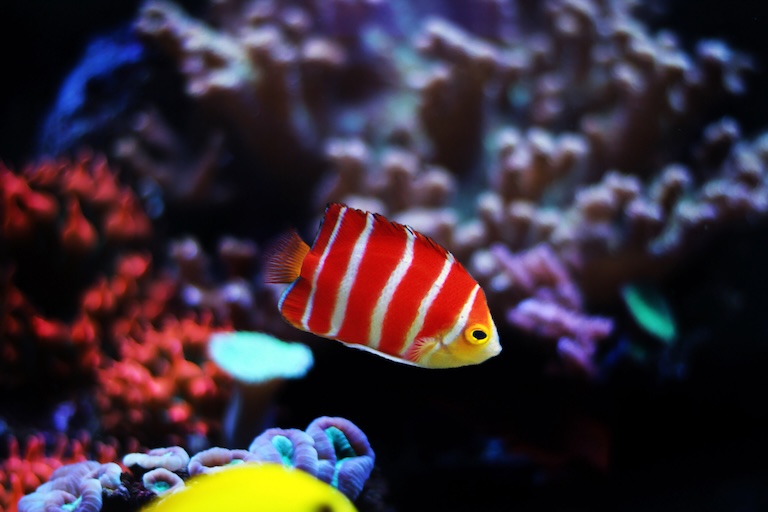
Peppermint Angelfish Facts Overview
| Habitat: | Marine: in coral rubble areas, ledges and caves on steep outer reef slopes |
| Location: | Eastern Central Pacific Ocean. Only known from the island of Rarotonga |
| Lifespan: | Potentially 5-7 years based off close relatives |
| Size: | Around 7 cm (2.8 inches) long |
| Weight: | Unknown |
| Colour: | Orange with vertical white bands; yellow face and pectoral fins; white nose |
| Diet: | Worms, crustaceans, sponges, tunicates, and detritus. |
| Predators: | Larger predatory fish, humans |
| Top Speed: | Unknown |
| No. of Species: | 1 |
| Conservation Status: | Least Concern |
The peppermint angelfish is a member of the marine angelfish group of pygmy angelfishes. What’s more, it’s a member of an elusive genus of angelfish known for tolerating much deeper waters than many of its family members, and this species in particular is one of the rarest and least well-known of them all. Their deep-water habitat and remote island location makes them hard to study, but recent samples are being worked with by well-regulated organisations to figure out what makes them tick, and with any luck, a captive breeding program will avert any drive to harvest them from their protected environments.
Interesting Peppermint Angelfish Facts
1. They’re pygmy angelfish
There are two distinct groups of fish commonly called Angelfish. One is a freshwater, tropical genus from South America, filled with very elegant and quite small fish called Pterophyllum. They are in the Cichlid family and entirely unrelated to their marine namesakes.
Marine angelfish are in a totally different family – in fact, a totally different order. They belong to the Acanthuriformes order, which is enormous and contains surgeonfish, snappers and grunts, among many others.
Marine angelfish are a family of their own in this order, called Pomacanthidae. They are known for being brightly coloured, often striped, and quite flat on the sides. They’re also mostly reef fish, said to be curious and bold, and stay within the top 50 metres or so of the ocean’s surface.
But the peppermint angelfish is a member of a slightly tougher genus than most in this family. This genus contains some of the so-called pygmy angelfish, at up to 15 cm long. And Centropyge fish are known to spend time in deeper reaches of the ocean! 1
2. They can handle the deeper waters
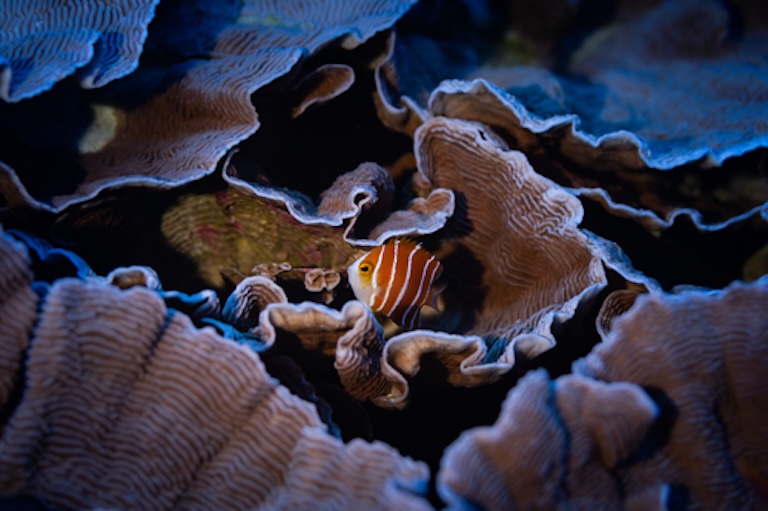
The peppermint angelfish, Centropyge boylei, shares its genus with the recently-discovered Centropyge abei, which was found at 150m below the surface. And it shares this preference for deeper waters, too. While it hasn’t been found quite as deep, it has been recorded at 120 metres, and chances are good that it will one day be found even deeper than that. 2
Because the peppermint angelfish is still quite an elusive animal and not much is known about it specifically.
3. They’re not very well known
This species is also a relatively recent discovery, in no small part because to reach it, divers need specialist equipment like rebreathers, and they have very limited time down there to boot!
So, despite this fish being vibrant and instantly recognisable, it’s not typically anywhere near people when it’s doing so. They also stick close to rocks and deeper reefs, and to top it off, they’re only known from a handful of locations.
4. They’re exceptionally rare
Much of what we can assume about this cute little fish comes from its better-studied relatives. Some in this genus are well described by aquarists, both in the industry and hobbyists. They’re said to nip at corals, but mostly feed on algae, sponges and small invertebrates found on the sea bed.
Dwarf or pygmy angelfish in general are said to be shy at first, but bolder once they have established their territories, and do okay with tank makes at long as they have enough space.
But all of this comes from other species, and that’s because the peppermint angelfish is too rare for in-depth study. But this rarity comes mostly from it being inaccessible – it’s only known from one island in the Cook Islands called Rarotonga.
This rarity goes some way to explaining how much it costs to buy one. 3
5. a $30,000 fish?
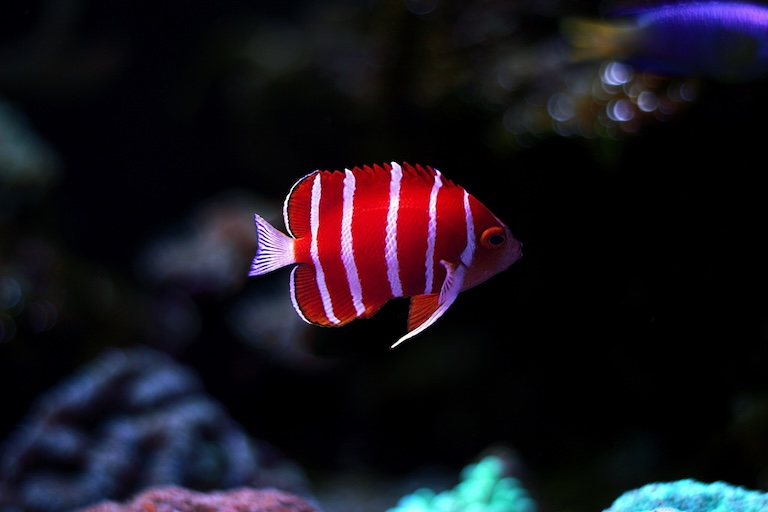
The Waikiki Aquarium in Hawaii recently boasted that they managed to acquire one of these fish, and made it known that collectors were offering them $30,000 for it!
At the time, this was the only one in captivity available for viewing, and the aquarist supplier, LiveAquaria, shared in this excitement with their own accusation of one. LiveAquaria spent months figuring out the delicate balance of water and light quality needed to make this fish thrive, and so it is that the living conditions of this species are finally being explored, but there is a concern that with a $30k price tag, poaching will become profitable, even given the hard work and technical skills required to reach the fish in the wild.
With any luck, captive breeding will solve this problem first! 4
6. They’re probably doing okay
As of 2009, this fish was deemed of Least Concern by the IUCN, and the understanding is that they’re probably more widespread than we have found at this time. At this remote location, habitat loss is minimal and there are no perceived threats to the species.
Still, with a conspicuous lack of data, this is a bit tenuous, so the more we discover about this rare and minty little fish, the better! 5 6
Peppermint Angelfish Fact-File Summary
Scientific Classification
| Kingdom | Animalia |
| Phylum | Chordata |
| Class | Actinopterygii |
| Order | Acanthuriformes |
| Family | Pomacanthidae |
| Genus | Centropyge |
| Species | boylei |
Fact Sources & References
- Pyle et al (1992), “Paracentropyge boylei”,Saltcorner.
- Pyle et al (1992), “Centropyge boylei”, Fishbase.
- Robert (Bob) Fenner, “Angelfishes for Marine Aquariums Diversity, Selection & Care”, wetwebmedia.com.
- Vanessa Kaneshiro (2012), “The $30,000 Peppermint Angelfish at Waikiki Aquarium”,Honolulu.
- Pyle et al (2009), “Peppermint Angelfish”, IUCN RedList.
- Anna Frostic (2003), “Centropyge potteri ”, Animal Diversity Web.