
Peninsula Cooter Profile
The word cooter has such presence in American English, seemingly in utterly unrelated places. You can be “as drunk as Cooter Brown”, spend a bag of cooters, or wear an “I heart Cooter” hat.
In Florida, you can buy a house next to a whole swamp of cooters. And today we’re talking about one of them: the peninsula cooter, a standard-looking terrapin with the thankless task of holding everything together.
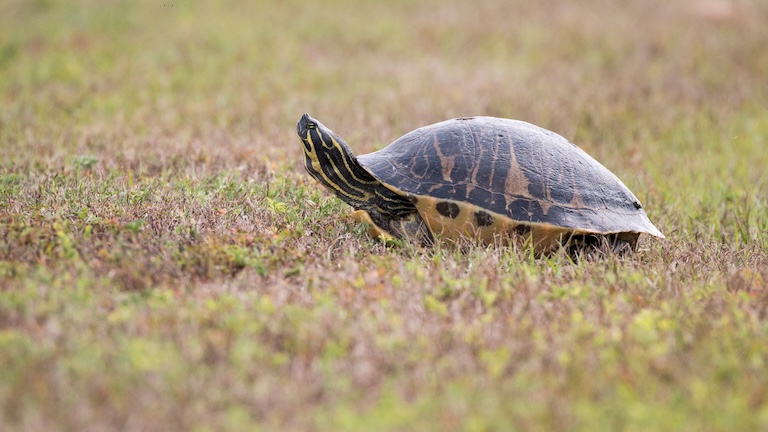
Peninsula Cooter Facts Overview
| Habitat: | Almost any freshwater body within its range |
| Location: | Widespread in peninsular Florida |
| Lifespan: | 30+ years |
| Size: | 35-40 cm long |
| Weight: | Usually 2-7 kg (5-15 lbs) but occasionally more than 16 kg (35 pounds) |
| Colour: | The shell is orange-brown with dense black patterns. Green and yellow skin, and a creamy brown belly. |
| Diet: | Adults exclusively eat aquatic plants. Juveniles may eat insects or small fish as well |
| Predators: | Otters and alligators |
| Top Speed: | Unknown |
| No. of Species: | 1 |
| Conservation Status: | Least Concern |
The peninsula cooter is a Floridian terrapin. It’s medium-sized, herbivorous and unassuming, so you’d be forgiven for overlooking its incredibly critical role in its environment. It supplies a mouthful for just a couple of predators, but its own diet maintains the shrubbery where it, and a thousand other species, live.
Interesting Peninsula Cooter Facts
1. They’re terrapins
The word “cooter” commonly means turtle (among other things) and seems to originally have meant snapping turtle. In the range of the Peninsula cooter, there are both common and alligator snappers, but neither is related to the Peninsula cooter, and in fact the latter is more closely related to the land-based tortoises than the snapping turtles.
Peninsula cooters are members of the freshwater family of turtles called Emydidae, and one of around 50 species in it. This family is far more commonly known as terrapins, but also sometimes pond or marsh turtles.
All of these turtles have well-developed swimming appendages with webbed feet and exhibit temperature-dependent sex-determination, which means that the temperature at which their eggs are incubated determines whether they will hatch as males or females!
This is a fairly hardy and common species, so it is popular in captivity, and the good news for the turtle species as a whole is that they readily breed when taken from the wild.

2. They are decent breeders
Chances are good that if you house a male and female Peninsula cooter, you’ll end up with more. Many records suggest that they are easy to breed and don’t need any encouragement to do so, though as mentioned, incubation of the eggs determines who specifically will come out of them.
Hatching happens within 60 days, and the babies come out looking kinda weird. 1
3. Their babies look like Pokémon
In animal biology, the growth of an animal can be divided into two major categories. Animals like snakes, who are born pretty much at their adult proportions but in miniature, exhibit what’s called isometric growth, in that as they age, they just get bigger but look the same.
Animals like humans, and mammals in general, are born with big bobbly heads, silly little limbs and variously disproportionate features that grow at different rates to (ideally) come out well-balanced in their final form. This is known as allometric growth (this is also why we are predisposed to consider big eyes cute – they trigger our parental aww instincts).
The vast majority of reptiles go the way of the snake, and pop out of the egg looking like they’re just really far away. But in many shelled reptiles like this, the young are a little more allometric in their growth than your average reptile, and this gives them a proportionally large head when they’re young.
4. Males have long fingers
This species reaches maturity at around 5 to 7 years old in females, and 3 to 4 years in the much smaller males. Males can also be distinguished by their salad fingers, which
They use these claws to finger and stroke their desired cooter and prepare her for mating. Presumably this is far less creepy in turtles, as the species is still listed as healthy – it’s Least Concern on the IUCN Red List.
5. They have few predators
Living in the Floridian waterways, you’d expect a meaty little snack like this to have plenty of enemies, but the shell of these turtles is extremely protective and its natural predators are limited to alligators and otters, both of whom have a terrific bite.
Otters can manipulate a turtle into a position to access its meaty bits, and a decent-sized alligator can pop a terrapin like a grape, which, while awesome, is quite unpleasant to watch.
Most of the other swamp predators can’t do much to this cooter, but they do have plenty of other things to worry about. 2

6. But they have a lot of enemies
Despite the relative ecological safety these turtles find themselves in, they are under threat from a multitude of other forces.
Habitat destruction is a big one, as swamps are drained for human development and industrial pollutants runoff into the waterways. The abundance and composition of the aquatic vegetation shifts for various reasons, from pollution to invasive species or grazing, and this affects wht the turtle can eat.
Habitat degradation reduces nesting site availability, and the increase in boat traffic results in many turtles killed on the water too. More roads mean more road crossings, and as tough as these little cooters may be, they don’t handle being run over by cars very well either.
Perhaps the most American of the threats to this animal is the direct persecution by fishermen, who shoot the turtles, believing that they are in competition with them for fish. It’s worth repeating that this is a vegetarian turtle, and doesn’t have any interest in eating fish.
But despite all these issues, the species appears strong, and that’s important to maintain, since this is considered a keystone species. 3
7. They’re a keystone species
This turtle occupies a spot as the swamp gardener. It will keep plant growth under control and maintain a habitat for everything else there to live in. This is a critical role, but it also supplies food for the aforementioned predators and fertiliser for the water from its waste.
This role is so important to the maintenance of this rich ecosystem that scientists have commonly referred to the Peninsula cooter as a “keystone species” – one whose removal would threaten the collapse of the entire ecological structure of the area.
Peninsula Cooter Fact-File Summary
Scientific Classification
| Kingdom | Animalia |
| Phylum | Chordata |
| Class | Reptilia |
| Order | Testudines |
| Family | Emydidae |
| Genus | Pseudemys |
| Species | peninsularis |
Fact Sources & References
- , “Peninsula Cooter Care Sheet ”, Northampton Reptile Centre .
- , “Photos of Peninsular Cooter (Pseudemys peninsularis)”, iNaturalist.
- (2010), “Peninsula Cooter”, IUCN RedList.