
Patas Monkey Profile
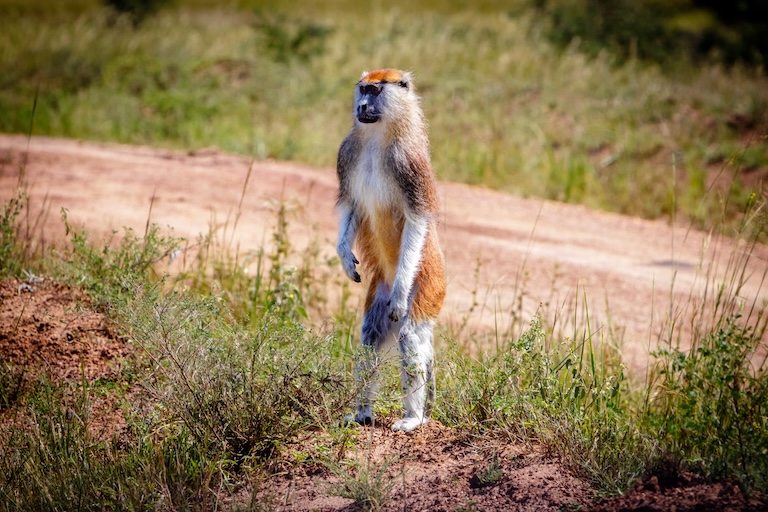
If you’re wandering around the African savanna wondering where all the monkeys are, you might want to read this one. Here’s a species of mostly-terrestrial, rather drab-looking monkey with a glorious set of family jewels at the back. And one that was once a lot more widespread than it is.
This is the story of one of the most imminent primate extinctions, and an animal whose cute face is mirrored by its cute testicles. An animal that is the epitome of “Hate to see you go, but love to watch you leave”, it’s the blue-balled patas monkey.

Patas Monkey Facts Overview
| Habitat: | Open country: savanna and woodland |
| Location: | Central Africa |
| Lifespan: | Up to 20 years |
| Size: | Up to 70 cm long |
| Weight: | Up to 13 kg. |
| Colour: | Reddish-coloured coat, black noses, blue testicles |
| Diet: | Fruit and insects but also includes leaves, roots, and bird eggs |
| Predators: | Raptors, snakes, leopards, chimps, hyenas, hunting dogs |
| Top Speed: | Monkey speed |
| No. of Species: | 3 |
| Conservation Status: | Data Deficient, Near Threatened and Critically Endangered |
Thankfully, not all patas monkeys are going extinct. Sadly, one third of the species are, and there’s very little being done to address it. This is a plains monkey, related to the vervet, and carrying with it the vervet’s renowned blue sac. They’re mostly matriarchal, hang about in vast, low-canopy, low-density acacia forests, and have managed to invade Puerto Rico.
So, this is an unusual monkey, and that makes it even more disappointing that we’re about to lose them.
Interesting Patas Monkey Facts
1. They’re Old-World Monkeys
Nobody knows what the deal is with monkeys. They’re found in Asia, Africa and South America, and it’s hard to know which one came first. It definitely wasn’t South America, at least – those monkeys hitched a ride on the continent when it split off from Africa, but whether monkeys originated in Asia and migrated into Africa, or the other way around, is a matter of debate.
Regardless, the African and Asian monkeys are distinct from the American ones, the former being grouped into a subfamily known as Cercopithecidae. These are the so-called Old-World monkeys, and most of them are found in Africa, but the Japanese snow monkeys, the langurs, and those ones with the long noses are just a handful of Asian exceptions.
Old-world monkeys in Africa can be terrestrial or arboreal or a mixture of both, and the patas monkeys are quite mixed, and live in open woodland areas, foraging a lot on the ground but retreating to the trees when necessary or when there’s some tasty fruit to be found.
Two were originally listed as a subspecies of the common patas but are now their own species.
Patas monkeys are similar to their close relatives, the vervet monkeys, in that they spend a lot of time on the ground, as well as in the trees. And, like the vervets, they have special testicles.

2. They have blue balls
Old World monkeys like the baboon and the mandrill are well known for the red flushing of their genitals when in heat, but vervets and patas monkeys go almost the opposite way – their scrota are a beautiful shade of sky blue!
On an otherwise plain-coloured monkey this really stands out, and that’s the point. But this isn’t such a seasonal shift, as with the baboons, it’s a permanent fixture and a sign of rank and virility. The deeper uses for blue balls are still being inquisitively fondled by the scientific community, but it appears that males with the bluest balls are more aggressive and bully others.
The testicles don’t change colour much during mating season, but can swell to twice their size! 1
3. There are three species (probably)
Taxonomy for the patas monkeys is a bit all over the place. Whether these groups are subspecies or species, and whether there are three or four of them, is a matter of debate (so don’t sue us if this happens to be contradicted in the literature somewhere).
The most widespread member is the common patas, Erythrocebus patas. This is the species from which other subspecies are proposed. It’s found from the coast of West Africa to East Africa, as far as Northern Uganda, and is also called the hussar monkey.
The Blue Nile Patas, Erythrocebus poliophaeus, is found around the Blue Nile in Ethiopia, Sudan and South Sudan. It’s also known as the Heuglin’s patas monkey.
Finally, the southern patas monkey, Erythrocebus baumstarki, was once found all over Kenya and Tanzania, but is now one of the most endangered primate species in the world, with fewer than 200 individuals remaining in Tanzania, and none known in Kenya. 2
They are ground-dwellers, mostly, and love the vast dry landscapes dominated by a particular, very special tree.
4. Whistling thorn
The whistling thorn acacia is an absolute icon of the African plains. It dominates in the fertile, black-cotton soils of the savanna and it is specialised to protect itself against elephant predation.
It does this with the characteristic thorns of the Acacia genus (though, this one has now been moved into the Vachellia genus) and with special growths on its leaf nodes that form chewable balls that ants can live in. Each of these trees, dotted across the landscape as far as the eye can see, will host its own colony of Crematogaster ants, which feed on its nectar and readily run up the nose of an elephant that gets too close.
This symbiotic relationship is a dainty little agreement that’s millions of years old, and creates the ecological stability required to host various other animals, such as the patas monkeys. These trees don’t grow below 200 metres above sea level, and so the patas monkeys don’t live below that boundary, either.
Except, perhaps, in Puerto Rico
5. They’re invading Puerto Rico
When the Carribean viral research centres brought in patas and rhesus monkeys to test vaccines on, they inadvertently introduced both species into the wilds of the islands.
Puerto Rico is now home to a free-roaming band of patas monkeys – perhaps the lowest altitude wild patas monkey population on the planet. Unfortunately, they’re on entirely the wrong continent and don’t fit into the native ecosystem very smoothly.
Patas monkeys in Puerto Rico are now considered invasive and detrimental to the habitat. 3 4
5. Sexy Drooling
Mating rituals in the patas monkey are very much like those of the human female: patas ladies will alert the males to her DTF status by sunning past him and waving her bum in the air. She’ll then dribble saliva and puff out her cheeks if he doesn’t get the hint.
Females are more socially stable than males, and most stable groups will be formed of a single male and a matriarchal group of up to 60 females. Females will also share childcare responsibilities between them, even if they don’t have their own young. Mating season brings in new males, who mate with multiple females and then go back to whatever they were doing before. There appears to be no hierarchy to the mating system and it’s a total upside-down pineapple event.
Afterwards, some of these males form groups of their own, others are solitary.
6. Some are in serious trouble
The next primate extinction may be coming soon, and there’s a good chance it’ll be a patas monkey.
The southern patas monkey was once widespread around the whistling thorn ecosystems of Mount Kenya and Mount Kilimanjaro. But by 2016, it had been totally extinguished from these zones and is now thought to only occupy a small area of protected habitat in the western Serengeti in Tanzania.
As always, human expansion is to blame. Livestock farming, habitat conversion and the fragmentation of the acacia forests have isolated and destroyed the vast majority of this species and it’s thought that fewer than 200 monkeys may be left in the wild.
What’s worse is that there is very little, if anything, being done to slow this down, and research suggests that they will be completely gone by the end of the century. 5 6

Patas Monkey Fact-File Summary
Scientific Classification
| Kingdom | Animalia |
| Phylum | Chordata |
| Class | Mammalia |
| Order | Primata |
| Family | Cercopithecidae |
| Genus | Erythrocebus |
| Species | 3 species |
Fact Sources & References
- Liz Langley (2016), “Some Monkeys Have Blue Testicles—Here’s Why”, National Geographic.
- Jong et al (2021), “Is the southern patas monkey Erythrocebus baumstarki Africa’s next primate extinction? Reassessing taxonomy, distribution, abundance, and conservation”, American Journal of Primatology.
- Magaly Massanet , “The Abundance, Geographical Distribution and Habitat Use of an Introduced Patas Monkey (Erythrocebus patas) Population in Southwest Puerto Rico”, Winthrop University.
- Christopher Bonadio (2000), “Erythrocebus patas ”, Animal Diversity Web.
- Jong et al (2020), “Southern Patas Monkey”, IUCN RedList.
- Jong et al (2021), “Is the southern patas monkey Erythrocebus baumstarki Africa’s next primate extinction? Reassessing taxonomy, distribution, abundance, and conservation ”, National Library of Medicine.