
Paper Wasp Profile
Of all the necessary belaboured rants allocated to entomologists and bug-lovers alike, championing wasps has to be near the top. The enduring hatred towards all wasps for a painful interaction with just a handful of species is a testament to the chemical defence adaptation of such a remarkably small animal.
After the mosquito, it can only be the wasp, whose infamy among insects is so unrivalled, yet of the 100,000 species or more, it’s just four or five responsible for all the wrath in our own species. Today, we’re stepping just slightly to the side of those wasps to talk about their closest relatives, the lesser-known but still quite spicy paper wasps.
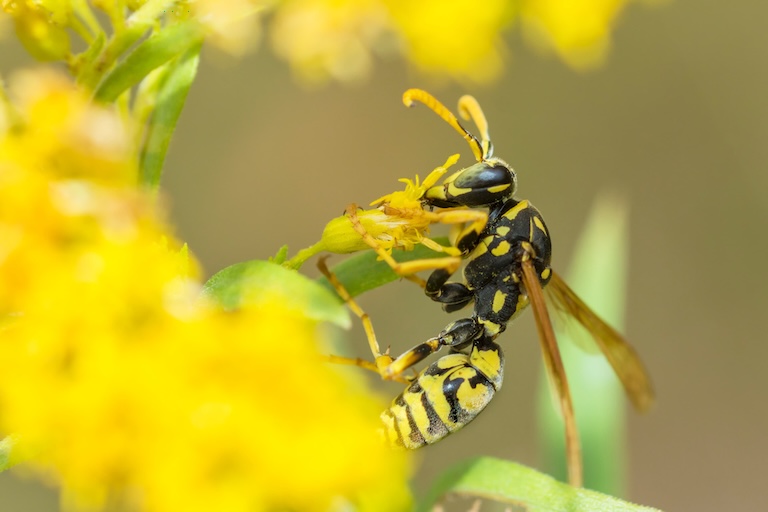
Paper Wasp Facts Overview
| Habitat: | Varied, mostly wooded areas with insect forage |
| Location: | Worldwide except Antarctica. Most are tropical |
| Lifespan: | A year for workers, three or more in Queens |
| Size: | Usually around 1.5 to 2.5 cm. Largest 8 cm long |
| Weight: | Not listed |
| Colour: | Varied, reds, browns, sometimes black and yellow |
| Diet: | Invertebrate protein, nectar |
| Predators: | Birds, bats, some mammals, reptiles, amphibians |
| Top Speed: | Buzzy |
| No. of Species: | 1100+ |
| Conservation Status: | Most are not listed |
Paper wasps are the lesser-known cousins of the yellowjackets, but are almost as widespread and varied nonetheless. They are found primarily in the tropics but extend to the Arctic regions in both the Old World and the New World, and while they are primarily characterised by upturned umbrella nests made of paper, they are as diverse as you’d expect from a wasp group. Among the 1100 or more species described, you can find small ones, big ones, angry ones, calm ones, even some that make honey and pollinate our food.
Interesting Paper Wasp Facts
1. Vespinae vs. Polistinae
These two words are essentially Harry Potter spells to a lot of people, but to biologists they mean a lot! The -inae suffix indicates that they are subfamilies, so contain groups of animals that sit between the family and genus levels on the taxonomic rankings.
Italian and wasp fans will recognise the Vespa part, too, as it means wasp in Latin (and Italian), and is the name they give to those scooters from the ‘60s.
Vespinae is one of the most infamous of all animal subfamilies as it houses the eusocial wasps everyone seems to hate the most. Yellowjackets and hornets are found here, and their members are on every continent except Antarctica. They are well known for having large colonies and living in paper nests.
But! While they are often called paper wasps, they’re not the entomologist’s definition of a paper wasp. True paper wasps belong to the other subfamily, Polistinae, and these are the wasps we’ll focus on here.
This is a lesser-known but almost as widespread subfamily of wasps that is also closely related to the Vespinae group, and shares a lot of characteristics. It’s also enormous – over 1100 species have been described and likely a lot more are to be found.
Both subfamilies are in the family Vespidae, which has over 5,000 species of eusocial wasps, and almost all the wasps that form colonies. Despite this tremendous figure, it’s thought that there are over 100,000 species of wasp in total, so this represents a tiny minority of wasp-kind.
Half of the true paper wasps described are in the neotropics, the other half scattered around the tropical and subtropical biomes of the Old World. A handful of species extend into temperate regions, too.
These wasps are generally differentiated from their better-known relatives by their paper nest design.

2. Umbrella wasps
While the Vespinae wasps make those big, ominous, closed-paper nests, the true paper wasp nests are generally smaller in size, housing a much smaller colony and don’t close their nests off.
Instead, they typically make an up-turned dome of a nest with open cells in it so you can peek at their babies if you want to brave it.
The shape of these nests has lent the group another nickname: umbrella wasps, and for the bright yellow and black species, this is the easiest way to tell them apart from the Vespinae wasps. Still, this is a general rule, and some will make closed nests, others even make mud nests.
3. They’re eusocial
This might seem a bit obvious, but paper wasps, like yellowjackets, form colonies of strict social castes with a queen and her workers, just like bees.
In fact, bees and ants are in the same order of insect as wasps, the Hymenoptera. And this order contains most of the insect societies that function like this. It’s called Eusociality.
But again, this is unusual in wasps – the vast majority are solitary parasitoids of other animals. And one fascinating revelation in wasps is that this eusociality evolved in the bee, ant, and wasp orders multiple times independently of one another. So far, it’s estimated to have happened between 8 and 11 times in this order, which is incredible, considering how rare it is outside of these insects, and nobody’s sure why!
It’s easy to overlook this fact, since the wasps we’re most familiar with are all eusocial, but it’s actually pretty uncommon, which makes paper wasps very special! And if that isn’t convincing, ask the flowers. 1
4. They’re pollinators
Like bees, wasps feed their growing young on a high-protein diet. In honeybees, this protein comes from pollen; in the majority of wasp species, it comes from the paralysed (and presumably mortified) bodies of spiders and caterpillars, who have been dragged into clay nests or subterranean burrows to be eaten alive from the inside out.
Paper wasps are more predatory, and can be seen returning to the nest with a bundle of goop, chewed out of the carcass of their victims. But as adults, they don’t need the protein, so they feed on high-energy nectar from flowers. This brings them into contact with pollen, which they then exchange between flowers to help them have sex.
People hate to admit this, but wasps are significant contributors to a healthy ecosystem. They even help us produce our own food, as they can pollinate tomatoes, peppers, beans, cucumbers, squash, carrots, fennel, dill, and coriander plants, among many others.
And some, like bees, store excess nectar in the nest as honey. 2
5. They make honey
One of the largest tribes of Neotropical paper wasp, the Epiponini tribe, has several species in it that are known to make honey, so it’s no coincidence that the Mexican honey wasp is in this tribe.
However, despite the name, this species can be found well into the US, and down to Northern Panama. The species name, Brachygastra mellifica, loosely translates to “Short-butt honeymaker”, the latter part sharing its root with the honeybee’s name, Apis mellifera.
Going against almost everything we’ve said about paper wasps, this one makes a closed nest and has a large colony, so it better resembles a Vespinae nest. But inside there are combs with honey in them that can be extracted and is a delicacy in some parts of Mexico.
6. They may mind-control ants
Bees, wasps, and ants all communicate with smells, to varying degrees. Ants are likely the most reliant on this form of communication and so can be manipulated the easiest using pheromones.
One species of paper wasp, whose main predators are ants, has a fascinating chemical defence that may trigger the ants’ “necrophoric” response. This is the chemical signal that tells the ants they need to start clearing up their dead comrades. So, in theory, a scouting patrol of ants stumbling upon this paper wasp nest would begin scrambling to pick up and carry off their very alive and likely quite perplexed colony mates.
This hasn’t been observed directly, but the composition of fatty acids released by the wasps matches those that trigger a response in their local predatory ant species, so it’s hypothesised that it has evolved for this purpose. 3
7. They’re generally not very aggressive
Paper wasps contain some of the most painful insect stings that have been recorded. The dreaded executioner wasp is one such example, and a member of this subfamily.
But even with this powerful defence, they are not as quick to use it as some of the more widespread Vespinae wasps.
This isn’t a hard and fast rule, though, as some other paper wasp species, like the Red Paper Wasp, are notoriously aggressive when in defense of their families. Others are scary just because of their sixe – the largest species, Polistes gigas, has queens of up to 8 cm long!
As always, however, an angry wasp isn’t just being a jerk – it’s trying to do what any protective sibling should: look out for its kind. The fact that our species enjoys doing things in wasps habitats is really more our mistake than theirs, and given all their ecosystem services, we should all try to take a moment to respect the wasp a little more! 4

Paper Wasp Fact-File Summary
Scientific Classification
| Kingdom | Animalia |
| Phylum | Arthropoda |
| Class | Insecta |
| Order | Hymenoptera |
| Family | Vespulidae |
| Genus | 26 + |
| Species | 1100 species |
Fact Sources & References
- Hughes et al (2008), “Ancestral Monogamy Shows Kin Selection Is Key to the Evolution of Eusociality”, Science.
- Bernheim (2017), “Bernheim Pollinators: The Paper Wasp ”, Bernheim .
- Haskins et al (1974), “Notes on Necrophoric Behavior in the Archaic Ant Myrmecia Vindex (Formicidae: Myrmeciinae)e”,ResearchGate.
- Drew Bratcher (2020), “The Devil’s Sting”, The Paris Review.