
Panther Chameleon Profile
In 1983, a group of flamboyant zoologists called Culture Club described a mysterious species of chameleon that has still not been fully confirmed by researchers. This elusive, red, gold and green animal would come and go a lot, and seemed hard to pin down. Until the Karma Chameleon makes itself officially known to science, we do have another strong contender for most stunning lizard, and it’s this guy: the Panther Chameleon.
The Madagascan native makes a popular exotic pet, and thanks to its hardiness, these two truths are not currently in conflict with one another.
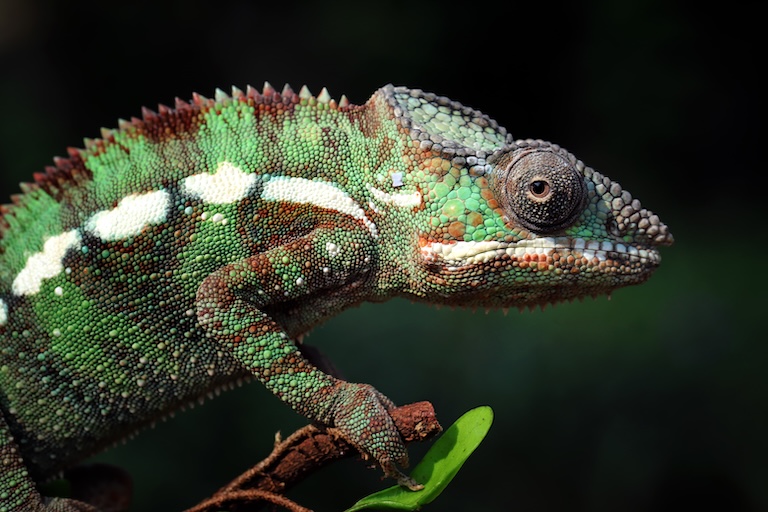
Panther Chameleon Facts Overview
| Habitat: | Tropical, arboreal: lowland, degraded scrub |
| Location: | Madagascar |
| Lifespan: | Up to 3 years in the wild, 5 in captivity |
| Size: | Up to 23 cm long (9 inches) |
| Weight: | Up to 180 grams (6.3 oz) |
| Colour: | Females pale green or pink, males vibrant, multicoloured: varies by location (may soon be split into multiple species) |
| Diet: | Invertebrates |
| Predators: | Likely birds, lemurs, and snakes |
| Top Speed: | Slow |
| No. of Species: | 1 officially, but perhaps will be split into multiple species |
| Conservation Status: | Least Concern |
Panther chameleons are one – perhaps multiple – of the prettiest lizards on the planet. They are hard-wearing, scrub-loving, Madagascan survivors, and while they are thought to be doing very well, the idea of splitting this one species into 11 shatters the certainty of their success.
In the meantime, fortunately, they breed well in captivity and have inspired stronger regulations in the pet trade.
Interesting Panther Chameleon Facts
1. They’re Endemic to Madagascar
Chameleons are lizards, and some of the most recognisable of the bunch. The Chameleon family is an old-world family known for their googly eyes, long tongues and ability to change colour.
In most species, this ability is somewhat overblown, and the most you’ll get out of a very energetic individual is a shift from leafy green to leafy brown. In reality, the colourful nature of chameleons is mostly baked in, but in others, they have a wider range and a particularly striking palette to start off with.
One such group is the genus of Madagascan chameleons known as Furcifer. There are 20+ species in this genus, all endemic to and the island, the panther chameleon is perhaps the most visually stunning of the lot.
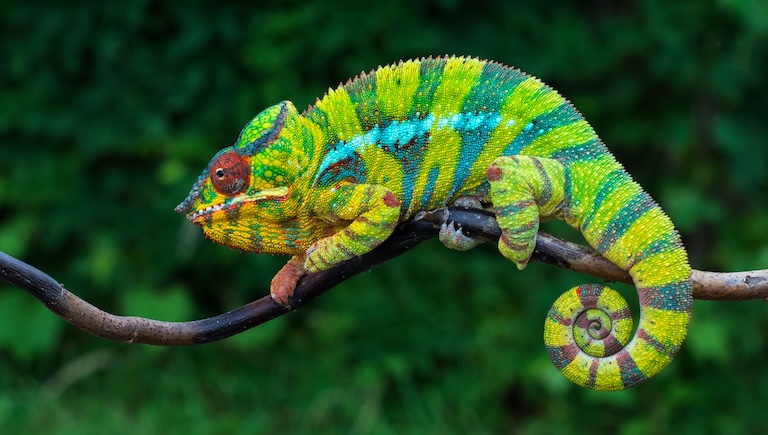
2. They are exceptionally bright
Lizards aren’t known for their wits. Being mostly cold-blooded, they don’t have as much energy to put into forming a strong argument, and generally stick to lunging, sleeping or hiding. But they do have one other thing that Gen Z doesn’t: dazzling, rainbow-coloured skin.
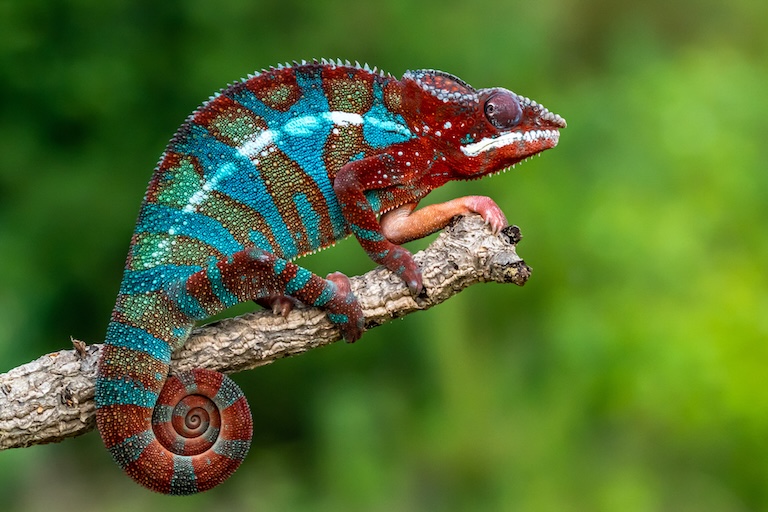
So, as dumb as they may be, panther chameleons are brighter than your ordinary vertebrate – at least, the males are. What’s more, they seem to vary in colour, depending on where on the island you find them.
This small feature could have big repercussions, and some researchers have posited that rather than a single, very variable species, these colour morphs could represent several more species within the genus. As far back as 2015 it was proposed that they could number 11 species, but this doesn’t seem to have stuck, yet.
As we’ll discuss shortly, this is more than a matter of logging taxonomic data into some basement computer at the natural history museum; this could have significant consequences for the future of the lizards too. 1 2
3. They’re popular with collectors
As you’d expect, the most stunning in a group of lizards known for being stunning would attract international attention, and so it is that Furcifer pardalis is one of the most sought-after species of chameleon in the international pet trade.
After they made up around 8% of total trade in chameleons between 1977 and 2001, quotas were put in place and exports became better regulated. This seems to have done the trick, as the species is still listed as stable and of least concern by the IUCN. 3 4
4. They’re probably deaf
This species appears to lack both a common olfactory organ and an outer or middle ear, which indicates that they don’t rely on a sense of smell very much and probably can’t hear anything. They really appear to have put all their options into looking good, which may be explained by their lack of parenting.
Neither males nor females appear to give two hoots about their offspring once they’ve hatched, but it should be pointed out that the mothers do put a lot of work in before that. They will spend a large amount of extra time basking in the sun when pregnant, gathering up surplus vitamin D to boost their calcium levels and make sure her eggs – and the skeletons of the embryos inside those eggs – are strong. 5
5. Life in the wild is stressful
Many animals don’t do well in captivity. Even humans are now showing signs of the notorious drop in reproductive rates we see in other caged and overly-stressed animals. Conversely, some do much better, and this species is one such example.
Reproduction, and life in general, are deeply difficult and stressful events in the habitat of the panther chameleon. Fighting off rivals, dodging predators, and trying to do all this while maintaining a balanced diet all work to shorten the life of the animal. In the wild, panther chameleons are lucky if they pass one year, and exceptionally lucky to pass two years.
However, in captivity, with most of these stressors eliminated, they can live to the ripe old age of five years, and perhaps a little more. And despite their shortened lifespans in the wild, these chameleons are very resilient. 6
6. They’re quite tough
The panther chameleons are thought to prefer low-lying scrub in degraded areas, rather than the upper reaches of the forest canopy. They do well in disturbed land, which is one of the reasons they’re still going strong.
In fact, they seem to be much more abundant beside roads than in closed forest.
So, they seem to be quite robust as a species, which is good, if indeed they arte just one species. Which brings us back to the proposed 11 species mentioned back in 2015.
Because splitting the one species into several changes everything. Suddenly, all the statistics on this species abundance are for next-to nothing. Suddenly, the pet trade may well be impacting some of these species a lot more than was apparent when they were all grouped together, and the same could be true for the habitat degradation in their native ranges.
Splitting the group into 11 species means that each species is substantially smaller in number than was once thought, which would hopefully lead to more urgent measures to protect them.
One key piece of evidence for the multiple species hypothesis is that in captive animals, breeding occurs quite well between individuals from the same population but is far less successful between differing populations.
So, there’s still a lot to learn about the panther chameleon and with any luck, we’ll learn it before we lose any of them! 7
Panther Chameleon Fact-File Summary
Scientific Classification
| Kingdom | Animalia |
| Phylum | Chordata |
| Class | Reptilia |
| Order | Squamata |
| Family | Chamaeleonidae |
| Genus | Furcifer |
| Species | pardalis |
Fact Sources & References
- (2015), “Up to 11 stunningly colorful chameleon species discovered in Madagascar”, Mongabay.
- Grbic et al (2015), “Phylogeography and support vector machine classification of colour variation in panther chameleons”, National Library of Medicine.
- Julie Riney (2011), “Furcifer pardalis ”, Animal Diversity Web.
- (2022), “Breeding Panther Chameleons”, Chameleon Academy.
- Julie Riney (2011), “Furcifer pardalis”, Animal Diversity Web.
- Julie Riney (2011), “Furcifer pardalis ”,Animal Diversity Web.
- Jenkins et al (2011), “Panther Chameleon”, IUCN RedList.