
Pantaloon Bee Profile
If you’re ever tired of the pressure of the patriarchy to do something you don’t really want to do, consider the bees! Not only are they matriarchal, but many prefer their ladies to have out-of-control, golden leg hair.
You might be thinking, “Well, this comes with the opportunity cost of being sterile, working non-stop and performing unrelenting childcare duties to two thousand of the queen’s helpless bee maggots!” And in your standard Apis species you may have a point, but the Pantaloon bee has all the perks and gets to keep all her reproductive rights to boot!
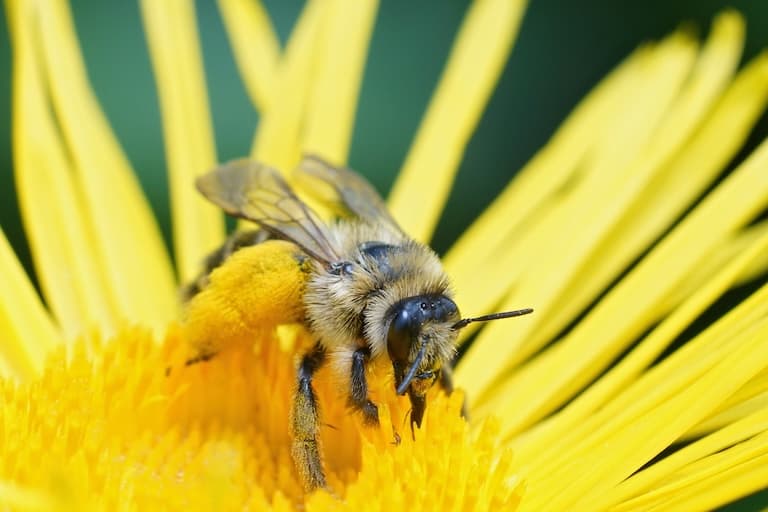
Pantaloon Bee Facts Overview
| Habitat: | Exposed, sandy areas or areas with loose dirt for burrowing |
| Location: | Eurasia |
| Lifespan: | Around a year |
| Size: | Around 13mm (0.5 inches) |
| Weight: | Not recorded |
| Colour: | Black to dark brown abdomen with golden hair on thorax and legs. Males fade to silvery grey |
| Diet: | Nectar and pollen |
| Predators: | Birds, spiders, lizards |
| Top Speed: | Unknown |
| No. of Species: | 1 |
| Conservation Status: | Least Concern globally, threatened locally (see text) |
Pantaloon bees shun convention in several ways. These hairy, digging, adorable animals pollinate daisies on sand dunes while listening to Groove Armada, digging impressively large burrows and minding their own beeswax.
And the best part is that they’re doing great! They have a recent assessment of Least Concern with a stable population and may continue their hairy tunnelling without a care in the world.
Interesting Pantaloon Bee Facts
1. They’re hairy
Bees are incredibly species rich and diverse, with more than 20,000 species described and probably many times that in existence. Bee experts will readily tell you how hard they are to tell apart, and many don’t bother past the genus level unless absolutely necessary.
There are only seven major bee families, so each should have a lot of bees in it, but the Melittidae is relatively tiny! There are only 200 species in this family, comprising around 15 or 16 genera. One of these is the Dasypoda, in which the pantaloon bee is situated.
The name Dasypoda does all you need to describe this bee, and the prefix Dasy- means “hairy” and – –pod means “leg”, or “foot”. So, these are the hairy-legged bees, and the pantaloon bee is so-named because of this.
Another common name for this species is the hairy-legged mining bee, which goes even further than looks and also describes its behavior.
2. They dig
We tend to think of bees and wasps as building hives or those big paper nests, respectively, but the reality is that only a few species of either live in colonies. The vast majority of bee species (and wasps) are solitary animals that we rarely notice, and the pantaloon bee is one such species!
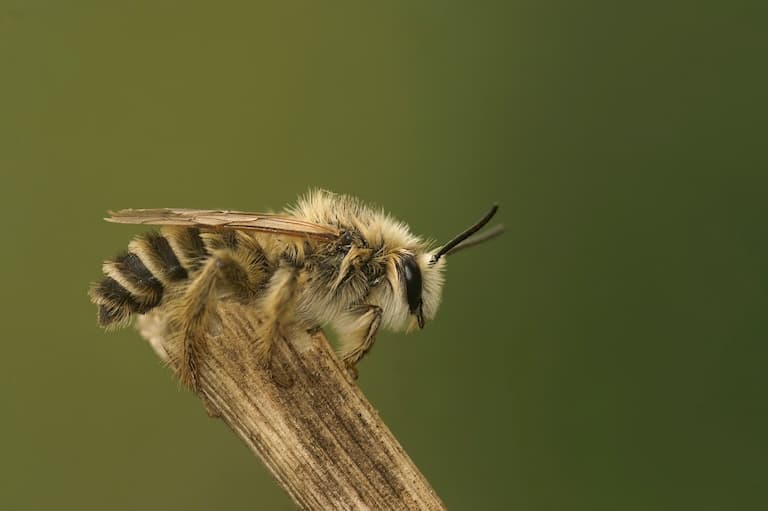
So, female pantaloon bees are all born fertile, and males have to feed themselves until they can find one. The strategy for building a nest in this species is to form pretty impressive burrows in sandy soil, which they excavate using their legs and mouths.
While they’re not social as such, they do this in areas with a lot of other female bees, as if there is some communal draw to the phenomenon, but each female only appears to be interested in her own nest and babies, and she will forage and return, bringing them food parcels of pollen and honey as they grow into adults.
These burrows can be up to 60 centimetres long, which for a 1.3 cm bee is really quite something!
The bees will then stay in these burrows until the afternoon, coming out to forage in the latter part of the day. But only the females!
It has been suggested that the shaggy hairs in the female – that are absent in the male – aid with this process of digging, and this might be true, but there are other uses for them too!1
3. They’re daisy feeders
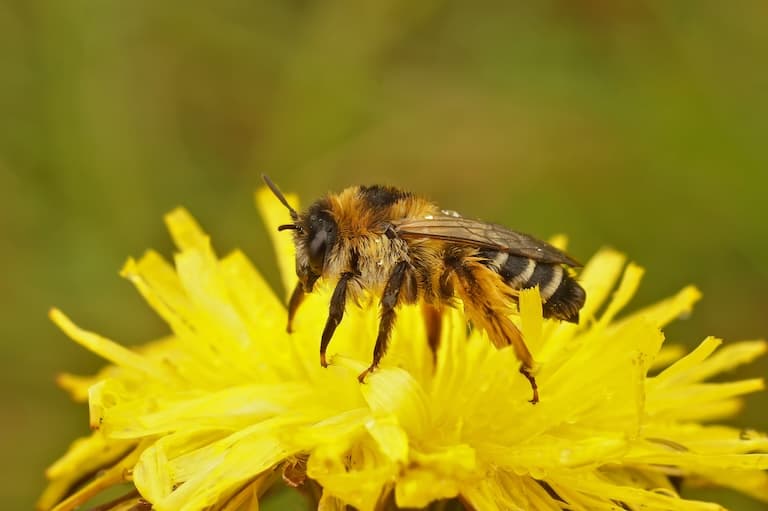
These solitary little hairy-legged insects are cute as a button already, but their preference for members of the Asteraceae family somehow make them even sweeter.
This is the star-shaped, daisy family and contains flowers like the daisy, aster and sunflower. In its bee’s range, it finds plants like hawksbeard and common cat’s-ear to drink from, and it flits between plants from uncultivated brushlands and suburban gardens equally happily.
Males of this species aren’t nearly as hairy as the females, and this is a clue as to why the hair exists in the first place. In bees, and insects in general, adults prefer a high carb diet. It’s usually the rapidly-growing youngsters who need the most protein. So, as female bees, looking after a clutch of wriggling larvae, they are responsible for finding this protein in the form of pollen in flowers.
Males, on the other hand, just have to feed themselves, so they don’t bother with collecting pollen. Thus, the big, bushy legs in the females suggests that it’s a tool for storing pollen, and this appears to be supported by observations. Males are still quite fuzzy, but not as distinctively shaggy as their female counterparts.
They do, however, exhibit a bit of a colour change as they age.2
4. Males go grey
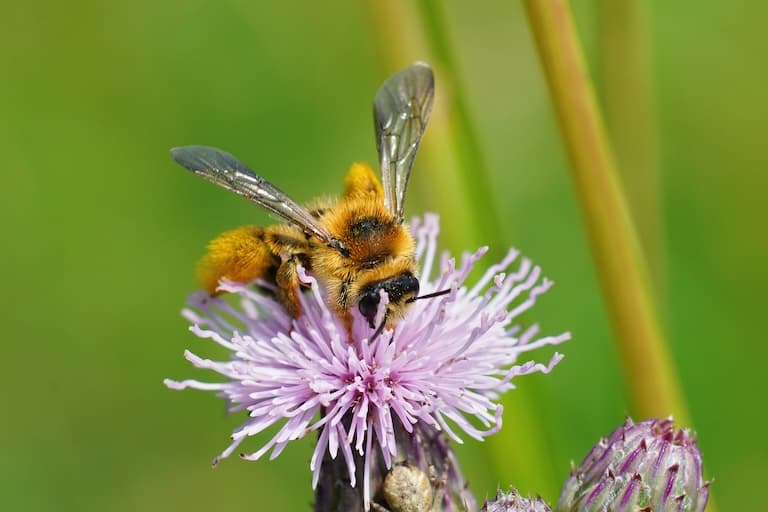
It is said that the male pantaloon bee, with its long, fuzzy hair, changes from a soft brown to a distinguished silvery-grey as it ages.
This adds yet another layer of sweetness to an overwhelmingly cute animal, whose role in pollinating flowers is a thankless one!3
The only issue with this fact is that it appears to be unsourced and the photo evidence also seems to be limited, though when you look at both sexes feeding on the same plant, there is a clear silvery tint to the male, relative to the female.4
6. They’re doing OK
The “Save the bees” slogan is commonly misused by influencers to get clicks on their weird ASMR beekeeping videos. The truth is, honeybees are fine, it’s the wild bees that are struggling and need attention!
But not this one, thankfully. The pantaloon bee appears not only to be of Least Concern but with a stable population to boot, so all the hairy ladies rejoice. They were last assessed as recently as 2025 and are deemed safe for now, which is great news for bees and for dune ecology all over northern Europe.5

Pantaloon Bee Fact-File Summary
Scientific Classification
| Kingdom | Animalia |
| Phylum | Arthropoda |
| Class | Insecta |
| Order | Hymenoptera |
| Family | Melittidae |
| Genus | Dasypoda |
| Species | hirtipes |
Fact Sources & References
- Else (1998), “Dasypoda hirtipes”, bwars.com.
- Else (1998), “Dasypoda hirtipes”, bwars.com.
- Mathew (2019), “Hairy Legged Mining Bee”, Nature Spot.
- Harriet (2023), “Dressed for labor, not for show – The pantaloon bee”, Biocommunication.
- Ghisbain et al (2023), “Common Pantaloon Bee”, The IUCN Red List of Threatened Species in 2023.