
Palm Civet Profile
Ever since cats nuzzled their way into our hearts, they have become the benchmark for all other so-called at-like animals to be compared against. The suborder Feliformia is where cats and their relatives sit taxonomically, but while cats lend their name to it, they themselves are some of the newest arrivals in the group.
It’s the Viverridae family that’s considered the most primitive branch among the feliform carnivorans, and this is where we find the incredible palm civets: nocturnal, “cat-like” tree dwellers from Asia.
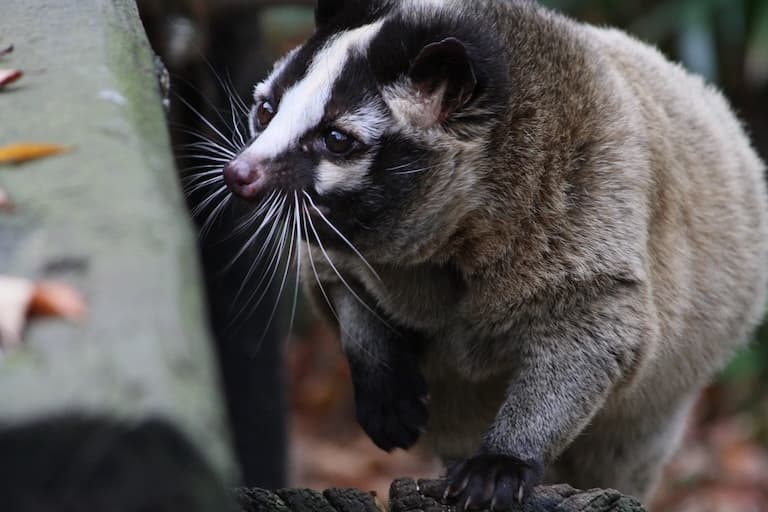
Palm Civet Facts Overview
| Habitat: | Arboreal, nocturnal: forests and wooded areas |
| Location: | South and Southeast Asia |
| Lifespan: | 20+ years in the wild, perhaps even more in the wild |
| Size: | Largest is 90 cm long (1.8 m with tail) |
| Weight: | Largest weights up to 20 kg |
| Colour: | Some are black, others brown and spotted |
| Diet: | Omnivorous, but mostly plant matter. Palm civets can hunt for small mammals and insects |
| Predators: | Tigers, leopards, snakes and raptors |
| Top Speed: | Unknown |
| No. of Species: | 6 Species in four genera |
| Conservation Status: | Binturong is Vulnerable, the rest are Least Concern |
Palm civets are a wonderful subfamily of Viverrids, occupying arboreal, nocturnal niches all over the forests of South and Southeast Asia. They are primitive, elusive and generally very chilled-out animals who patrol the branches in the cover of darkness, keeping incredibly quiet and eating pretty much everything.
Their casual approach to life has served them well and seems to continue to do so – almost all of them are still doing very well and are not generally threatened with extinction just yet.
Interesting Palm Civet Facts
1. They’re Viverrids
Civets are generally considered to be members of the same family, but this is a pretty general name given to more than ten different species, and isn’t a strict taxonomic clade as it only applies to certain species in the family, and even a couple of species outside of it.
Viverrids are a strange group, being that they’re not quite cats, nor mongooses, nor really anything else within the filiform suborder, but something in-between the lot. And palm civets are even more unique.
Being viverrids, palm civets are characterised by having four toes on each foot and claws that are semi-retractable. One other quirk of this family is that their urethral opening, at least in the males, points backwards, which conjures up countless practical and humorous uses in anybody with a healthy imagination.
Palm civets form a subfamily called Paradoxurinae, which has in it four genera.
2. Toddy cats, musangs and uguduwas
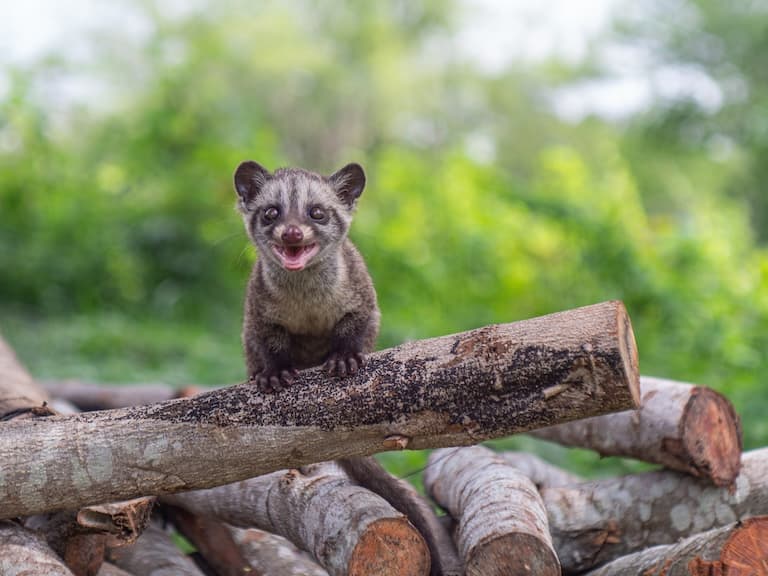
There are six species we’d call true palm civets, and one honorary mention. All true palm civets are of Asian origin.
In Sri Lanka alone, there’s the Asian palm civet, the Small Indian civet and the Golden palm civet, all of which are referred to locally as uguduwa. The Asian palm civet is also known as the toddy cat or musang.
But the Small Indian civet has its own genus, Viverricula, the other two belong to the genus Paradoxurus, along with the Brown palm civet, found in India.
Arguably, the weird and wonderful binturong is a palm civet, and this is often called the bearcat for precisely the reasons you’d expect. It’s the largest of the subfamily, in the genus Arctitis.
Finally, we have the masked palm civet, also called the gem-faced civet or Himalayan palm civet. This is in its own genus too, called Paguma.
The genus Nandinia contains what is commonly called the African palm civet – the most genetically isolated carnivoran in the world – and this is found only in sub-Saharan Africa, but this isn’t a true civet at all, let alone a palm civet, and belongs to its own family!
3. They’re Nocturnal and Crepuscular
These are really ancient animals and quite elusive to boot. Not only are they primarily arboreal, or tree-dwelling, but they are most active at night.
To top it off they’re mostly solitary, meaning you don’t see them very often at all. The best you can hope for is some action around dawn and dusk, which is known as crepuscular activity.
The brown palm civet uses Indian giant squirrel nests to hide in during the day, and civets are thought to prefer darker nights in general, which suggests they have exceptional night vision.
Palm civets don’t appear to be all that adventurous, either; if there’s food nearby, they’ll stay put1.
4. They live a long time
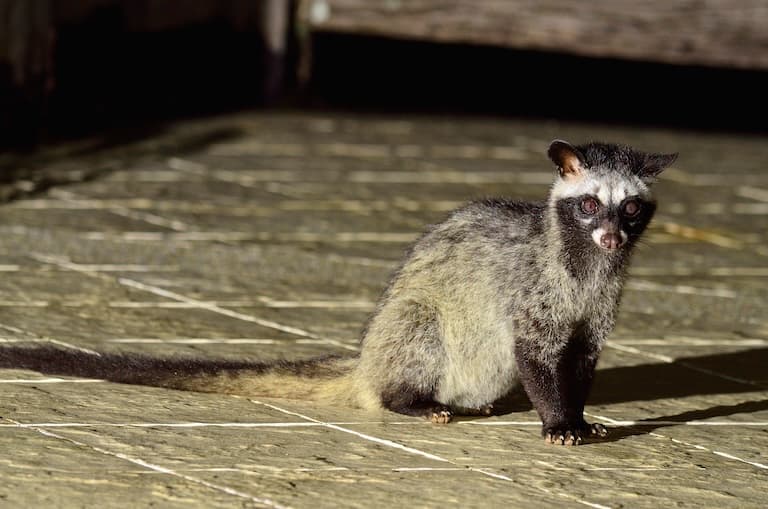
Being conservative seems to work for them, though. They stay out of sight of the diurnal raptors and out of reach of the larger predators like leopards. Some palm civets like the Asian palm civet live much longer than your average viverrid: around 20 years in captivity, which is twice as long as the average.
The golden and brown palm civets aren’t quite as lucky, and seem to reach around 10 years or a little more in the wild.
5. They’re quiet
Being arboreal, nocturnal and solitary, you’d think they’d also be agile, but palm civets aren’t all that athletic. They tend to walk, rather than jump, through the branches and don’t move all that quickly.
They are very rarely vocal, too, so they keep to themselves well and make almost no noise in the canopy. Communication is limited to scent markings, pooping on things and spraying pee everywhere. This vocabulary all amounts to more or less the same message: “leave me alone”. But changes somewhat during mating season, which is the only time palm civets can really be found together.
For scent marking, females will drag their anus along the ground like a dog with worms (much as they do in Essex), and males spray on the ground, pick it up and rub it on trees, which is really more of a Watford thing.
6. They can eat anything
On the topic of food, these palm civets are generally not fussy. Being slow and relaxed in their movements, they primarily eat plants, but this may not be a preference as much as a practicality. Different species show more or less inclination to seek out meat, but those who do can and will hunt animals too.
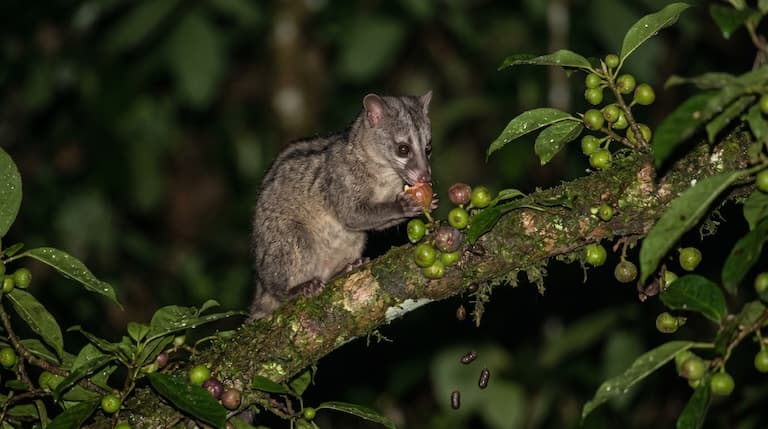
The brown palm civet appears to eat the most vegetation, mostly fruits, and a true variety: figs, chiku, mangoes, coffee, guava, rambutan, pineapples, bananas, cardamom, papayas, and pulpy berries are all on the menu, and Asian palm civets are also known to include sap.
When hunting, they’ll eat a lot of arthropods, for obvious reasons, but also eggs, reptiles, birds, small rodents, and frogs. So, palm civets are true omnivores and this makes them incredibly powerful members of the ecosystem2.
7. They plant seeds
The most obvious service to the ecosystem comes out of their back ends. All this fruit eating produces a lot of seed pooping, and a lot of plants have evolved to increase their seeds’ germination chances by mixing with various microbes in the guts of the animals who eat them.
Perhaps the most high-profile example of this comes from the coffee bean poo of the Asian palm civet, called Kopi luwak, which has become a bit of a novelty worldwide. Coffee beans passed through this civet are said to have a more complex and richer flavour, and are now farmed in Southeast Asia under ethically dubious conditions with caged civets for sale all over the world.
But in the wild, seed-pooping plants many trees and keeps the forest strong. Eating insects and other animals also keeps diversity and species health in order, so the palm civets really are jungle custodians worthy of protection.
8. They’re doing OK
Fortunately, most palm civets are still doing really well, though many are in decline. Deforestation and habitat conversion is an inescapable destructive force for forest dwellers all over the world, and palm civets will not be immune, though many species are quite tolerant of disturbances.
Most palm civet species listed are of Least Concern, only the binturong is now vulnerable. But being such elusive and solitary animals, the fact that most are still thriving is a testament to how adaptable and well-equipped this little group of viverrids is3.
Palm Civet Fact-File Summary
Scientific Classification
| Kingdom | Animalia |
| Phylum | Chordata |
| Class | Mammalia |
| Order | Carnivora |
| Family | Viverridae |
| Subfamily | Paradoxurinae |
Fact Sources & References
- Jonas (2022), “Paradoxurus”, Animal Diversity Web.
- Jonas (2022), “Paradoxurus”, Animal Diversity Web.
- Willcox (2016), “Binturong”, The IUCN Red List of Threatened Species 2016.