
Pallid Harrier Profile
The traditional complexion of a British Etonite leaves a lot to be desired and is well worthy of the pallid. Synonyms for pallid include ashen, wan, pasty, bloodless, and washed-out – all very applicable to members of the country’s most diversity-bereft political parties, but none remotely descriptive of today’s wonderful bird: the Pallid Harrier.
In stark contrast, this animal is stern, charismatic, agile and fit for purpose. And it kills indiscriminately.
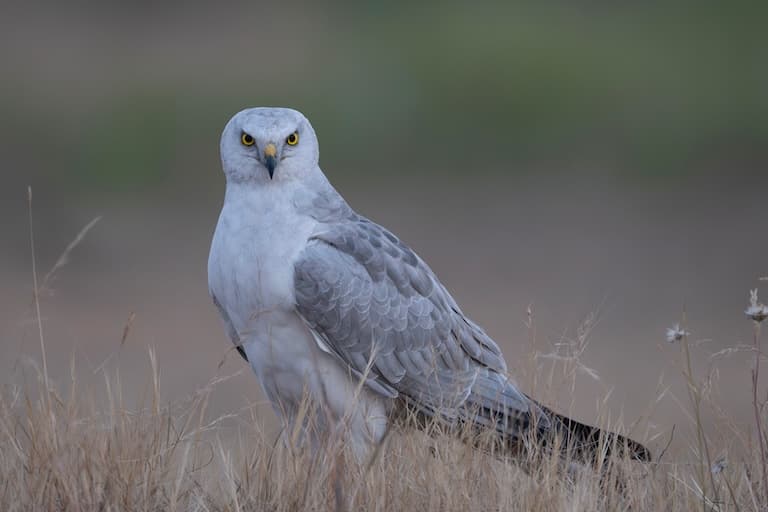
Pallid Harrier Facts Overview
| Habitat: | Open fields and moors, nests on the ground |
| Location: | Widespread across Africa and Eurasia, |
| Lifespan: | Likely around 16 years based on similar species |
| Size: | Up to about 50 cm (20 in) long |
| Weight: | Up to around 445 g (15.7 oz) |
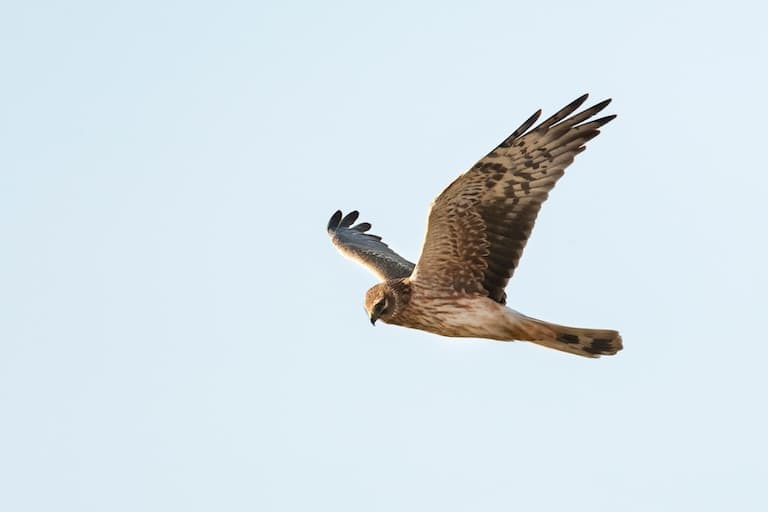
| Colour: | Males are grey with lighter face and darker tail feathers, females are tawny to dark brown. |
| Diet: | Small mammals, other birds, amphibians, large insects |
| Predators: | Young can be taken by foxes, raptors, |
| Top Speed: | Possibly up to 38 km/h (24 mph) |
| No. of Species: | 1 |
| Conservation Status: | Near Threatened |
Pallid harriers fit that sort of vague middle ground for raptors: not as enormous as the eagles, not as iconic as a Hen harrier, and sort of similar looking to equally obscure Montague’s harrier. But they are worthy of recognition, even among harriers, as they are some of the more flexible of their kind, not only in diet, but also habitat preference, and this might save them, as their species is not only persecuted, but ousted by human development across their traditional range, and they may need to find new pastures.
Interesting Pallid Harrier Facts
1. They’re harriers!
Raptors, with the exception of the falcons and the owls and a couple of others, mostly make up the Accipitriformes order of birds. This is a very diverse, but generally pretty lethal order of predators that includes eagles, vultures, hawks, kites, and so on.
There are four main families here, ospreys and secretary birds have their own, as do the American vultures, but the majority of old world Accipitriforms are in the like-named Accipitridae family, and this includes eagles, Old World vultures, hawks, kites, and harriers.
Harriers are technically in the true hawk group. This is a subfamily of raptors that make up the original hawks before the Americans started calling kites hawks and confused matters. There are eleven genera in the “true hawks” subfamily, and harriers are one of them: Circus.
Unlike most hawks, who drop down from branches in wooded areas, this genus tends to fly low over fields and nab unsuspecting animals from beneath the scrub. As grassland birds, they have longer legs than most of their relatives. Harriers are mid-sized raptors, and among them, the Pallid harrier sits somewhere at the bottom of this spectrum.
2. They’re small-sized harriers
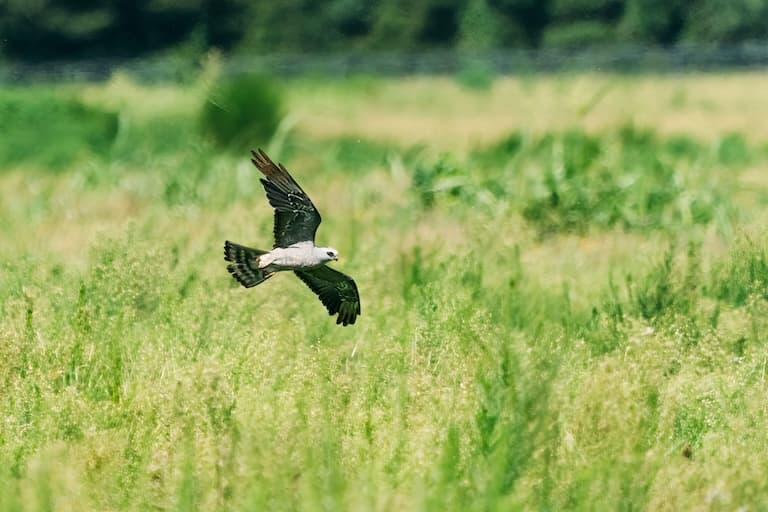
The marsh harrier is the largest species in this genus, at over half a metre long and up to 750 grams in weight. At the other end are the Montagu’s and Pied harriers, weighing less than half a kilo and reaching around 50 cm long, and this is more or less where the Pallid harrier is, as well.
This is a small bird, and light in the air, which gives it tremendous agility as well. It has narrower wings than its larger cousins, and is identified against the Montagu’s harrier, with whom its range overlaps, mostly by colour: as the name suggests, the Pallid harrier is paler.
3. They are not very flat-faced
The characteristic disc-shaped face of birds like the barn owl is quite common in some harrier species, too. These are essentially sound-catching surfaces to amplify the tiniest rustlings of mini prey in the grass. Hen harriers are some of the flattest-faced of the harrier group, but northern harriers have it, to a lesser degree, too.
One cool thing about hawks is how well they can see. True hawks have been shown to have up to five times as many photoreceptors in their eyes as humans do, which take up a lot of space, and so replace a lot of the low-light receptors we have. That means, they can see incredibly well – much better than we can – but only in good light.
So, flat faces solve a lot of that problem for those who need it, but are a secondary trait in general to the incredible vision of these birds.
Pallid harriers are much less flattened in the feathers around their heads, though there is a little flatness to be seen at certain angles. This suggests that it is less of a specialist feeder, and may use a combination of sight and hearing to hunt. The reported diet of this species supports this.
While hen harriers primarily eat small insects and birds (in the UK it is traditionally persecuted for eating grouse, which the farmers want to eat), Pallid harriers eat pretty much any small animal, including rodents and birds, but also large insects, worms, amphibians, and lizards.
Having said this, their diet varies primarily by season, and in some locations they are so reliant on the local vole population for part of the year that they could be considered specialists.1
4. They’re widespread!
Being unfussy with food allows this species quite a range of habitats, and migratory populations have just that! They breed in Central Asia and Eastern Europe, moving west to chase the sun and overwintering across Africa and India.
Some individuals will travel 6,000 km on a migration, and as you’d expect, their food availability changes dramatically along these trails. So, being adaptable is a huge benefit to the species.
Unfortunately, it looks like that’s not quite enough any more.2
5. They’re in decline
The open grasslands that the harriers prefer are under tremendous threat from humans who consider them worthless and either plough them to plant crops or feed them to their livestock.
As the pallid harrier nests on the ground, this destruction is destroying their ability to breed as well as feed, and the species as a whole is now in decline globally.
In addition, around 1% of birds globally are thought to be killed illegally in North and Central Europe on their way between breeding and overwintering sites by bird shooters. This represents the biggest threat to populations on the move.
The Pallid harrier is now listed as in decline and Near Threatened by the IUCN.3
6. But The Times They Are a-Changin’
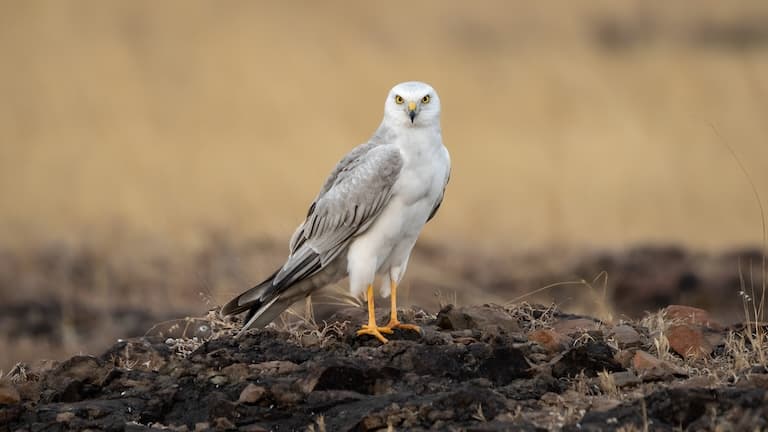
But all is not lost! This adaptable bird is still finding new homes, and as protections around wild lands increase in Northern Europe, they become a refuge for species like this one whose historical range is under attack.
In 2017, a breeding pair was identified in The Netherlands for the first time, perhaps signalling a new shift in behaviour for the bird, and a chance at recovery!4
Pallid Harrier Fact-File Summary
Scientific Classification
| Kingdom | Animalia |
| Phylum | Chordata |
| Class | Aves |
| Order | Accipitriformes |
| Family | Accipitridae |
| Genus | Circus |
| Species | macrourus |
Fact Sources & References
- “Pallid Harrier”, Harrier watch India.
- Jaume (2016), “Pallid Harrier”, CornellLab.
- Birdlife International (2021), “Pallid Harrier”, The IUCN Red List of Threatened Species in 2021.
- (2017), “The Pallid Harrier, a new breeding species for the Netherlands”, Nature Today.