
Pallid Bat Profile
This North American desert is hard and wild, but those who are brought here are harder still. And if you thought the continent’s most dangerous scorpion was the baddest of the Badlands, you might be in for a treat. Because today’s animal is a silent assassin of some of the toughest desert invertebrates around.
This extremely specialised nocturnal hunter flies low and strikes the ground in total darkness. And it’s got really cute, enormous ears. This is the Pallid Bat, a surprisingly important ecosystem servant of the western North American continent.

Pallid Bat Facts Overview
| Habitat: | Rocky areas in arid or semi-arid habitats |
| Location: | Western North America |
| Lifespan: | 10 years |
| Size: | Around 7.9 cm (2.75 inches) long without tail, another 5 cm tail |
| Weight: | 14-25 grams |
| Colour: | Yellowish brown to cream colored fur on its back and white fur on its belly |
| Diet: | Beetles, grasshoppers, moths, crickets, scorpions, and sometimes lizards, nectar |
| Predators: | Cats, fox, racoons, snakes, coyotes and frogs. |
| Top Speed: | Unknown |
| No. of Species: | 1 |
| Conservation Status: | Least Concern |
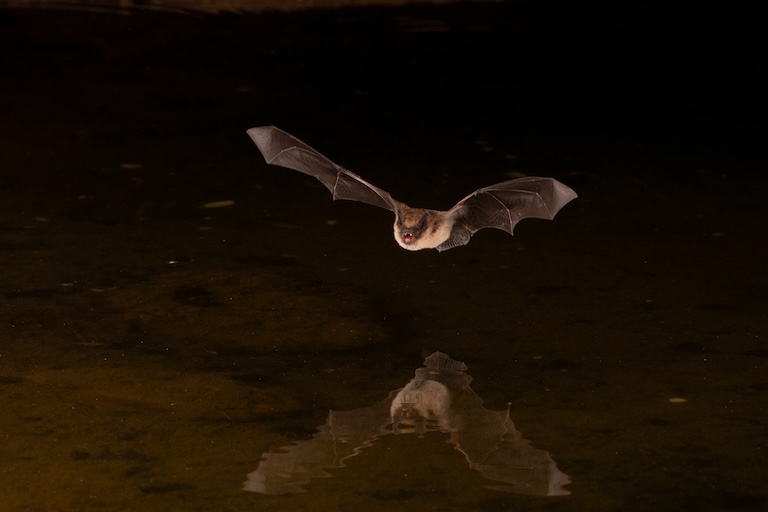
Pallid bats are technically microbats, but big ones! They have cute piggy noses and enormous ears, which they use to find scuttling arthropods on the ground at night. They’re big enough to take lizards and even some fish, but their most accomplished quarry might be the bark scorpion.
These bats have a distinct smell, a distinctive mating strategy and a very wide impact on their habitats, and while they’re doing well on paper, their data is in need of a refresh.
Interesting Pallid Bat Facts
1. They’re microbats!
Bats are the most recent entry into the kingdom’s aviator competition, representing us mammals and the fourth known class of animal to take to the skies. The previous three in descending chronological order are the birds, the pterosaurs and the insects.
But bats – as far as we know – are the only members of this mile-high club that use sonar to navigate, and this allows them dominance in the night time, when almost everything else that can fly would crash.

Bats are absolutely the dominant nocturnal vertebrate, let alone in the air – they are the second-largest order of mammals after the rodents, making up 20% of all mammal species, spread across more than 20 families. One of these families is the microbats, the Vespertilionidae.
This is the most widespread and diverse family of bats, as it happens, and not all of them are micro: the pallid bat’s ears alone are over 2.5 cm long, and they can have a wingspan of up to 40 centimetres.
2. They’re stinky
This bat has a pig-like snout and enormous ears. It’s very distinctive for these reasons alone, but in the dark, its smell is what can identify it the most clearly to potential mates or predators.
Pallid bats release a skunky smell from glands on their faces, and this is thought to be a deterrent – it certainly works against humans – but may also be a mode of communication between the bats themselves. 1
3. They’re fearless scorpion hunters
Unlike many bat species that hunt on the wing, this one employs a strategy more like that of an owl or kestrel, finding ground-based prey to descend on and capture. They fly low over the ground, scanning it with their echolocation until they come across a suitable victim.
This is usually an insect of some kind, but larger individuals can take lizards, spiders, even fish. But one of the coolest food items for the pallid bat is the Arizona bark scorpion. Lethality is very rare among scorpions, but it is one of the most venomous species in North America and has killed people before. But the pallid bat takes no heed and scoffs them down without an issue.
It’s thought that one of the gene mutations in the pallid bat allows them to develop a resistance to the scorpion venom, allowing the bat to be stung multiple times while hunting and simply honey badger along regardless. 2
4. They are desert pollinators
But it’s not all venom and fangs in this bat’s diet – in the more arid regions of its range, the pallid bat has been known to gather valuable fluids and carbohydrates from the nectar of cactuses.
This is rare in bats, though not unheard of, and the mammalian fuzz that they carry on their bodies is a perfect pollination brush for the cactuses, whose pollen sticks to it and is transferred between plants.
So, the pallid bat, as well as being a great pesticide, is a useful desert pollinator too! 3 4
5. They collect sperm
The animal kingdom has a bunch of really fun ways to have sex. Some do it with cuddles, some do it with a method known as “traumatic insemination”, and of the thousands of methods in-between, the pallid bat’s is remarkably transactional.
Many marsupials are able to delay oestrus, which means the female can have her eggs fertilised and then just wait until she’s ready to germinate the little brat in her own time. Similarly, pallid bats are capable of something called delayed fertilisation, in which the female takes the sperm when it’s ready but doesn’t fertilise the egg with it until she has all her stuff in order.
So, in an offering that echoes the romantic gestures of Van Gogh, the male pallid bat presents the female with his sperm to do with what she will. And most often her will is to sleep through the winter before doing anything with it. A female will store the dubious package in her uterus around October, take a long torpor nap, and emerge in spring, ready to conceive. Females almost always give birth to twins. 5
6. They have their issues
This strange asynchrony might seem like an evolutionary glitch, but it actually capitalises on harvest season, when males have access to the most resources and can compete at their best to mate. This means the female gets top pick of the males at their best, but doesn’t have enough time to pop one out before the winter sleep.
It’s an elegant and effective reproductive strategy that keeps this species listed as of Least Concern by the IUCN, but it is not a panacea against all external forces. In fact, its assessment is now quite overdue, and there have been concerns that this sensitive species might be in more trouble than we realise.
Human disturbance has affected their foraging areas, as has the use of pesticides on their known populations, so with any luck there will be an updated assessment in the pipeline that can draw attention to the pallid bat’s plight and reduce these impacts. 6
Pallid Bat Fact-File Summary
Scientific Classification
| Kingdom | Animalia |
| Phylum | Chordata |
| Class | Mammalia |
| Order | Chiroptera |
| Family | Vespertillonidae |
| Genus | Antrozous |
| Species | pallidus |
Fact Sources & References
- (2018), “Pallid Bat Antrozous pallidus”, Bat Conservation International in partnership with the NABat Program.
- Hopp et al( 2017), “Arizona bark scorpion venom resistance in the pallid bat, Antrozous pallidus”, National Library of Medicine.
- Frick et al (2009), “ Facultative Nectar-Feeding Behavior in a Gleaning Insectivorous Bat (Antrozous pallidus) ”, Journal of Mammalogy.
- Frick et al (2025), “Insectivorous Bat Pollinates Columnar Cactus More Effectively per Visit than Specialized Nectar Bat”, The University of Chicago Press Journals.
- Beasley et al (1984), “ Melatonin Influences the Reproductive Physiology of Male Pallid Bats ”, Biology of Reproduction.
- Cabrales et al (2016), “Pallid Bat”, IUCN Red List.