
Painted Lady Profile
In Pulp Fiction, Bruce Willis nails an ironic line, “I’m American, honey, our names don’t mean sh-”, but surely, all words begin without meaning and adopt them as time passes. Case in point: the name Vanessa.
Pieced together in the 1700s by Gulliver’s Travels author, Johnathan Swift, it was given as a pet name to one of his students, and just a century later, the name Vanessa was gifted to a beautiful genus of butterflies found in British gardens. And Vanessa cardui, or the Painted Lady, is more than worthy of its title!
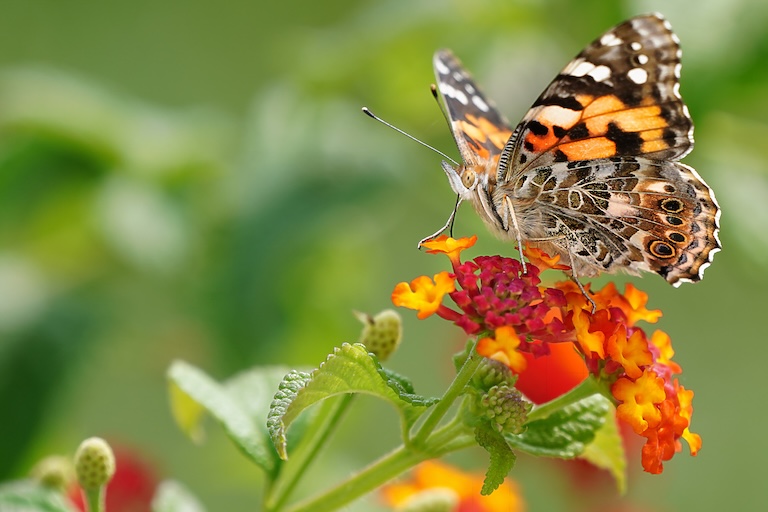
Painted Lady Facts Overview
| Habitat: | Grasslands, meadows, open spaces |
| Location: | Incredibly widespread, found on every continent except Antarctica |
| Lifespan: | Around one year |
| Size: | Around 5.5 cm (2.1 inches) wingspan |
| Weight: | Not listed |
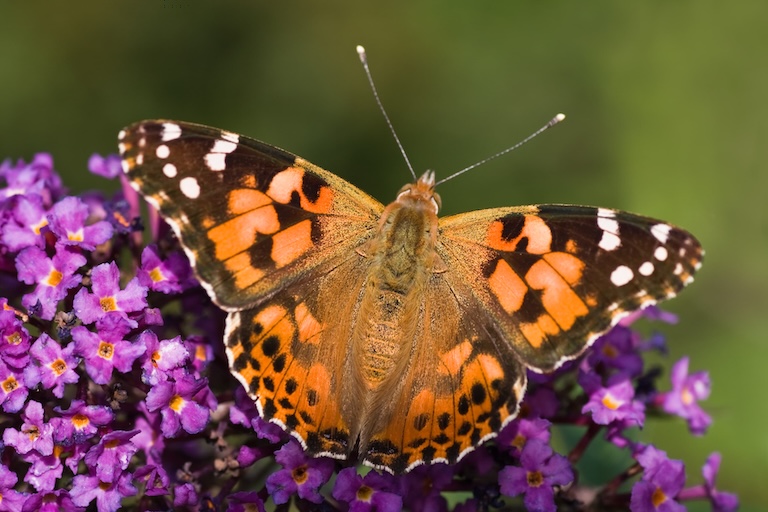
| Colour: | Dark green-grey larvae, orange with black wing tips and white flecks as adults |
| Diet: | Nectar as adults, plants in the daisy family as larvae. over 100 plant species involved; honeydew from aphids sometimes taken |
| Predators: | Birds, bats, reptiles, mammals |
| Top Speed: | Butterfly speed |
| No. of Species: | 1 |
| Conservation Status: | Least Concern |
Painted Lady butterflies are not only iconic summertime insects, but also incredible jet-setting maniacs who fly almost non-stop, lay eggs everywhere, travel the world, mate on the wing, and then die.
And they do this with 33% fewer legs than most. All the while maintaining an elegance worthy of the name Painted Lady. Despite their almost cosmopolitan distribution, much of what they do and how they do it remains a mystery.
Interesting Painted Lady Facts
1. They’re Nymphalids
The insect order Lepidoptera is one of the largest orders of animals in the world. It contains around 10% of all described animal species! There are 126 or so families of Lepidopterans, covering all butterflies and moths, and close to 200,000 described species among them.
Moths make up a disproportionate number of these species, but among the butterflies, the Nymphalids are the most abundant. There are 6,000 species in this family alone, and they’re found all over the world. This family contains butterfly icons such as the Monarch and the Admiral, the latter of which is the subfamily that contains the Painted Lady’s genus, Vanessa.
In fact, Vanessa also contains the red admiral, one of 22 species in the genus, and several other regional painted ladies, such as the Brazilian painted lady and the Australian painted lady.
But the original painted lady is Vanessa cardui, and this is one of the most widespread animal species on earth!
2. They’re brush-footed
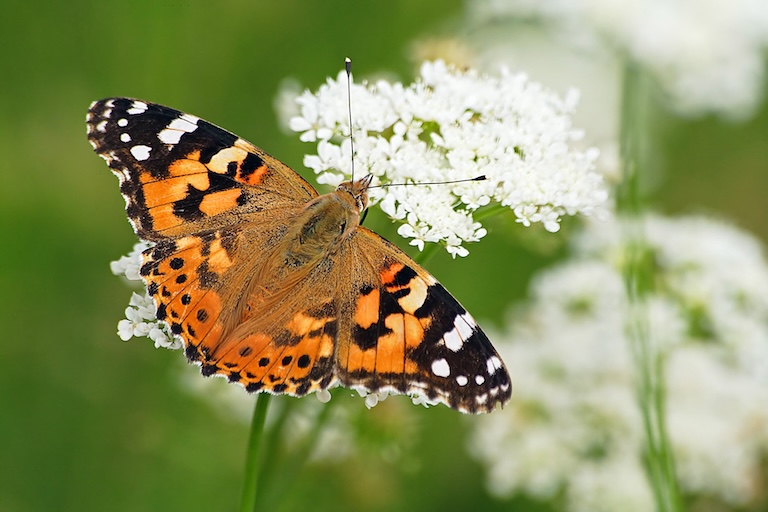
Another name for the Nymphalidae family of butterflies is “brush-footed”, and this explains why they appear to only have four of the six legs they’re entitled to as insects.
The other two, the front pair, are reduced in most species in this genus, some to the point of being hard to find at all. But far from becoming that abomination, the vore in Quake, the Painted Lady, wears this really well and perches just as elegantly on a flower with four legs as it ever would on six.
The use of these legs is unclear. It’s commonly said that they are covered in sensory hairs and therefore used for navigating the butterfly’s environment, but this doesn’t appear to have been studied in depth yet.
They are indeed covered in hairs, which is how they get the nickname “brush-footed”, so they are certainly not useless, though incapable of walking. Whatever they’re for, they certainly don’t get in the way of this lady getting around! 1 2
3. They’re the most widespread butterfly
There are few places you can escape the Painted Lady butterfly – not that you’d really want to unless there was something very wrong with you.
They are found on every continent except Antarctica, which is bereft of almost everything else as well (there’s only one insect that can survive on Antarctica and it’s a weird fly).
Painted Lady butterflies are widespread across North America, Europe, Asia and North Africa. They also blow in occasionally to New Zealand and perhaps Australia, though they’re not considered native.
There is no other species with such a number of passport stamps! 3
4. They dance
When preparing for bed, this species engages in a pretty little dance, documented in the ‘80s as “roosting behaviour”.
They have been described in Montana, chasing one another around a cottonwood tree. Groups of between two and eight individuals circled one another for up to five seconds and then dispersed.
Individuals would flit between groups of dancers, and at no time was mating witnessed, so the purpose of this behaviour remained a mystery.
However, this species is unusual in that it is capable of mating throughout the season, repeatedly, so the chances are strong that this is what the dances are all about. Being that you have to catch them and count the tarsal segments in their legs to determine whether they’re male or female, it’s impossible to know the makeup of the sexes within these dancing groups from just looking. 4
5. They travel!
We’ve talked about all the places that this species is a resident to, but there’s more to this globetrotting butterfly than that. Not only does it live all over the place, it travels remarkable distances between locations as well.
This is a migrant, and prefers warmer regions, so will go on holiday once a year to avoid getting too cold.
It will enter Britain from the Mediterranean and North Africa in the summer, occasionally even going up to Iceland.
British Painted Ladies show up after completing a migration of up to 14,000 km round trip, having left just before the previous winter.
Research suggests that these transits occur at high altitudes, and therefore are still a bit of a mystery and rarely witnessed!
6. They breed along the way
Six generations of this species can pass during the course of one of these migrations!
Females will mate on the wing, then pull over for a quick break to deposit some eggs along the way, before going back up and starting it all over again.
The life of this species is one of almost continuous movement, which is equal parts mysterious and incredible. It’s also thought that they are drawn to rain, for some reason, but so much of their lives occur well out of reach of human instruments, so despite being the most widespread butterfly, we are still in the dark as to the ins and outs of how they do it! 5
7. Then they die
Living fast like this comes at a cost. And for the painted lady, that cost is a lifespan of around one year. Still, six generations and 14,000 kilometres behind them, they have earned their perpetual rest,
Adults in lab conditions only live for up to 24 days, which is another avenue for exploration, but in the wild, it’s impossible to know since they can’t be tracked.
From egg to death is thought to take around a year, and so this beautiful, icon of the British Summertime is a live fast, die young kind of gal. 6
Painted Lady Fact-File Summary
Scientific Classification
| Kingdom | Animalia |
| Phylum | Arthropoda |
| Class | Insecta |
| Order | Lepidoptera |
| Family | Nymphalidae |
| Genus | Vanessa |
| Species | cardui |
Fact Sources & References
- (2020), “Forelegs and four legs in butterflies! ”, Ray Cannon’s nature notes.
- Peter Eeles , “Nymphalidae”, UK Butterflies.
- , “Painted Lady Butterfly”, Gardenia.
- RICHARD L. HARDESTY (1987), “ROOSTING BEHAVIOR IN ADUL T VANESSA CARDUI”, Journal of the Lepidopterists’ Society.
- Charles Harlan Abbott (1951), “A Quantitative Study of the Migration of the Painted Lady Butterfly, Vanessa Cardui L.”, The Ecological Society of America.
- Kreiger et al (2014), “Vanessa cardui ”,Animal Diversity Web.