
Paddyfield Pipit Profile
Even people who dedicate their waking hours to looking at birds struggle with these pipits. They are some of the most widespread of any genus of songbird, but birders and taxonomists alike still don’t fully understand which is which.
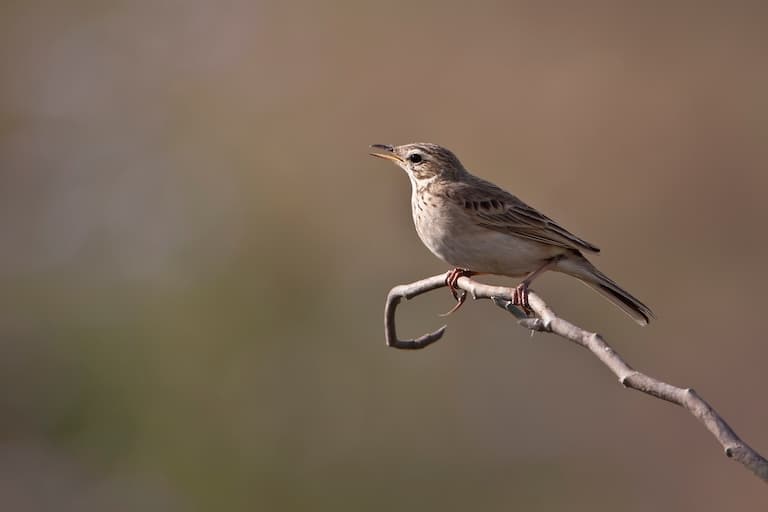
So, the paddyfield pipit, a drab, small, unassuming little bird with a wide range across Asia, requires a whole host of criteria to be met in order to identify it.
Paddyfield Pipit Facts Overview
| Habitat: | Wetlands, farms, fields, and even large parks |
| Location: | India and Southeast Asia |
| Lifespan: | Possibly around 5 years |
| Size: | 15 cm (6 inches) long |
| Weight: | Around 40 g 1.41 oz |
| Colour: | Some appear very warm rufous or buffish-brown, while others appear more greyish, mostly quite plain-looking. |
| Diet: | Mostly small insects, but also larger beetles, tiny snails, worms |
| Predators: | Raptors, snakes and small mammals |
| Top Speed: | Not recorded |
| No. of Species: | 1 |
| Conservation Status: | Least Concern |
The Paddyfield pipit is one of 70 or so pipits in the Pipit genus, and one of several who live where it does. In the winter, things get even more complicated, as other migratory species come home to survive the cold and be unassuming alongside it.
This little bird is hidden in plain sight, at least to our eyes, yet it represents quite a monstrous little beast to the insects and worms that it chases down in the undergrowth.
Interesting Paddyfield Pipit Facts
1. An undistinguished looking bird!
To understand pipits, we might start with wagtails. Almost everyone can spot a wagtail. They’re the little bouncy-bum birds found all over the world, often vivid, black-and-white, walking along rooftops, river banks, driveways and gardens and bobbing their tails as they go.
Wagtails are in the songbird group of the largest order of birds, the Passeriformes. And they share their family with the longclaws – a small genus of six species – and the pipits. This group of unlikely relatives make up the family Motacillidae, which is a small, but impressively-distributed family of around 70 species.
Pipits make up more than half of these, and are found in both the Old World and the New World, from New Zealand to New York and beyond. They cover almost all of the Earth’s surface, with the exception of the really, really cold bits, and are the only genus in the family to make it to the Americas. Wagtails are not this widespread, yet are typically better-known and one of the main reasons for this is just how similar pipits look to one another, and how plain they look in general.
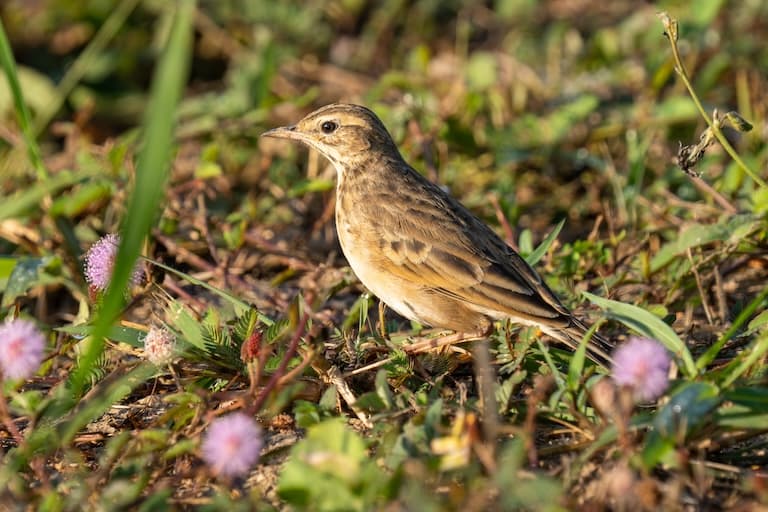
The Paddyfield pipit is a species in the pipit genus Anthus, whose own Wikipedia entry describes it as an “undistinguished looking bird” 1
2. They’re larger than ordinary pipits
Even male and female paddyfield pipits look very similar, and it becomes apparent that the most remarkable aspect of this species is just how unremarkable they are, but they do have one thing going for them – they are one of the largest pipits.2
They are around 15 cm long, which is a lot bigger than the smallest species, which is only 11 cm long. Unfortunately, even this becomes inadmissible during the winter, when the paddyfield pipit shares its range with the Richard’s and Blyth’s pipits, both of which are larger than it is.3
3. They’re easier to identify by their call
The Paddyfield pipits may look like every other bird but they have a distinctive call that becomes quite easy to recognise.
This simple string of cheeps may at first seem like a generic bird call, but there’s really not much else that sounds like it in its region.
But even this can be misleading, as the species has a wide repertoire of calls, some of which do overlap with other species.4
4. They’re residents
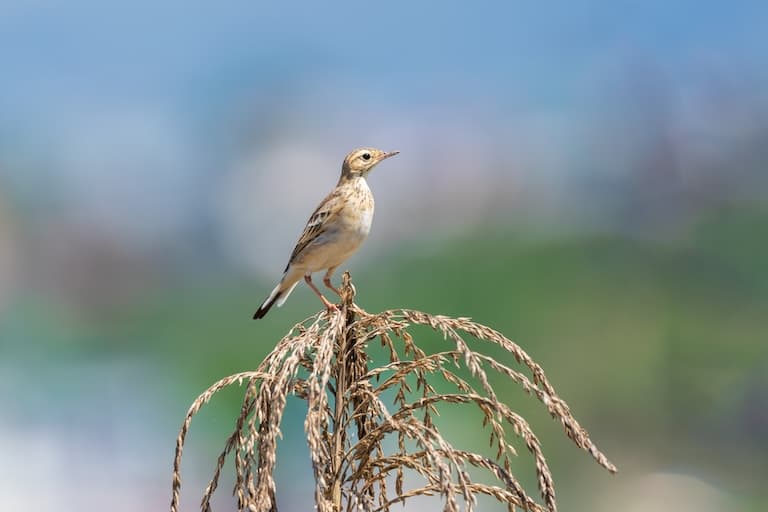
Paddyfield pipits don’t migrate, and are residents to their breeding locations, unlike their migratory doppelgangers who only show up for the winter.
As such, there’s another way to tell them apart: paddyfield pipits don’t fly all that strongly, and have a more fluttering, bumbling approach to aviation.
They’re fatter, too, which is what you’d expect from a bird that stays put!5
5. They can run well
The longclaws we mentioned in the first fact are named for an extra long claw thought to be used for running well through grass. Paddyfield pipits don’t have such a claw, but they may have a bit of the spirit of the claw in them, as they prefer to stay on the ground, even when chased, and will run very quickly before electing to fly a short distance as a last resort.
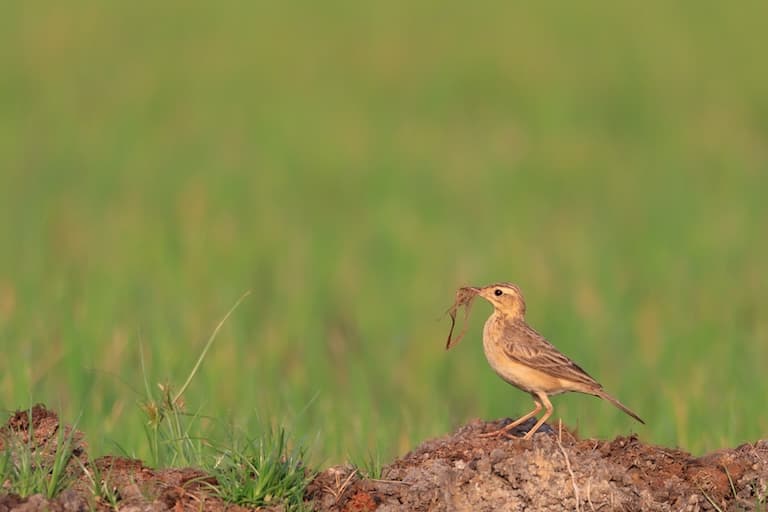
Paddyfield pipits will also breed and roost on the ground, making terrestrial nests and putting out up to two clutches in a year.
6. They’re tiny predators
As cute and unassuming as these birds look, to their victims, they are Godzilla-esque therapods with murder on their minds.
Paddyfield pipits are insect feeders and will chase down and grab prey like a skinny, feathered T-rex.
This makes them quite useful to people in the area, as they function as pest control among farmlands and cultivated grasslands.
7. They’re prey too
Being small birds, even very scary little ones, the paddyfield pipits are a tasty snack for much larger predators like raptors and snakes.
If running fast isn’t enough to escape, they can hide – presumably among the countless other bird species that look like them – and if their young are under attack, they are not above pretending to be injured to lure predators away.
Ultimately, this little bird sits in a very significant middle tier in the trophic ladder, providing food for some, fertilizer for others, and the threat of looming therapod slaughter for others still.
Paddyfield Pipit Fact-File Summary
Scientific Classification
| Kingdom | Animalia |
| Phylum | Chordata |
| Class | Aves |
| Order | Passeriformes |
| Family | Motacillidae |
| Genus | Anthus |
| Species | rufulus |
Fact Sources & References
- Baker (2009), “The brown rock-Pipit”, Internet Archive.
- Hall (1950), “The Taxonomy and Identification of Pipits”, Bulletin of the British Museum.
- (2021), “Paddyfield Pipit”, Ayuwat.
- “Paddyfield Pipit ”, eBird.
- Ramit(2018), “Identifying Paddyfield Pipits”, Bird Count India.