
Paddlefish Profile
It’s hard to know if it’s a lack of originality or an innate understanding of the concept of convergent evolution, but it’s always interesting to note how aliens in science fiction look remarkably similar to animals on Earth.
And this principle works in reverse, too. When we reach back into our murky, social-media-addled imaginations to consider what aquatic life on Jupiter’s moon Europa might look like, we invariably conjure something akin to the paddlefish.
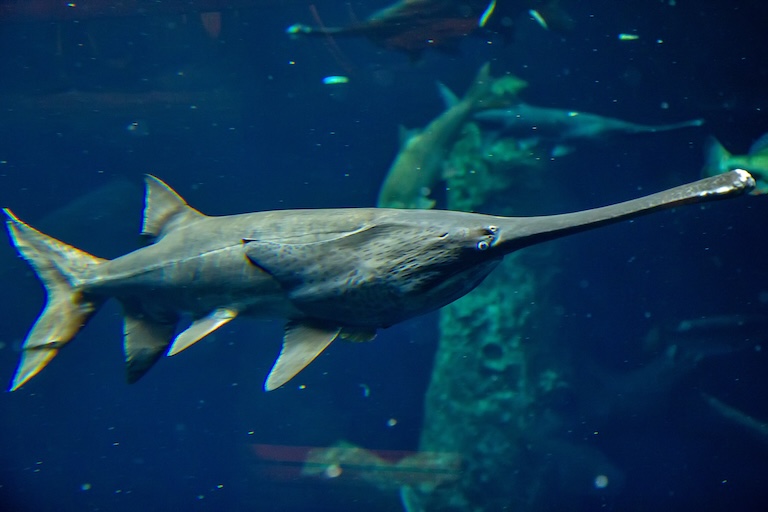
Paddlefish Facts Overview
| Habitat: | Freshwater, brackish water: slow-moving, large, deep, freshwater rivers and reservoirs |
| Location: | North America: Mississippi River basin from southwestern New York to Montana and south to Louisiana; Alabama, Texas, USA. |
| Lifespan: | Up to 55 years is recorded |
| Size: | Largest recorded was 3.63 metres (11.9 ft) long |
| Weight: | Up to 200 kilograms (440 lb) |
| Colour: | Grey-blue fading to cream underneath |
| Diet: | Filter-feeders |
| Predators: | Alligators |
| Top Speed: | Usually extremely slow |
| No. of Species: | 1 |
| Conservation Status: | Some are Critically Endangered |
Of the eight species of paddlefish described, seven are extinct. Six are prehistoric, but the Chinese paddlefish made it all the way into the 2000s before it succumbed to our presence.
The remaining species, the American paddlefish, is a truly primitive beast; it has several shark-like adaptations, and is one of the only animals in our very own phylum who still carries a notochord into adulthood.
It has long been under pressure as a source of caviar and leather, but more recently, it’s being looked at as a potential source for learning about cancer, and ironically, perhaps its potential as a savour of our species might secure its future.
Interesting Paddlefish Facts
1. They’re ancient.
Fish come in various branches of mostly aquatic vertebrates, ranging from the cartilaginous group that includes sharks, to the bony groups which contains the lobe-finned group (of which we are a member), and the ray-finned group, which makes up most of the bony fishes, including this one, the Paddlefish.
But unlike most bony fishes, this one is truly ancient. Earliest fossils of ancestral paddlefish date back over 120 million years to the Cretaceous period, which, for perspective, is about 50 million years before T-rex showed up.
Paddlefish belong to a very old lineage of bony fishes that’s basal to most around today, and this group includes another bizarre looking giant, the sturgeon. Like the Sturgeon, the paddlefish produces eggs that people like to eat, and this has led to their rapid decline from over fishing, but more on that later.
Paddlefish, as prehistoric fish, have characteristics that differ significantly from most of their more modern counterparts. 1
2. They have electroreceptors
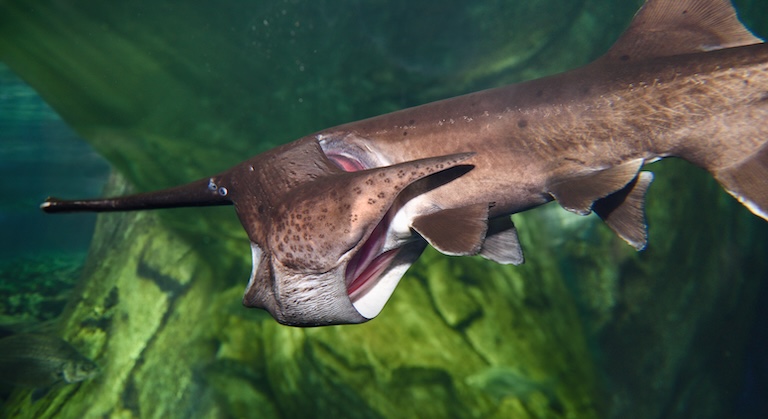
This is a bony fish with a lot of cartilage in its skeleton. They have small eyes, a shark-like body, and some shark-like traits, too, with their ability to pick up on electrical signals in the murky waters they inhabit.
Paddlefish were once thought to dig through the sediment with their funny noses, but it turns out these are instead used as a sort of sweeping metal detector, covered in special pores that pick up tiny electrical impulses. In most sharks, this is used to find skates and rays beneath the sand, but in paddlefish, it’s sensitive enough to pick up plankton!
While this incredible nose is the primary tool of navigation for this fish, research has shown that even without it, there are enough of these sensory organs for the paddlefish to navigate in the dark. 2
3. They have a notochord
Paddlefish are technically bony fish, but have very few bones! They are so old, they seem to predate the point at which this line of fish chose to ossify their cartilage almost completely, and represent a primitive quality that – as mentioned – was more similar to what we see in sharks today.
But something even more primitive is maintained in these fish, and that’s a notochord. Our phylum, the vertebrates, are defined by the presence of this notochord, but in all but a few species, it only shows up for a brief moment in the womb/egg as part of our development. In Paddlefish, it’s retained, and runs up the back as a clear, jelly-like cable where its spine would be.
4. They don’t get cancer
The immune system of the paddlefish is a recent point of interest, as it has been suggested that this animal may be immune, or immensely resistant to cancers.
This is likely owed to the presence of so much cartilage, which reduces blood flow and therefore restricts the ability of cancer cells to metastasise. Though the mechanism isn’t known, it has allowed the paddlefish a new level of appreciation as something other than a food source for people, and may end up saving its very existence!
5. There’s only one left
So many ancient species, such as most of the dinosaurs, have gone extinct before our time. And so many have gone extinct in the olden days before our lifetimes, like the dodo of the Moa. But extinction, while a natural process of life, is now happening at an accelerated rate, and it hasn’t stopped, or really even slowed down, in many cases.
Species are still going extinct today, at more than ten times the natural rate, and it’s because of us. Paddlefish are an example of an animal that survived the Cretaceous extinction. They survived an enormous asteroid impact that killed the ammonites, the triceratops, the pterosaurs, the monster marine reptiles, and a huge percentage of fish. But they couldn’t survive us.
The Chinese Paddlefish, the only other species of paddlefish left, was declared extinct in 2022. This is so recent that there are numerous fleshy specimens in museums and collections all over the world, and video footage of them when they still existed. And they were wiped out by overfishing and habitat loss. Paddlefish have been used for leather, caviar and meat, and are still caught for sport in the Americas.
But the American Paddlefish is now the last remaining species of a very old lineage of very weird and amazing fish, and even this last remaining species is now considered Vulnerable!
They are now being farmed, which reduces the pressure on their wild populations from overfishing, but does nothing to curtail the unchecked destruction of waterways and breeding sites that wild populations require to survive. The paddlefish represents an iconic example of the tragedy of the human-led extinction event, but also an opportunity to start taking it more seriously and protecting our wildlife. 3
Paddlefish Fact-File Summary
Scientific Classification
| Kingdom | Animalia |
| Phylum | Chordata |
| Class | Actinopterygii |
| Order | Acipenseriformes |
| Family | Polyodontidae |
| Genus | Polyodon |
| Species | spathula |
Fact Sources & References
- , “Paddlefish”, U.S. Fish & Wildlife Service.
- , “BIOLOGY OF THE PADDLEFISH”, Louisiana Department of Wildlife and Fisheries and Louisiana Sea Grant College Program .
- (2009), “Chinese Paddlefish”, IUCN RedList.