
Pacific White-sided Dolphin Profile
In the North Pacific, it’s the dolphins who are in charge. Orcas, being the only true apex predator in the world, are top dogs as usual, but there are others in the same family who handle upper-management. The charismatic and curious white-sided dolphin is one of several woefully under-represented cetaceans that have all the charm, wit, and killer instinct as their more famous cousins but are still lacking in the research needed to ensure their safety.
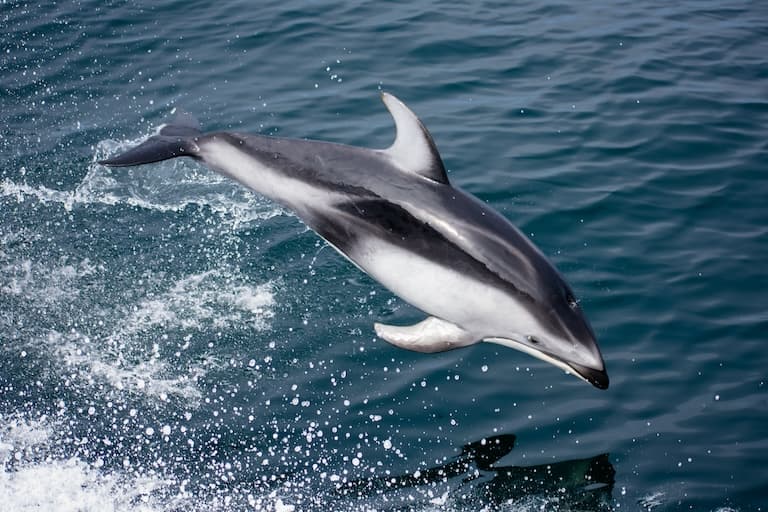
Pacific White-sided Dolphin Facts Overview
| Habitat: | Marine |
| Location: | North Pacific |
| Lifespan: | 40+ years (46 years in captivity). |
| Size: | Up to 2.5 m (8.2 ft) long |
| Weight: | Up to 200 kg (440 lb) |
| Colour: | Grey-white on the front, dark on the back, with a grey-white patch on the dorsal fin |
| Diet: | small pelagic schooling fish, salmon and cephalopods |
| Predators: | Humans, orcas |
| Top Speed: | Possibly up to 29 mph |
| No. of Species: | 1 |
| Conservation Status: | Least Concern |
White-sided dolphins were, until very recently, grouped in the genus Lagenorhynchus, and this is where you’ll find the majority of the primary literature on them up until 2005. Now, they’re the twin siblings of the Dusky Dolphin.
With their own language, philosophy, and welcoming nature, these are the kinds of animals you’d want to be friends with, but being so far out of sight has meant that we have neglected their care and despite being listed as of Least Concern, there are legitimate concerns around their safety from our presence.
Interesting Pacific White-sided Dolphin Facts
1. Dusky dolphins
The white-sided dolphin is also sometimes called the hookfin porpoise, but this latter name is a misnomer, as porpoises belong to their own family, separate from the Delphinidae family of marine dolphins, where this one sits.
There are around 40 species of oceanic dolphin, all of which are predators, and all of which are cute as a button and extremely intelligent.
The number of genera in this family has changed recently, with a brand new one opening up in 2025, when the Pacific White-sided dolphin was identified as a close relative of the dusky dolphin and moved from its traditional genus Lagenorhynchus into the newly-constructed Aethalodelphis.
This genus now contains only two species, with the dusky dolphin’s range covering much of the Southern Hemisphere and the white-sided dolphin seeming to be exclusively a Northern-hemisphere dolphin. The two species are thought to have separated from a common ancestor only 2 million years ago.

2. They have their own language
Dolphins are some of the first animals identified to use language, and still it’s almost a total mystery what they’re talking about!
What is known is that the language of the white-sided dolphin differs substantially from that of the famous bottlenose dolphin, using more low-frequency tones over all but also when echolocating.
Dolphins use their voices to navigate their murky worlds, but they also have names for themselves and their families, so you’d think figuring out how to talk to them would be a top priority of all humans, but this hasn’t fully sunk in yet.
It’s also thought that variations in subpopulations of this species might be a product of niche partitioning among the species – a way for populations to share their space with other groups of the same species without competing.1
3. They’re adaptable
While the vocal repertoires of these incredible animals may still be under-studied, what’s well known is that they are very clever and very opportunistic animals that can use their smarts to hunt a wide variety of prey. A white-sided dolphin will eat up to 20% of its bodyweight in a single day, but it isn’t so fussy about what it’s eating. This species primar7ily hunts shoaling fish, as they are easier to catch in a group, but will also take squid, octopuses and salmon.
Whistles and clicks are used as sonar to find prey and along with their vocal language, these dolphins use touch and visual displays to communicate, allowing them to both hunt cooperatively and form complex social structures. In fact, they can sometimes be found in enormous groups.2
4. They’re very social.
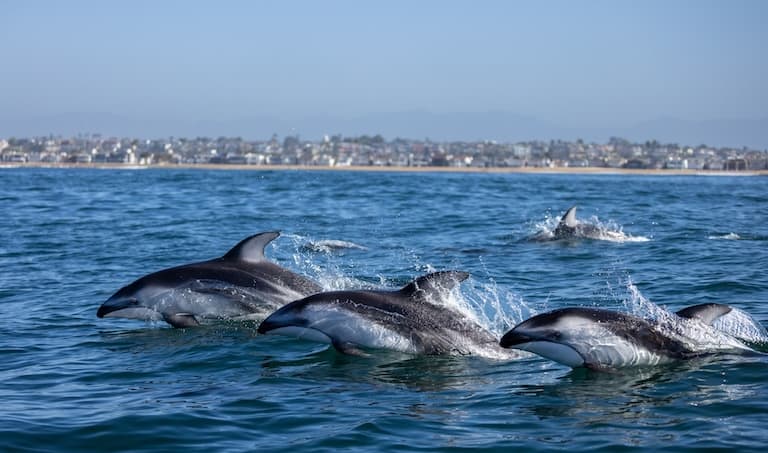
This dolphin, like most dolphins, is a relatively shallow-water animal, staying around the continental shelf to feed and socialise. They form groups of around 11 to 50 on average, and inferring from similar species, they likely have a fission-fusion dynamic where individuals will mingle and swap between groups as they pass one another.
It’s not unusual for some of these groups to have up to 100 members, and in some special cases, even up to 300 white-sided dolphins can be found together.
And they’re not exclusive, either. This species is commonly found hanging out with like-minded members of other species, such as the Risso’s dolphin and northern right whale dolphins, both of whom are from entirely different genera.
This is a dolphin species that doesn’t segregate by age or sex, too, and both sexes as well as their offspring of all ages are welcome.3
5. They’re friendly
It’s often observed, especially when inside these mixed groups, that white-sided dolphins are really enjoying life.
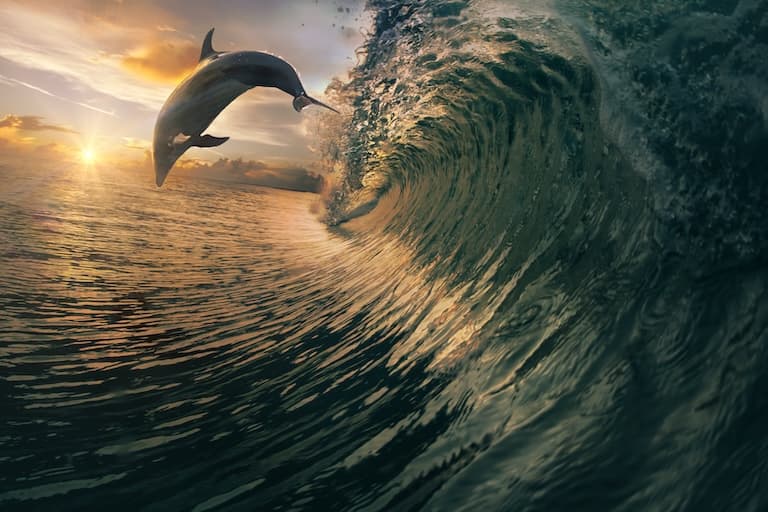
They play together, chase one another, and leap into the air for aerial displays as if sharing a festival spirit with one another. In fact, it might be that the life of the white-sided dolphin is one of the more care-free in the animal kingdom – there are few predators other than orcas to bother them – but unfortunately, humans have managed to change the course of this utopia.4
6. They sequester toxins
Gillnets in the 20th Century put huge pressure on this species and killed many, as they still kill over 100,000 cetaceans a year to this day.
Bans on this form of fishing have reduced its impact on this species, but industry as a whole puts out all sorts of pollution that follows waterways into the ocean and is taken up by its inhabitants. Animals at the top of the food chain, like these dolphins, sequester the most of these pollutants, which can cause reproductive issues and other problems with their health.
Whaling was another historical threat to the species, and another that has died down in recent years, and climate change appears to be altering their preferred range, but it’s hard to know for sure how bad it is. The good news is, to the best of our knowledge, they are doing ok.5
7. But they seem to be doing ok
The intelligence and curiosity of this species makes them hard to assess, as they have a habit of rushing up to investigate boats coming to survey them. This may sound like it makes counting them easier, but to the contrary, it confuses things a bit when trying to figure out which ones come from where and how many of them exist.
Some estimates have them at one million, while others are less committed to putting a figure on it. In 2018 they were assessed as being of Least Concern by the IUCN, but the population trend was still unknown and with the aforementioned pressures, this uncertainty makes their assessment a little weaker.
Still, 2018 wasn’t all that long ago, and chances are they are still doing alright – one good thing to come out of this new taxonomic shift is that it should inspire more attention and better gathering of data, so expect to see their assessments updated soon enough!6
Pacific White-sided Dolphin Fact-File Summary
Scientific Classification
| Kingdom | Animalia |
| Phylum | Chordata |
| Class | Mammalia |
| Order | Artiodactyla |
| Family | Delphinidae |
| Genus | Aethalodelphis |
| Species | obliquidens |
Fact Sources & References
- Soldevilla (2008), “Classification of Risso’s and Pacific white-sided dolphins using spectral properties of echolocation clicks”, UC Sab Diego.
- Layton (2019), “Lagenorhynchus obliquidens”, Animal Diversity Web.
- Layton (2019), “Lagenorhynchus obliquidens”, Animal Diversity Web.
- Ashe et al (2018), “Pacific White-sided Dolphin”, The IUCN Red List of Threatened Species 2018.
- Ashe et al (2018), “Pacific White-sided Dolphin”, The IUCN Red List of Threatened Species 2018.
- Ashe et al (2018), “Pacific White-sided Dolphin”, The IUCN Red List of Threatened Species 2018.