
Pacific Salmon Profile
Anyone who’s ever been a teenage boy knows how uncomfortable it can be to have to disguise spontaneous arousal at inopportune times.
But imagine if the manifestation of your hormonal shift wasn’t concealed in your pants, but on your face. And that it drove you to such tail-chasing feats that your organs turned to liquid and your skin fell off.
Fortunately for most of us, this isn’t the case. And fortunately for the Pacific salmon, whose sexual readiness is one of the most unmistakable and bizarre phenomena in the animal kingdom, they don’t live in the kind of society that shames them for it.
Pacific Salmon Facts Overview
| Habitat: | Marine and freshwater systems |
| Location: | North Pacific Ocean and associated rivers |
| Lifespan: | Up to 7 years |
| Size: | Up to 150 cm (58 in) in the largest species |
| Weight: | Up to 59 kg (130 lb) in the largest species |
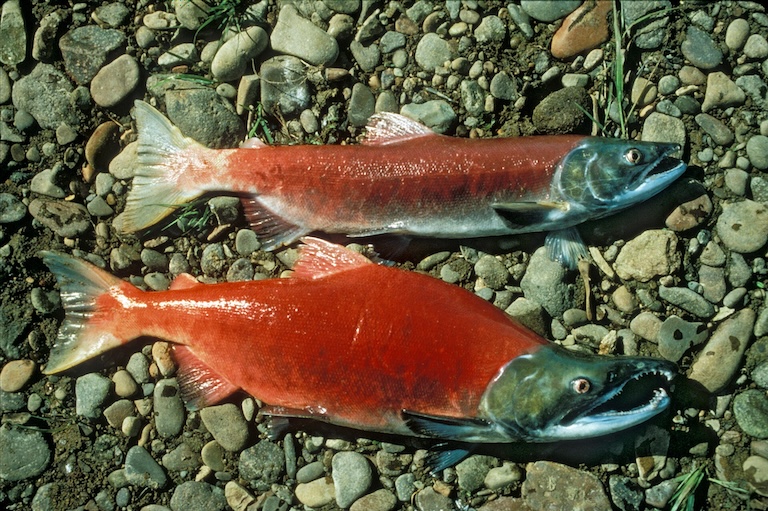
| Colour: | Usually silvery, mottled, some change to blood red during mating season |
| Diet: | Plankton, then krill, shrimp, squid, and smaller fish |
| Predators: | Orcas, sharks, bears, people |
| Top Speed: | 7 mph (\(11\) km/h) |
| No. of Species: | 6 |
| Conservation Status: | Varies depending on species, from Least Concern to Critically Endangered |
Salmon have one of the wildest life cycles in the animal kingdom.
Interesting Pacific Salmon Facts
1. Trout Vs Salmon
When discussing salmon, it can be a bit tricky to truly identify what one is. Salmon isn’t a strict taxonomic definition, and instead is a common name given to a number of similar, but somewhat unrelated fish.
For example, the Pacific salmon are in the genus Oncorhynchus, and there are six of them. This sounds pretty taxonomic until you realise there are also ten species of Pacific trout in this genus, too.
All are migratory, all are predators, and all can handle both freshwater and saltwater habitats! And none of the so-called Pacific salmon are in the more salmony genus of Salmo. So, what’s the difference?
Well, there isn’t a meaningful biological one, it’s mostly down to what fishermen call them. As it stands, the six species of Pacific “Salmon” are the pink, chum, coho, masu, sockeye and chinook salmon.
2. They get pretty big!
Salmon go way back, too. In the early days, when sabre-teeth were in fashion, there was Oncorhynchus rastrosus – the sabre-toothed salmon. These are the largest salmon known, and grew to almost three metres long.
Despite the name, though, it’s suggested that they were likely plankton feeders and their scary teeth pointed outwards as a sweeping defense against predators and competition.
Today, chinook salmon grow to be the largest of the Pacific salmon, sometimes reaching up to 1.5 metres long and almost 60 kg.
4. They get weird when they’re horny
What makes these fish so worthy of a blog post is what they do when they breed. During the off-season, Pacific salmon swim about, minding their own business, looking like any ordinary fish.
But when they are gearing up to mate, they go into a bizarre caricature of a horny beast: arched backs, protruding jaws, bright red colouration and a frenzied approach to life that can only come from a powerful dose of hormones.
Even their organs change position and size, and the males attempt to realise their true purpose as pawns for the emotionally indifferent process of entropy that is life. 1
5. They are euryhaline
Salmon and their trouty neighbours are unusual among fish in that they can tolerate freshwater and marine habitats.
Usually, species have to pick one, as enduring water that is a different salinity – either more pure or saltier – than your inner fluids requires a plethora of adaptations to stop you turning inside out (or outside in).
But salmon have a special ability to move from one to the other, and this ability is called euryhaline. Haline refers to salt, and the Eury- suffix means wide. So, they handle a wide range of salinity, in contrast to the stenohaline, or “narrow salinity” abilities of most aquatic life.
This gives the salmon a unique ability to migrate into and out of two completely different environments!
6. They engage in epic migrations
Pacific salmon hatch in freshwater and swim with the rivers out into the ocean to feed. They may spend eight full years in marine environments eating plankton, then fish, crustaceans, and larger prey until they are big enough to breed themselves.
As they prepare for spawning, they begin to change colour and the strange mutant stage begins. Males begin to look like Disney witches and engage in aggression towards other males, and the salmon start to move back up the rivers towards their original home.
Pacific salmon literally put all they’ve got into this breeding drive, as it will be the last thing they ever do.
7. Zombie Salmon
Pacific salmon only reproduce once in their lives. This bizarre transformation in males redistributes nutrients to only the bare essential organs and only for long enough to get them home to spawn.
As this epic journey progresses, the body of the salmon begins to decay even while it continues to swim, as nature takes control and the individual is reduced to a medium of reproduction. During this time, there’s no need to eat – the stomach no longer functions – so they just swim and decay, swim and decay, until their skin peels off and they either explode in a cloud of sperm or die before they get the chance to do so.
Salmon in this state are often called zombie salmon, for now obvious reasons. Their bodies return to the ecosystem to fuel the next generation of weird fish.
Pacific Salmon Fact-File Summary
Scientific Classification
| Kingdom | Animalia |
| Phylum | Chordata |
| Class | Actinopterygii |
| Order | Salmoniformes |
| Family | Salmonidae |
| Genus | Oncorhynchus |
| Species | 6 |
Fact Sources & References
- Susuki et al (2014), “Dorsal hump morphology in pink salmon (Oncorhynchus gorbuscha) ”, National Library of Medicine.