
Pacific Loon Profile
Pliny the Elder was the closest thing to David Attenborough that the first Century had. He wrote a 37-volume encyclopaedia known as Natural History, in which he documented around 400 species. His natural curiosity led him to rush towards an erupting volcano, instead of away from it, and this is how his story ends. But before this, he wrote about a sweet little water bird he called a “Sea Mew” (but in Latin).
Today, that’s an old term for “seagull” and the original sea mew is now called a Loon. This one, in particular, is the Pacific Loon, a quirky little bird with a stunning mating plumage.
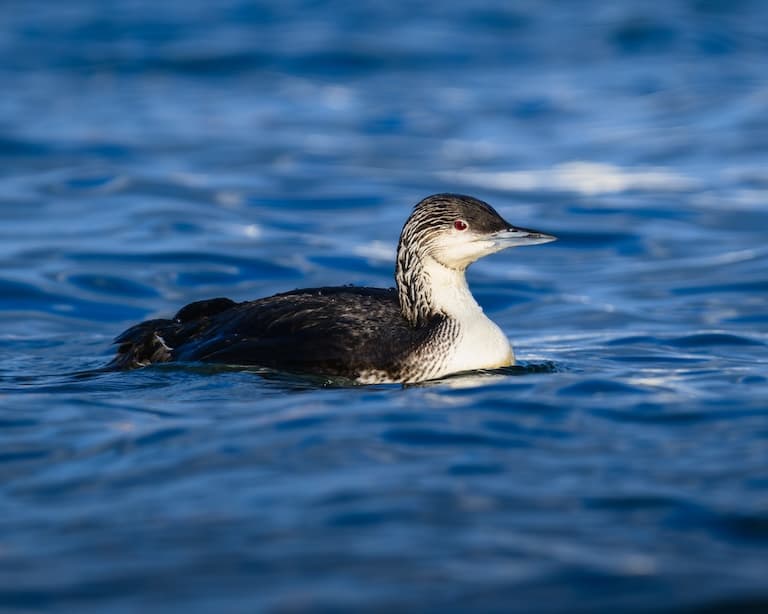
Pacific Loon Facts Overview
| Habitat: | Coastal, also inland waterways and lakes |
| Location: | West Coast of the US in winter, and in Northern Canada and Alaska in spring and summer. |
| Lifespan: | Possibly 10 to 20 years |
| Size: | Up to 75 cm (2.5 feet) long |
| Weight: | Up to 2.5 kg (5.5 lb) |
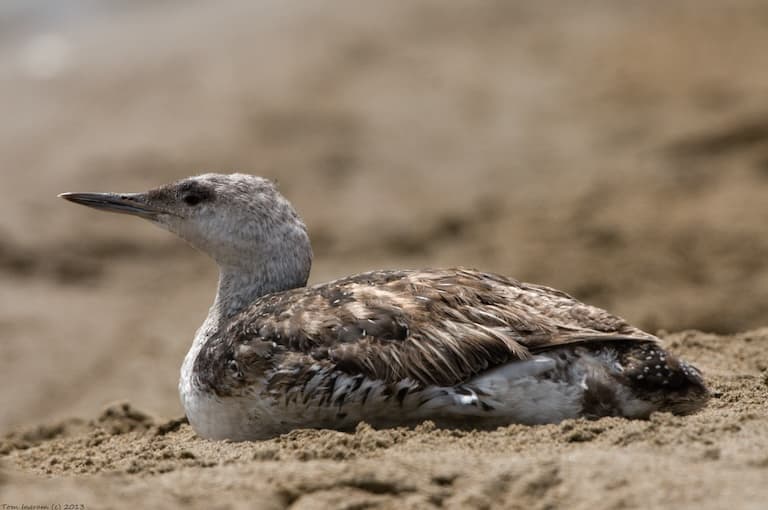
| Colour: | A drab, mottled brown-black in the winter, a stunning grey head and stark black back in the summer. |
| Diet: | Fish, crustaceans, mollusks, aquatic insects, and some plant material |
| Predators: | Fish, raptors, small terrestrial predators |
| Top Speed: | Not reported |
| No. of Species: | 1 |
| Conservation Status: | Least Concern |
Pacific loons really glow up. They begin life as scrawny little freeloaders, go through an awkward fluff phase and then settle into their pretty drab non-breeding phenotypes. But when it comes to mating, they put on some incredible headgear, make excellent noises, and exhibit a reasonable amount of loyalty.
And this strategy appears to be serving them well!
Interesting Pacific Loon Facts
1. They’re Loons!
The Gaviiformes order of birds is an incredibly small order of birds with only one genus left in it. They’re loosely into a clade with the great white pelican, but as we go down the taxonomic rankings, it’s loons all the way down.
The only family in the order is Gaviidae, and the only genus in this family is Gavia. In this genus sit the five loon species, all of which are duck-sized water birds from the Northern Hemisphere. All too are very specialised for paddling, with feet situated right at the back for propulsion.
The other four are the Common, red-throated, yellow-billed and Arctic loons, leaving the Pacific loon who occupies territory around Northern Canada and Siberia.
2. They’re smart
Loons are mostly solitary outside of breeding season, so the fact that they cooperate to hunt is a sign of something fairly special.
Fishermen in Pacific loon territory have reported seeing these birds work together to herd fish, much like dolphins do, and gather them into easy-access bait balls for plucking. The fishermen themselves benefit from this, as it also brings in larger predatory fish which are of value to them.
This became a historical relationship between the two species, as the behaviour of the loons could be exploited to gather a year’s worth of fish in just two months for the fisher communites.1
3. They’re migratory.
When breeding, Pacific loons pick more sheltered, freshwater habitats, but as the temperatures rise and their babies become more independent, loons migrate to the coastal regions, resting only on water as they go.
Their specialised feet make them quite clumsy on land, and in fact they aren’t able to take to the air on foot at all, and can only lift off from water, so these are really quite specialised water birds. There are some suggestions that the name “loon” comes from an Old Norse word meaning lumbering and are perhaps a reference to the birds’ awkward terrestrial gait.
In the water, their rest stops are marine locations full of plankton, which encourages slightly larger animals that the loons can feed on. They hunt by sight and will paddle about happily, making lots of noise.2
4. They’re noisy
Another suggestion for the strange name comes from this bird’s incredible call. They have a long, mournful cry with a prehistoric quality to it that echoes through the forests, even after dark3.
But this isn’t their only song. Loons are really quite chatty in general and have a vast repertoire of noises for different contexts, including croaking, squealing, purring, clucking, cackling, and growling sounds!4
5. They’re adaptable
These are very northerly birds in general, so naturally they avoid humans by their very nature, but as our species’ encroachment continues northward, the loons show sensitivity to it.
They will keep away from people, choosing remoter areas to breed. This adaptability in the face of a shrinking range is serving the species well, as it continues to avoid our disturbances for now.
However, there is ongoing research into the effects of chemical pollutants on loons, which is thought to be a potential problem for the species and one that might be harder to avoid as our waterways become progressively toxified.
6. They’re monogamous (within reason)
Humans are generally not monogamous by nature and, with some exceptions, tend to choose it for convenience or be coerced into it by wider society. They always love a good story of fidelity as it makes them feel like they haven’t wasted their lives with the wrong partner.
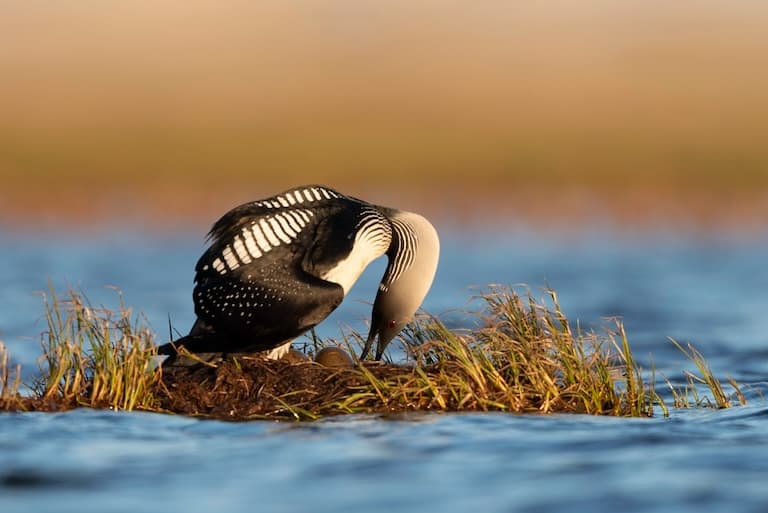
Pacific loons, then, are fit for purpose in this regard. These birds pick a mating partner and stick with them! Well, at least until the mating partner is deemed unfit to produce offspring, in which case the whole arrangement is abandoned.
This might sound cruel, but birds are dinosaurs, after all, and the way of the bird is a harsh and pragmatic one that extends into breeding, too. Once the chicks hatch – usually two at a time – both parents tend to the young, but if resources are slim, they’ll pick a favourite and let the other starve.
Should all chicks survive though, we are treated to one of the most adorable sights in the bird kingdom5.
7. They are water buses
During breeding season, loons develop an incredible head of hair (technically feathers). Both males and females put on their finest breeding plumage and go about the business of getting it on.
There is a general trend in birds – when only one sex has pretty mating plumage, different breeding roles are designated to either of them. Pretty males will usually put a lot of energy into finding a mate and less into looking after the babies.
In contrast, when both males and females develop this stunning garb, it’s safe to assume that both males and females take roughly equal roles in rearing the young, and this is the case with the equally-adorned mating loons.
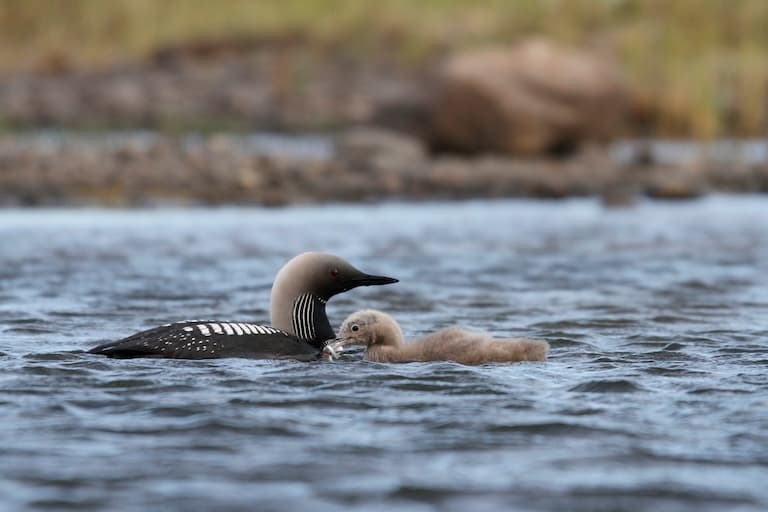
Parents forage for baby food for almost two months until the babies can fly but they can paddle like nobody’s business a lot sooner than that, and for around 5 to 7 weeks, while the babies are still entirely dependent on their parents for food, transport is provided by way of a wide and feathery back.
As they get older, they’ll gradually become better at transporting themselves and regulating their own body temperatures, and by the eighth week they are starting to fish by themselves, too.
8. They’re doing very well.
The human impact is undoubtedly affecting loon populations locally. Agricultural runoff pollutes but also fertilises waterways which causes algal blooms and kills all sorts of aquatic wildlife and the animals that feed on it.
Heavy metal buildup is also occurring around the poles, and Pacific loons are slowly accumulating these in their tissues as well.
As of 2018, though, this species was still considered Least Concern by the IUCN and its population was said to be increasing. So while the future may look bleak for the Pacific loon, for now they appear to be doing well6.
Pacific Loon Fact-File Summary
Scientific Classification
| Kingdom | Animalia |
| Phylum | Chordata |
| Class | Aves |
| Order | Gaviiformes |
| Family | Gaviidae |
| Genus | Gavia |
| Species | pacifica |
Fact Sources & References
- (2008), “Pacific Loon”, Smithsonian’s National Zoo.
- (2008), “Pacific Loon”, Smithsonian’s National Zoo.
- Spencer (2014), “Pacific Loon Sounds”, Cornellab.
- “Pacific Loon”, Auduboun.
- Herbst(Year), “Gavia pacifica”, Animal Diversity Web.
- Gavia (Year), “Pacific Loon”, The IUCN Red List of Threatened Species in 2018.