
Comb Jellies Profile
From sand dollars to sea cucumbers, marine biologists always seem to be setting us up for disappointment with their naming schemes.
The Pacific Sea gooseberry may well burst on the tongue just like a real gooseberry, but the experience just isn’t there yet. Because sea gooseberries are not as fruity as they sound – they’re gelatinous animals called Ctenophores, or comb jellies.
The good news is that this is only a disappointment if you were planning to chew on one. Because these guys are far more exciting that anything a plant could come up with. If you’re looking for aliens, look no further! They’ve been with us for over half a billion years and all we have to do to touch one is visit the beach.

Comb Jellies Facts Overview
| Habitat: | Marine |
| Location: | Worldwide |
| Lifespan: | Moths to years, depending on the species |
| Size: | Up to 1.5 metres (5 ft) |
| Weight: | Up to 20 kg (44 lb) |
| Colour: | Varied, usually translucent and bioluminescent |
| Diet: | Carnivorous; small, planktonic animals |
| Predators: | Most larger animals |
| Top Speed: | Slow/planktonic |
| No. of Species: | 186 recognised, many more undiscovered |
| Conservation Status: | No status |
Comb jellies are genuine ancients of the ocean, having outlasted the dinosaurs more than twice over, and been some of the first animals to try out muscles and nerves as ways to manage a body.
These multicellular pioneers are represent an entire phylum of some of the most widespread animals on Earth and yet they remain poorly understood with only 186 species described.
Many are deep-sea, radially symmetrical, bioluminescent gelatinous beasts, and while they do look very similar to jellyfish, they are not even close!
Interesting Comb Jellies Facts
1. They’re ancient
Ancient is a funny word when dealing with timeframes like this. Ancient Egypt might have been five thousand years ago, but ancient cave paintings in Europe date back 40,000 years or more.
Ancient hominid fossils in Ethiopia date back a whopping two million years, but on the other side of the Continent, Nigeria is home to a forest that’s anciently been sitting around for 60 million years.
The dinosaurs are pretty ancient, showing up around 240 million years ago, and land vertebrates on the whole go back about 360 million years.
The first animals on land were ancient millipedes, wiggling out of the water around 425 million years ago, and the positively ancient horseshoe crab appeared in the fossil record around 445 million years ago.
Plants showed up on land around 470 million years ago, before which there were just bacteria and rocks there, and while the land was this empty, the oceans were teeming with strange and ancient life, most of which looked nothing like what we’ve got now.
Mammals didn’t exist, birds were a pipe dream, insects were inconceivable. Fish – well, fish existed, but they were weird.
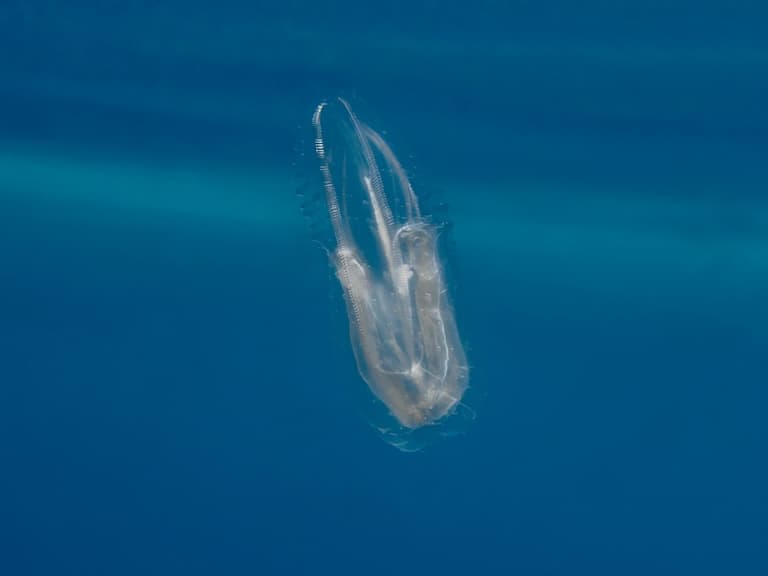
An incredible 515 million years ago the earliest recognisable comb jellies appeared. And we still have them fluttering around today.
2. They’ve come a long way
Ancestral comb jellies show up around the Cambrian, before which, the world was very much like the one Trump wants to bring us back to: there were inhospitable levels of greenhouse gases, oceans with no oxygen, and all life on land was limited to microbial extremophiles. Taiwan didn’t exist.
But there were some key differences. For one thing, life was diversifying rapidly. This was the period during which it made the dramatic shift from mostly unicellular to the collaborative and functional multicellular life. It’s when things like shells, tentacles, muscles, nervous systems and skeletons, show up – all of which are still in use today.
So, Ctenophores were some of the first to ever do it and this early success in new niches set their descendants up for generations to come.
Comb jellies are thought to have diverged from the ancestors of all bilaterians – these would be all the animals with lefts and rights, and some even think they are a sister group to all other animal life, including all the round ones like jellyfish and urchins.
They may not look like they’ve changed much, but molecular studies show that this line’s mitochondria evolve at an incredible rate, and this has contributed to an exceptional diversity in the phylum. 1
3. They get quite big
Comb jellies make up only around 150 known species, though there are likely more to be found, but within this relatively small sample, we find a decent amount of diversity.
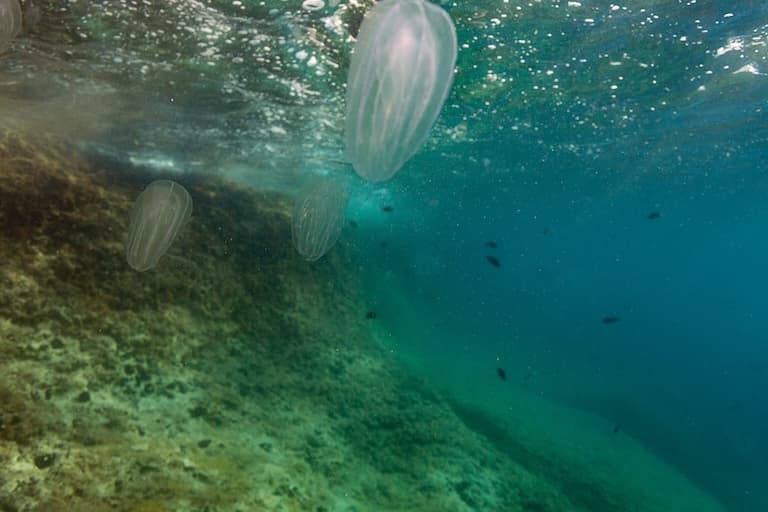
Most are less than the palm of a hand in size and egg-shaped, but some get a lot bigger. The Venus’ girdle, named after a very enviable piece of fabric, is an elongated and striking jelly worm of up to 1.5 metres long.
Unlike most, this one undulates its entire body for locomotion, moving elegantly under its own steam. 2

4. They’re not jellyfish
The long evolutionary line is one that took comb jellies from a common ancestor of the jellyfish more than half a billion years ago.
This is about as long as it was that the evolutionary line of humans and comb jellies diverged, which makes their similarities to jellyfish entirely a product of the environment and not their relationship.
But comb jellies only look like jellyfish at first glance. When studied through the eye of an evolutionary biologist, they are quite distinct. And one of the key clues to their dissimilarity comes from their means of propulsion. 3
5. They have cilia
Having cilia isn’t unusual, you have them, dogs have them, Paramecia are covered in them. They’re usually little cellular hairs that are great for moving things across a surface.
For example, cilia in your lungs push all that delicious mucous into your mouth to keep their surface clean and available for air, carrying away any contaminants that might otherwise build up.
But it’s rare for cilia to move an entire animal around, unless it’s very, very, small. Comb jellies are the largest animals to push themselves along with cilia, and do so with spectacular results. 4
6. They glow
Many comb jellies live in the darker realms of the ocean, where light from the surface doesn’t reach. So, they make their own.
At least two species have been found to produce light, a different skill than the refractive effect of their cilia, which creates strobing rainbow visuals down the combs of the animal as it swims.
So, comb jellies are dazzling to look at, both in the dark and in the light, but they take it a step further and put on this show independently of other organisms.

7. They glow it alone
If you were to swallow a light bulb and then walk around in the dark with a glowing neck, you’d rightfully be ostracised.
But this is how it’s done for the majority of glow-in-the-dark animals, whose light comes not from their own body but from bacteria they’ve consumed or housed within them.
But unlike most, glowing comb jellies have been found to make these luminous compounds themselves, independently of their diets, which, offers researchers a fascinating avenue to pursue, in studying which genes are responsible for this and whether, perhaps, we can one day turn them on in ourselves and never have to swallow light bulbs again.
8. They can be formidable
Comb jellies might not seem very intimidating, but drifting around eating everything can be a remarkably successful strategy, and when a North American species was introduced into the Black Sea by accident, it exploded in number, gobbling up all the planktonic food of the native animals and within a decade, it had destroyed the fishing local industry.
Thankfully, another chance introduction saw another comb jelly species plopped into the fray, and this one was a voracious predator of the first, which led to some level of restoration as the invasive jelly numbers were dramatically reduced.
So far, the ecological effects of this second species have not been fully estimated, but as any Simpsons fan can tell you, stacking in more invasive species will surely solve the problem, should it arise.
Comb Jellies Fact-File Summary
Scientific Classification
| Kingdom: | Animalia |
| Phylum: | Ctenophora |
| Class: | Tentaculata, Nuda, Scleroctenophora |
Fact Sources & References
- Leonid L Moroz (2015), “The Ctenophore Genome and the Evolutionary Origins of Neural Systems”, PubMed Central.
- “Comb jellies”, ZooPlankton.
- Jeremy Wright “Ctenophora comb jellies”, Animal Diversity Web.
- “Jellyfish and comb jellies”, Smithsonian National Museum of History.