
Palm Cockatoo Profile
There are very few animals as ugly as a baby parrot, so given that parrots grow to become such spectacular specimens is alone a remarkable feat of avian engineering.
And as members of a fast-growing group who are very fond of a large black cockatoo, we find today’s subject really quite hard to make fun of. The Palm Cockatoo is a big and boisterous bird, sharp as a tack and with stunning plumage. It’s also the only one of its kind!
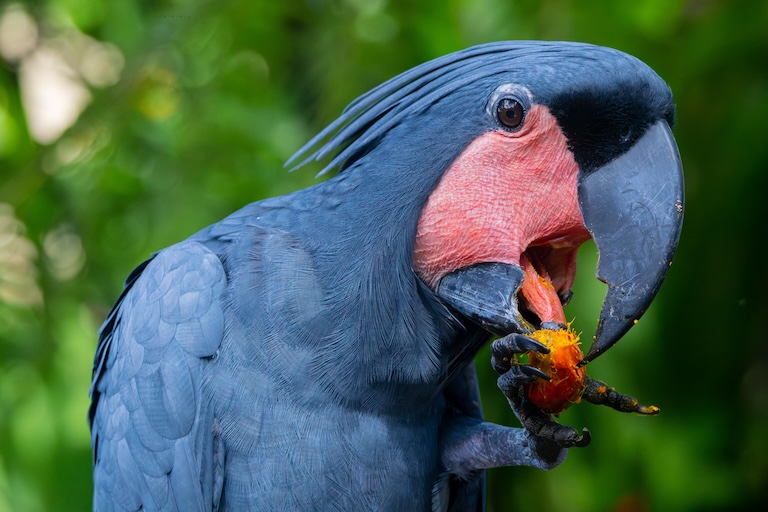
Palm Cockatoo Facts Overview
| Habitat: | Lowland forest, some savanna |
| Location: | New Guinea and Australia |
| Lifespan: | 56-60 in the wild, possibly up to 100 in captivity. |
| Size: | 55 to 60 cm (22 to 24 in) long |
| Weight: | Up to 1.1 kg (2.4 lb) |
| Colour: | Black with red cheeks |
| Diet: | Leaf buds, seeds, and fruits, some insects |
| Predators: | Few – possums steal eggs, some snakes, perhaps raptors may kill adults |
| Top Speed: | Not listed |
| No. of Species: | 1 |
| Conservation Status: | Near Threatened |
Palm cockatoos are striking animals, both in their colour and size. The genus name refers to their very black plumage, and the sharpness of their powerful beaks is matched by a mind that we are still wrestling to understand. Like most parrots, these are loud, intelligent and crucial members of their ecosystems, but unlike most parrots, they are the only members of their genus.
Interesting Palm Cockatoo Facts
1. They’re the only ones left
The cockatoo family, Cacatuidae, is an iconic group of birds in the parrot order, Psittaciformes. There are around 22 species in this family, mostly known for their wonderful crests and ability to scream profanities when excited.
Cockatoos are native to Australasia, and are the continent’s ecological equivalent to the Macaws in South America. They’re one of the earliest off-shoots of the parrot order, branching off some time after the New Zealand parrots, who are widely considered to be the earliest branch of parrots around.
In fact, the palm cockatoo is sometimes referred to as the “black macaw”, despite being from a different family altogether. It is perhaps the largest parrot found in Australia, at up to 60 cm long and over a kilo in weight, and is the only member of its genus still around. 1
2. They can change colour
Cockatoos are not shy in communicating their moods, and the Palm cockatoo does so in more ways than one. A quirk of this species is its ability to flush its red cheeks, which can change colour depending on how it’s feeling.
This can be a fun way to tell when they’re excited, but also a useful tool in assessing how healthy the bird is feeling, as a pale set of cheeks could also indicate stress or sickness. As cockatoos, their impressive erectile crest does nothing to slow the barrage of available puns but is, in addition, another tool the bird uses as body language.
3. They’re loud!
Cockatoos make noise, this is one thing they’re very well known for. Parrots are some of the most vocal birds in existence, and many, like the African greys, go as far as to have recognisable words and syntax.
It’s hard to know for sure how complex a cockatoo’s vocal communication is, since we aren’t quite as smart as we think we are, but it’s undeniable that whatever they’re saying, they’re saying it with gusto.
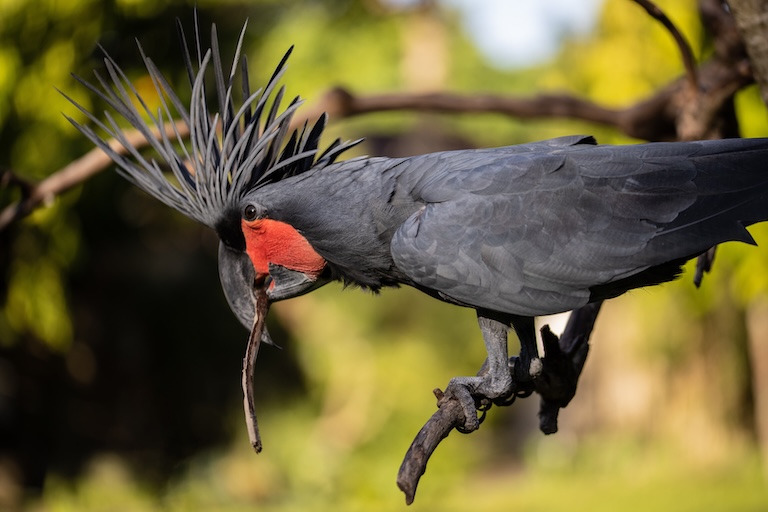
The palm cockatoo is one of the loudest parrot species, an accolade much like being one of the heaviest Americans. They have a range of calls, mostly whistles and screeches with varying tone, volume and complexity. They also like to stamp their feet, and will even bang on things with sticks.
In the wild, they do this to declare their presence in their territories. In captivity, they’re probably lonely and/or bored.
4. They’re independent yet social
In the wild, palm cockatoos are often quite content by themselves for various lengths of time, but they’re commonly found in pairs or larger groups too. They spend most of the daylight hours foraging with friends, and flitting between feeding and sleeping sites.
Early mornings are typically social gatherings, and when the largest groups will be found preening one another and warming up their social muscles.
They’ll also take showers together when it rains, hanging upside down on a branch with their wings out, chattering away. 2
5. They’re smart
All of this socialising is associated with a brain capable of handling a lot of information. This species in particular is known to produce long, complex sequences of calls, which ties into what we mentioned earlier about language and whether they’re speaking.
Regardless, this is some serious complexity in communication, and so it’s no surprise that the palm cockatoo is a very intelligent animal.
The use of tools tracks with this as well, and even their drumming patterns seem to have distinctive purpose. Individuals will fashion their own percussive tools based seemingly on personal preference, and all clues point to this being a very witty bird, even by parrot standards.
Unfortunately, this makes it a species vulnerable to boredom and neglect in captivity. 3
6. So they can suffer in captivity
Palm cockatoos don’t breed easily in captivity. This may or may not be a product of their intelligence and the subsequent stress they experience when not able to live their best lives in the wild, but they certainly do suffer stress in captivity.
This species is prone to compulsive, repetitive behaviours, known to zoologists as “stereotypies”. In these birds, these manifest as feather plucking, furniture damage, or other destructive behaviours, and are clear signs that the individual’s needs aren’t being met.
Captivity isn’t a step down for all species – some animals do fare much better away from the terrors and unrelenting brutality of the wild – but so far it does seem that the palm cockatoo isn’t one of these. 4
7. They’re seed dispersers
In the wild, these birds shine. They are fruit and seed-eaters, and dominate that niche in the forest canopies. As such, they are responsible for the fertilisation and distribution of many seed plants, which they spread about with abandon, sewing the next generation of flora into the forest from the distribution hole at their back ends.
So, for every bit as grand and charismatic as these birds are, they are equally critical to the ecosystems they evolved to serve. 5
Palm Cockatoo Fact-File Summary
Scientific Classification
| Kingdom | Animalia |
| Phylum | Chordata |
| Class | Aves |
| Order | Psittaciformes |
| Family | Cacatuidae |
| Genus | Probosciger |
| Species | aterrimus |
Fact Sources & References
- Brown et al (1999), “Molecular Systematics and Biogeography of the Cockatoos (Psittaciformes: Cacatuidae)”, Ornithology.
- Justine Zingsheim (2006), “Probosciger aterrimus ”, Animal Diversity Web.
- Zdenek et al (2015), “Vocal complexity in the palm cockatoo (Probosciger aterrimus)”, ResearchGate.
- Garner et al , “Stereotypies in caged parrots, schizophrenia and autism: evidence for a common mechanism ”, National Library of Medicine.
- Justine Zingsheim (2006), “Probosciger aterrimus ”, Animal Diversity Web .