
Papuan Python Profile
Most snake enthusiasts know Titanoboa, the heaviest snake ever discovered. This biblical beast lived in South America around 60 million years ago, not long after the dinosaurs disappeared, and belonged to the boid lineage that still dominates its swamps today.
In the East, the primitive Madtsoiidae reigned supreme. Among them was Vasuki indicus, a contender for the longest snake ever known. The madtsoiids grew to similar lengths as the Titanoboa, but carried less mass. And they eventually vanished, with their final refuge being around modern day New Guinea. And in their place: the pythons, generally more slender than boids but every bit as formidable.
True to form, the Papuan python is a long, slender and powerful predator that has little to fear in New Guinea.
Papuan Python Facts Overview
| Habitat: | Terrestrial: lowland monsoon, rainforest, and savanna woodlands. |
| Location: | New Guinea, Indonesia |
| Lifespan: | Unknown, likely 30 years or more |
| Size: | Up to 5 meters (16 ft) |
| Weight: | Average around 22.5 kilograms (50 lb) when fully grown |
| Colour: | Usually olive green or brown, but varies from black to yellow and can change colour |
| Diet: | Mammals, birds, and reptiles |
| Predators: | Young snakes are prey for birds, crocodiles and monitor lizards |
| Top Speed: | Slow |
| No. of Species: | 1 |
| Conservation Status: | Least Concern |
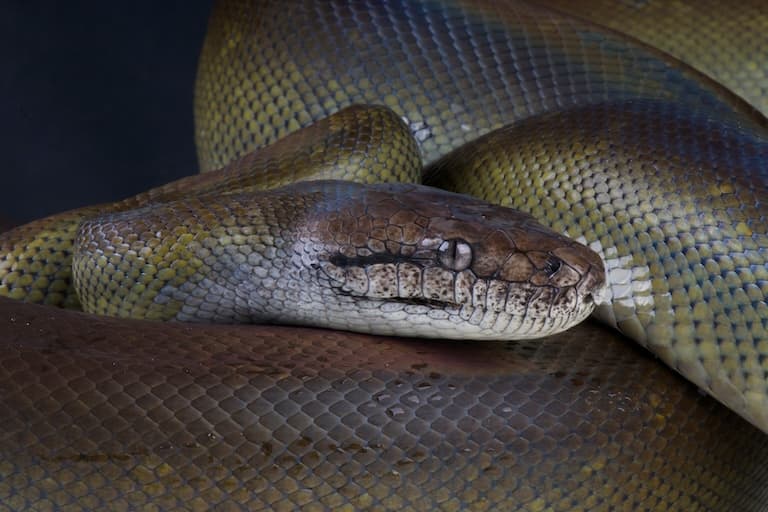
Papuan pythons, sometimes called Papuan olive pythons, are some of the largest snakes in the world. They’re a striking (get it?) olive green by default, but change colour as they age, and perhaps even at will. They are the only members of their genus, poorly documented, and unique in a number of ways, and as far as we can tell, they seem to be doing just fine, ambushing food at the top of the food chain in New Guinea.
Interesting Papuan Python Facts
1. Apodora
The evolutionary roots of this genus are vague. For tens of millions of years, snakes have tended towards having fine, bendy bones and living in forest habitats – both factors that reduce the chances of leaving behind a useful fossil to almost zero.
Still, it’s thought that the primitive Madtsoiidae of the Oceania realm was not adaptable enough to sustain itself in the chaotic geological formation of its modern arrangement, while pythons were much more capable.
Today, the Papuan python is the only known member of its genus, Apodora, which suggests a fascinating evolutionary history that somehow allowed it to slip through the cracks. And perhaps it did so by way of its special skin1.
2. Terrestrial and nocturnal
Unlike many of the best-known pythons, this one spends far less time in the trees. It is a ground-dwelling ambush predator and hunter, though with its prehensile tail it is also more than capable of climbing too.
What sets it apart is the strange loose skin it has, which seems to tear and break away with ease. This is perhaps an adaptation to traversing the rough and difficult terrain of the scrub floor. Here, they hunt at night, are capable of squeezing into and through tight spaces, and taking down animals as large as forest wallabies.
3. They’re enormous
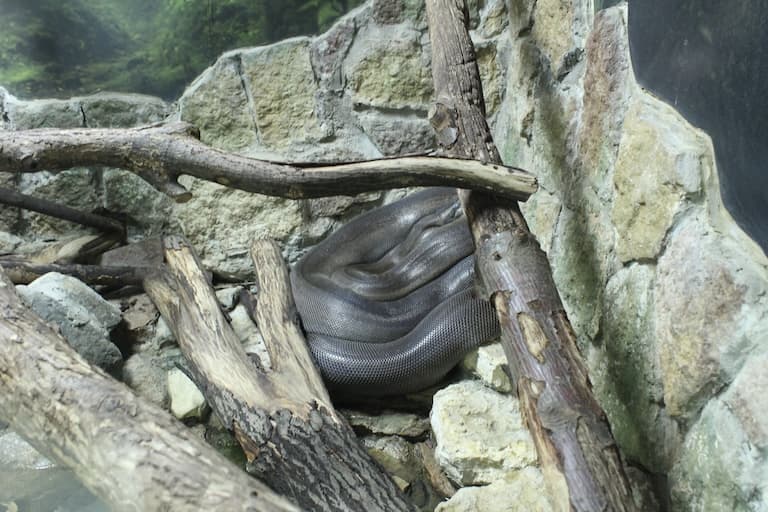
A Papuan python at full mature size is a very large snake. These animals commonly grow to around four metres in length, and are said to even reach five metres or more at the top end.
Despite this length, they’re quite slender animals, and usually weigh no more than 25 kilos, which is still more than enough to pack a wallop, but not as chunky as other members of its family of similar lengths2.
Inside its mouth, should you ever be unlucky enough to see it coming, is black with pigment, just like in the mambas. But in terms of colour, pretty much everything else is less certain3.
4. They can change colour
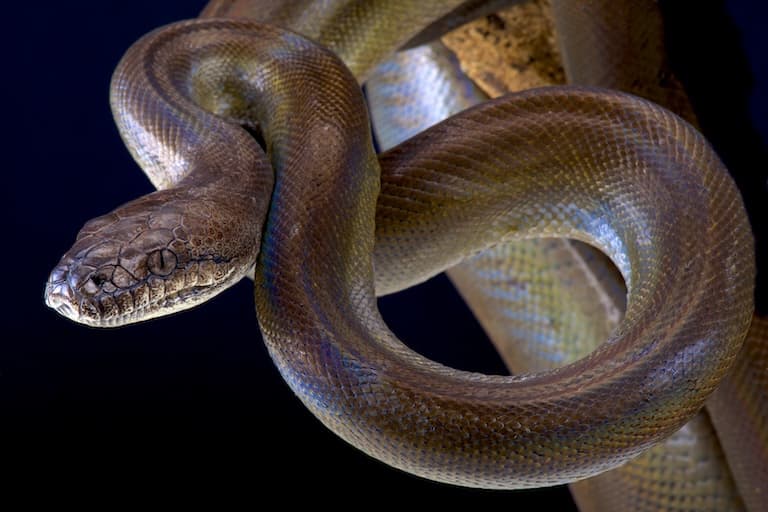
The Papuan python is sometimes known as the Papuan olive python for its olive-green colouration. This is the base reference colour for the species and naturally darkens as the individual ages, but being snakes, and being pythons in particular, they are prone to quirks of colour variability.
In the wild, the Papuan python can be found ranging from almost black to a sort of mustard yellow, and the colour of this species is also said to be non-static, and can change in response to certain stresses or temperatures.
This fact, however, is very hard to certify! There appears to be no video of a Papuan python doing this, and a properly sourced claim is also conspicuously absent. However, it’s not beyond the pale for snakes in general, and a few snakes from other families have been documented exhibiting this cool colour morphing adaptation. Within pythons, the only verified colour change is all down to what’s known as ontogenetic change, which is the fancy name for a colour changing over time as the snake ages4.
5. They’re docile
By all accounts, this species is said to be very chilled out. It’s a slow-moving ambush predator, considered terrestrial or semi-arboreal, and patrols calmly through the brush in search of food or holdout locations.
When handled, even wild individuals are hesitant to bite, and are said to calm down quickly if treated with care. They’re also said to have a lot of personality and are naturally curious and active animals.
This is, of course, a non-venomous snake, but being one of the largest snakes around, it’s more than capable of causing harm with a bite from the rows of backward-facing razor spines it uses for teeth. Furthermore, it’s said to be a powerful and violent feeder, packing a serious punch when hungry, but only aimed at smaller prey items, and not typically at handlers.
But, being one of the largest snakes around, it has little to fear from anything else.
6. They’re top predators
In New Guinea, there doesn’t appear to be a snake larger than the Papuan python. There don’t seem to be very many other predators at all that come close, either. So, this five-metre snake is more or less at the top of the food chain.
That’s not to say it’s devoid of enemies: monitor lizards, birds, crocodiles, and small mammals will happily munch on a juvenile python, with little to fear in return from this non-venomous snake.
But if they survive this gauntlet, they can relax, safe in the knowledge that the only threat to their dominance is some herpetologist nerd on the other side of their planet who might nab them for their collection!
7. They’re doing fine for now
So far, it seems as though captive breeding in this species is non-existent. The handful of very expensive individuals you can see for sale online appear to be all wild-caught, which does not bode well for any species in the long run.
Thankfully, this doesn’t appear to have caused any issues just yet, according to the IUCN Red List, which has them placed in the Least Concern category with a stable population. Having said this, the assessment is woefully out of date now, published in 2014, so whether it still holds true remains to be seen5.
Papuan Python Fact-File Summary
Scientific Classification
| Kingdom | Animalia |
| Phylum | Chordata |
| Class | Reptilia |
| Order | Squamata |
| Family | Pythonidae |
| Genus | Apodora |
| Species | papuana |
Fact Sources & References
- Damien et al (2022), “Evolutionary models demonstrate rapid and adaptive diversification of Australo-Papuan pythons”, The Royal society publishing.
- Peters & Doria (1878), “Apodora papuana”, The Reptile Database.
- Paul Sørensen, “Apodora Papuana”, DkPythons.
- John Pickrell (2006), “Chameleon’ snake can turn white in minutes”, NewScientist.
- Tallowin et al (2014), “Papuan Olive Python”, The IUCN Red List of Threatened Species 2018.