
Palo Verde Beetle Profile
The internet is rapidly descending into a CGI hellscape of outrage and hate, but there are some bastions of the old times and one of the best is the plethora of videos showing baby raptors reacting in terror to things that pose them no danger whatsoever. How cute! We think, as we wallow in our ignorance, secure in the understanding that we higher beings are beyond such animal behaviour.
But after the monsoon in Arizona, higher beings than us watch and laugh, as our species gets the ick from the Palo Verde beetle: one of the most harmless animals in the kingdom that still manages to trigger our lizard brains.
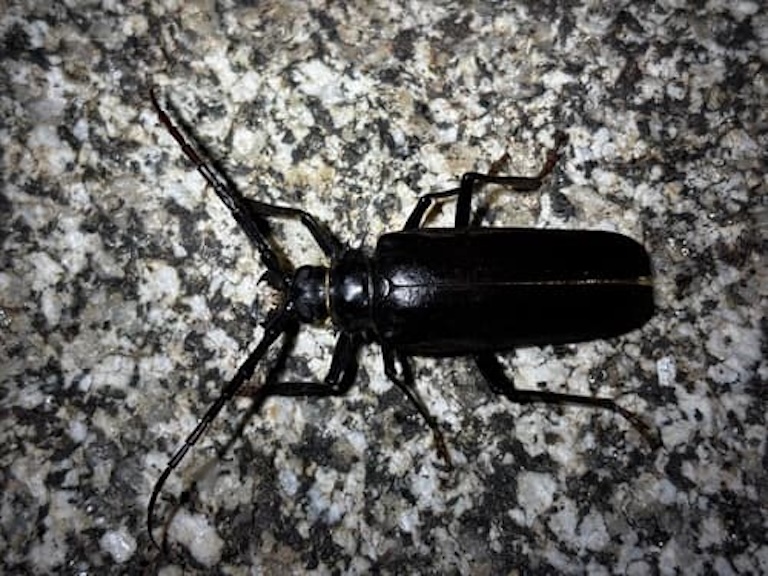
Palo Verde Beetle Facts Overview
| Habitat: | Arid |
| Location: | Arizona and surrounding US states |
| Lifespan: | 4+ years |
| Size: | Up to 9 cm (3.5 inches) long |
| Weight: | Unlisted |
| Colour: | Black or brown as adults, larvae are cream to pale green |
| Diet: | Wood |
| Predators: | Birds, reptiles, bats, coyotes |
| Top Speed: | Slow to move, but can fly in a lumbering manner |
| No. of Species: | 1 |
| Conservation Status: | Not Listed |
It’s easy to understand why people unfamiliar with the real world would find this animal intimidating: This flying, screaming, spined monstrosity comes with a portfolio of red flags, but as far as insects go, these are some of the most benign. The Palo Verde beetle comes out for only a few months to breed, after spending years as a grub, out of sight, feeding on the Palo Verde plant.
Despite their scary noises and loud flight, these enormous longhorns pose no threat to anyone and are really quite cool!
Interesting Palo Verde Beetle Facts
1. They’re Longhorns
For insect lovers, the family Cerambycidae has so much to offer. They’re beetles, which makes them cool already, but this particular group of beetles, commonly known as longhorn beetles, contains some of the largest insects on the planet.
Even excluding the horns, which are actually very long antennae, these beetles are exceptionally large. The largest of their kind is the sabretooth longhorn, which has tremendous mandibles to boot, bringing its un-horned length to over 17 centimetres!
Longhorns can live for decades, chew through and ungodly amount of wood, and can scream.
2. The Largest beetle in North America
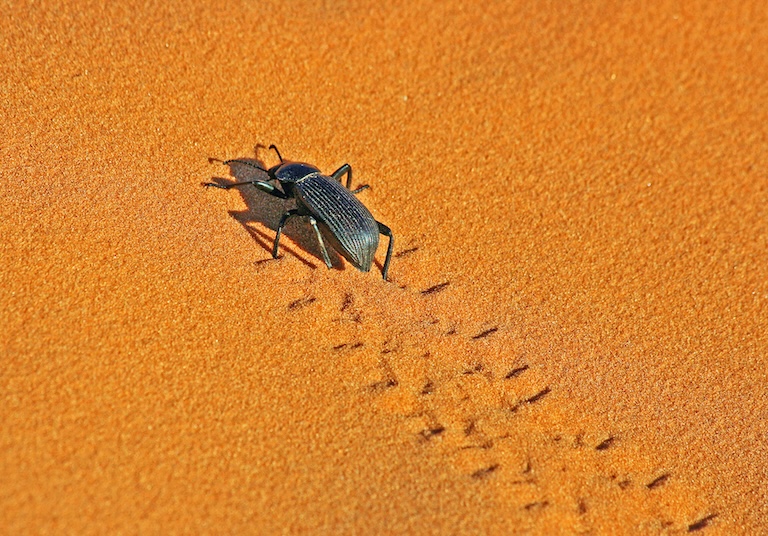
Beetles are one thing the USA doesn’t have the largest of. South America is where both the Titan and Hercules beetles live, and they are true giants of the beetle world. Even among longhorns, South America rules, as this is where the sabretooth longhorn is found as well. But the Palo Verde beetle is no slouch, either.
It grows to an impressive 9 cm in length, which makes it one of, if not the largest beetle in North America, depending on whether you count the occasional vagrant titanic beetle from Mexico.
This size is a quite unusual in North America, so it’s quite understandable that the frighten people.
3. They can fly
An adult Palo Verde beetle is large enough to give a painful bite, but is unlikely to break the skin, let alone draw blood, and it is by no means an aggressive animal, so you’d really have to be doing something to upset it in the first place.
They are easy to pick up and handle, and while their flight is loud and intimidating, it’s also clumsy, due to their weight, and used more to get away from trouble than to fly towards it.
One thing they will do far more readily than bite you, is shout at you.
4. They squeak
Like almost all longhorns, this one has the ability to use sound as a defence. Lacking vocal cords and a diaphragm to push air through the mouth in the first place, they instead use ridged plates on their exoskeleton to create sound. In longhorns this is done by rubbing the thorax against the head plate and creates quite a high-pitched and loud sound that can surprise you quite effectively if you don’t know it’s coming.
This is a process called stridulation and it’s very common in insects. Grasshoppers are perhaps the best known for this, and cicadas and mole crickets are the loudest. Each example uses a different part of the body, but the principle is the same: hardened, specialised sections rub against one another to create a useful sound. In the Palo Verde beetle, this use is to scare the bejeebus out of anyone picking it up who wasn’t aware they could do this.
Unfortunately, once people realise that they make a sound, they bring out their phone cameras and make clips of themselves scaring the bejeebus out of the beetle to illicit its quirky defences. This is the insect equivalent of poking a dog to make it bark, and as far as we know, is likely an act of unnecessary cruelty!
But while the giant, squeaking behemoth is the final form of this animal and what it’s best recognised as, like all beetles, the majority of its life is spent very differently.
5. They spend most of their lives underground
This animal lives anywhere from 2 to 4 years, and perhaps even longer. But it doesn’t spend much time as an adult beetle, and instead, most of its existence is spent as a subterranean grub, gnawing on roots beneath the soil.
Thankfully for fans of the Palo Verde plant, its preference appears to be for dead and decaying root matter, and it’s said that this boring beetle does little harm to mature and healthy plants.
The larvae themselves can be pretty huge, too. Well over 7 cm in length and a strange combination of creepy and gorgeous with a bulging, lemony skin.
They will pupate in their earthen sanctuary, emerging only to mate as the spined, jawed, shouting beetles that make people so nervous. 1
6. They don’t live long as adults
The adult beetles are almost entirely around to pass on their genetic code towards the end of their life cycles, so they hardly bother to eat. They will take sugary sources like fruit, and their scary appendages are primarily there for self-defence.
Being such a large beetle, their jaws are big enough to bite a person but they will only bite those who deserve it, and even then, a sharp pinch is about the worst you can expect.
This animal is non-toxic (though for legal reasons we can’t advise you to eat one), non-venomous, docile and actually a pretty chill person once you get to know it. Also, if you see one, it’ll likely be dead within a month, so cut it some slack. 2
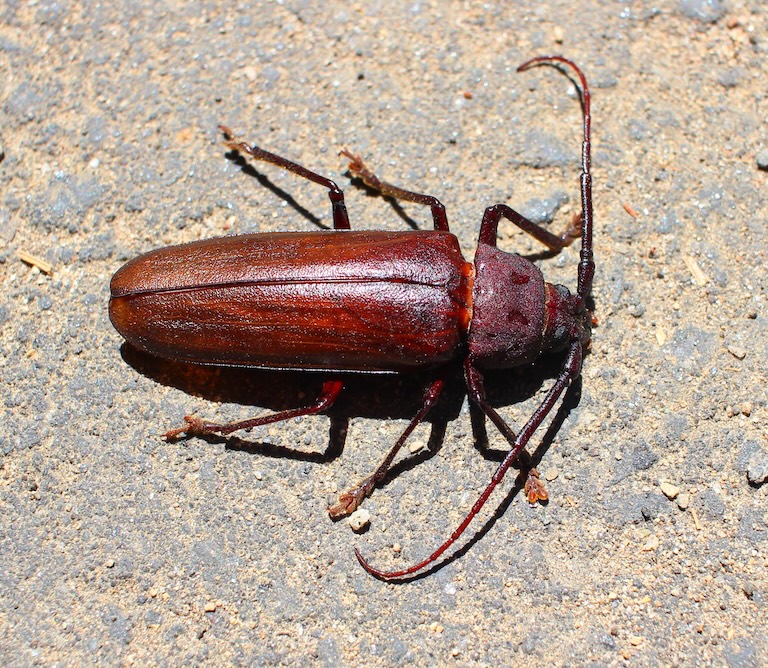
Palo Verde Beetle Fact-File Summary
Scientific Classification
| Kingdom | Animalia |
| Phylum | Arthropoda |
| Class | Insecta |
| Order | Coleoptera |
| Family | Cerambycidae |
| Genus | Derobrachus |
| Species | hovorei |
Fact Sources & References
- (2011), “Palo Verde Beetles”, The Dragonfly Woman.
- “Animal Fact Sheet: Palo Verde Root Borer Beetle grub ”, Arizona-Sonora Desert Museum.