
Papuan Frogmouth Profile
There’s an unfortunate slur going around for a group of photogenic birds whose adorable mating pairs can be seen cuddling up on branches, looking cute. The adjective, ‘Instagr*mmable’, should not be repeated in polite company, but there is no question that these birds are adorable. Part of the reason for this is their wide mouths.
There are quite a few to choose from, but today’s wide-mouthed starlet is a large one from the New Guinea region. Not to be confused with the Clacton frogmouth – an unrelated architect of British decline – the Papuan Frogmouth is a far more elegant and charismatic creature from the other side of the planet.
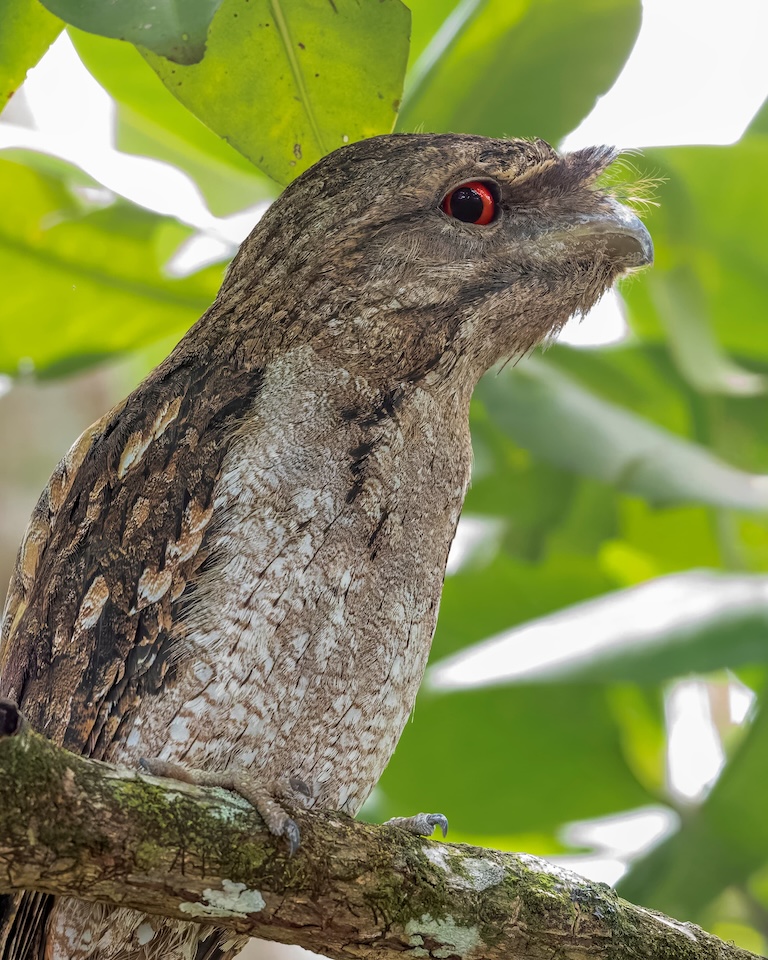
Papuan Frogmouth Facts Overview
| Habitat: | Tropical savanna, forest and shrubland |
| Location: | Mostly Papua New Guinea; the Cape York Peninsula, Australia; and Aru Islands, Indonesia. |
| Lifespan: | Up to |
| Size: | Up to 60 cm (24 in) long |
| Weight: | Up to 570 g (20 oz) |
| Colour: | Mottled browns and greys |
| Diet: | Large insects |
| Predators: | Snakes, raptors, cats and foxes |
| Top Speed: | Slow and lumbering |
| No. of Species: | 1 |
| Conservation Status: | Least Concern |
The Papuan frogmouth is one of only three in its genus, and on average, the largest of all frogmouths. Despite its size, this master of camouflage is incredibly hard to spot and prefers to come out only in the cover of darkness, where it uses its red eyes as camouflage and its stinky mouth as a potential lure to bring in insects. This is one of the most charismatic birds to both see and hear, yet while it’s become somewhat of a viral sensation on social media, the scientific research into it has a long way to catch up.
Interesting Papuan Frogmouth Facts
1. The largest mouth
Frogmouth company is perhaps the most misfitted bunch of birds in any single bird clade.
Frogmouths look and behave a lot like the nocturnal nightjars, whose big eyes, mottled colouration and ability to crouch flat against a branch are all shared characteristics between the two groups.
It’s no surprise, then, that frogmouths were once grouped with the nightjars, but in 2019, this relationship was shown to be as distant as that between whales and their terrestrial relatives, at 50 million years apart.
Instead, frogmouths are thought to form a clade alongside swifts and hummingbirds, two groups that are about as different from one another as they are from frogmouths. A good name for this clade would be Batrachostoma, literally meaning “frog mouth” – and that’s the name of one of the genera in this family – but taxonomic rules dictate the earliest accurate name should be that the one used, and so the order for the frogmouths became the Podargiformes – a name that was picked in 1918.
Since the reclassification, the Papuan frogmouth has become the largest, on average, of its kind. Only the tawny frogmouth, who is smaller on average, can surpass it in size.
2. They have red eyes
Frogmouths are nocturnal birds, which are quite rare since the advent of bats, as the latter has come to dominate most of the nocturnal niches. There are somewhere around 20,000 species of bird and only about 4% of them take the night shift.
Unlike bats with their sonar systems, birds have to use eyesight, even at night, so they come up with fantastic optical adaptations like the conical eyeballs found in owls (that take up so much of their skulls there’s almost no room for a brain), and – as we see in frogmouths – deep, red eyes.
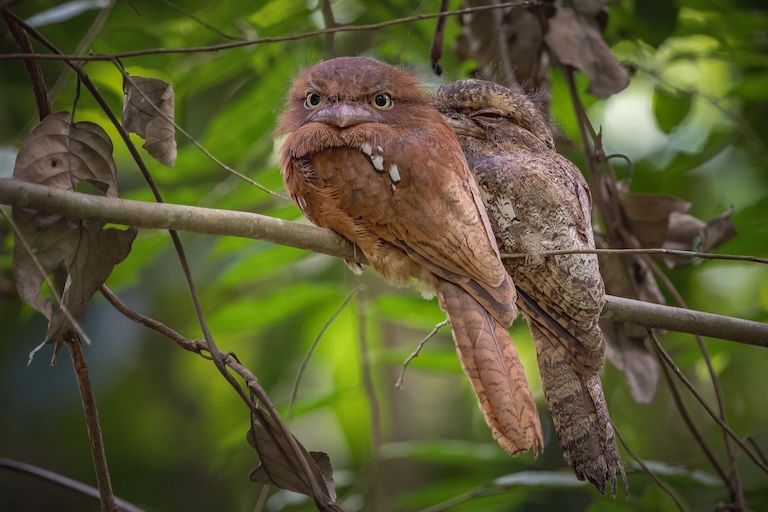
The purpose of these red irises isn’t clear. It doesn’t appear to help with vision, but there are some ways the redness of the eyes could be an advantage. The most obvious way would be camouflage. While the frogmouth can keep its eyes closed all day, when the dark closes in, red light fades fastest, so having red eyes aids in the bird’s camouflage in the twilight.
Another way red eyes could be useful is in signalling to other members of its species that it’s ready for some lovin’. Red eyes could indicate to potential mates how healthy and desirable they are, and play a role in mate selection. 1
3. They have yellow mouths
This is another weird and wonderful feature of the Paupuan frogmouth! While this bird is drab and leafy-looking on the outside, when it opens its mouth you are met with a vibrant yellow beneath those deep red eyes.
This is said to be some sort of lure, and perhaps resembles a flower in the low light of the crepuscular forests. Insects are drawn towards this beacon at dusk and meet their demise in the wide, froglike beak.
But colour only works as a lure when there’s enough light to see it, and the frogmouth is exclusively nocturnal, so once the sun has fully set, it relies on its breath instead.
4. They have bad breath
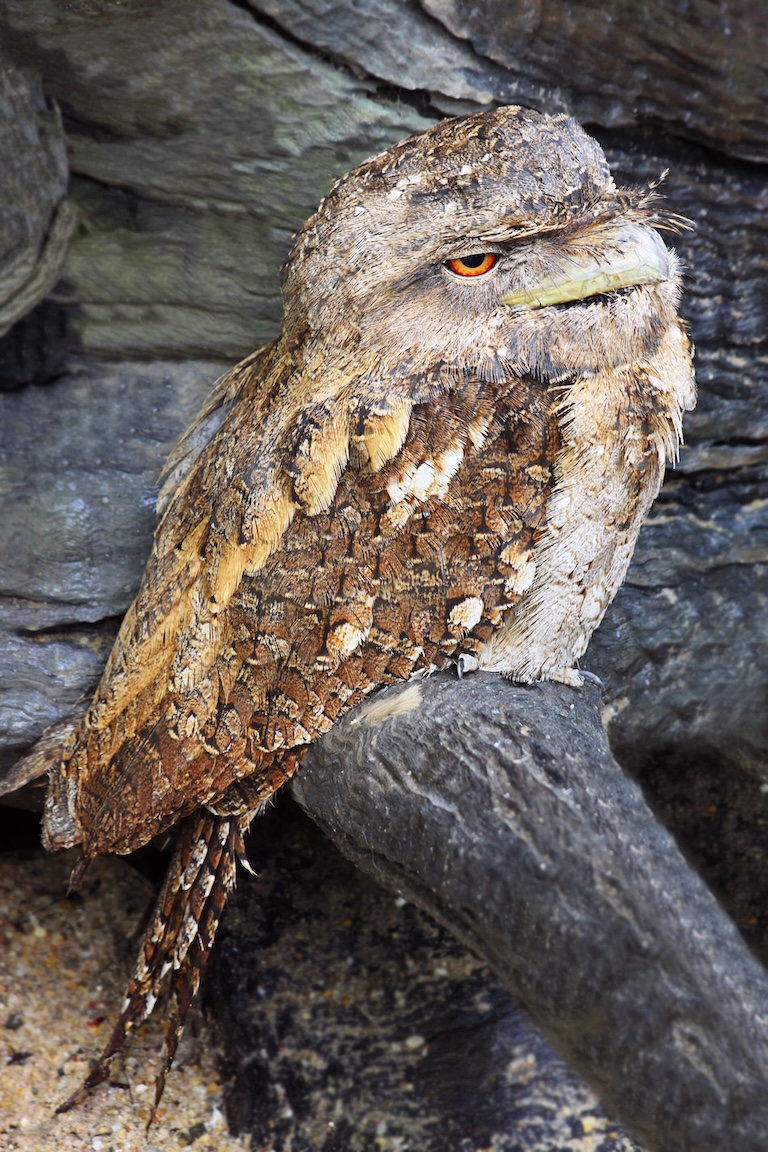
The inside of the Papuan frogmouth’s beak isn’t just yellow, it smells funny, too! At least, that’s what’s been said about it in certain books – it’s hard to find a primary source for this claim, but it would explain why the bird sits so comfortably with its mouth wide open, waiting for its food to come to it!
Otherwise, the Papuan frogmouth is said to hunt on the ground, plucking large insects, and even small mice and lizards from the terrain. 2
5. They have exceptional voices
Rainforests are well known for all the animals they have in them, but some are more distinctly rainforesty than others. The Papuan frogmouth is one such animal, and makes the sort of vocalisation you’d probably think of if someone asked you to think of nocturnal rainforest sounds.
The most common call of these birds is a sort of deep, pulsing, oooph, but they will also drum and even clap their beaks, which draws more similarities with the notorious (and totally unrelated) shoebill stork.
A forest full of Papuan frogmouths will sound about as rainforesty as it gets!
6. They’re not well known
The Papuan frogmouth is one of only three in its genus, Podargus, and this group as a whole has very little primary literature on it. This is despite frogmouths being so social media-savvy and popping up all over the ‘gram.
Population sizes for the Papuan frogmouth are unclear, as are its conservation needs, but as of yet they are thought to be stable, based on the absence of evidence of any declines. This is a tentative assessment by the IUCN, who lists them as of Least Concern, but with any luck, that assessment will be reinforced by deeper research when the TikTokers look up from their phones long enough to get research grants! 3
Papuan Frogmouth Fact-File Summary
Scientific Classification
| Kingdom | Animalia |
| Phylum | Chordata |
| Class | Aves |
| Order | Podargiformes |
| Family | Podargidae |
| Genus | Podargus |
| Species | papuensis |
Fact Sources & References
- Eamon Corbett (2023), “Why do birds have different eye colours?”, BOU.
- “Papuan Frogmouth”, BIRDA.
- (2016), “Papuan Frogmouth”, IUCN Red List.