
Panther Puffer Profile
Humans have apparently always taken pride in how challenging their food is to acquire. In medieval Europe, even kings were killed while unnecessarily hunting boars with their own spears; Americans travel half way across the world to traverse a polar desert in pursuit of the Marco Polo sheep; and in Japan, a traditional delicacy involves skilfully avoiding the lethal gonads of a fish whose entire phenotype evolved not to be eaten.
This is the panther puffer: an animal that really just wants to be left alone.
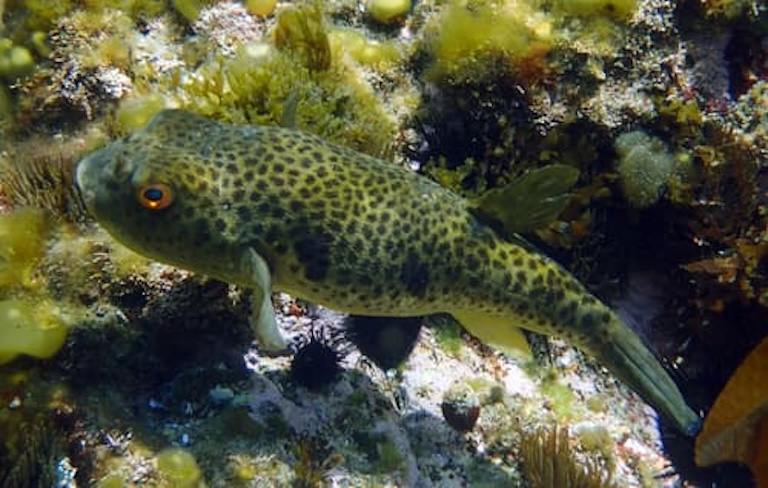
Panther Puffer Facts Overview
| Habitat: | temperate, coastal, demersal species over rocky (Yamada et al. 1995), sandy, or muddy bottoms as well as in seagrass beds at depths ranging from very shallow to 20 metres. |
| Location: | Central Japan, Korea and China: Yangtze River estuary |
| Lifespan: | Unknown |
| Size: | Up to 30 cm long |
| Weight: | Not recorded |
| Colour: | Mottled greenish with black spots, pale cream belly. |
| Diet: | amphipods, while adults feed mainly on hard-shelled animals such as gastropods, bivalves and crabs. |
| Predators: | Few |
| Top Speed: | Unknown |
| No. of Species: | 1 |
| Conservation Status: | Least Concern |
The Panther puffer, Takifugu pardalis, is a little-known member of one of the most toxic fish families in the ocean. Known locally as “river pigs”, they contain the same tetrodotoxin you find in the blue-ringed octopus, and are just as capable of killing, should you be unlucky enough to eat their toxic testicles. As deadly as they are though, this is all in self-defence, and these non-aggressive fish are more threatened by us than we are of them.
Interesting Panther Puffer Facts
1. River Pigs
Puffer fish are a family of rather funny-looking fish called Tetraodontidae. The name refers to their teeth, rather than their ability to balloon into a naval mine: they have a set of four large, frontal teeth that look like the incisors of a camel, and this is what has lent them their scientific names, meaning “four-teeth”. This is actually a sort of ever-growing, bony beak that’s used to crunch through hard-shelled prey, and this is what makes the puffer such an umportant member of the reef community.
The family is part the wider group of Tetraodontiformes – an order that encompasses their closest relatives, including many similar spiky, inflatable fish, but also the strange and amazing molas, the marine ROV-looking cowfish, and the beautifully coloured triggerfishes.
The panther puffer gets its common name from the spots on its skin (which is a little ironic as the panther is a leopard famous for its lack of spots), but its genus, Takifugu, comes from the common name in Japanese, fugu: the river pig. 1
2. They’re a marine species
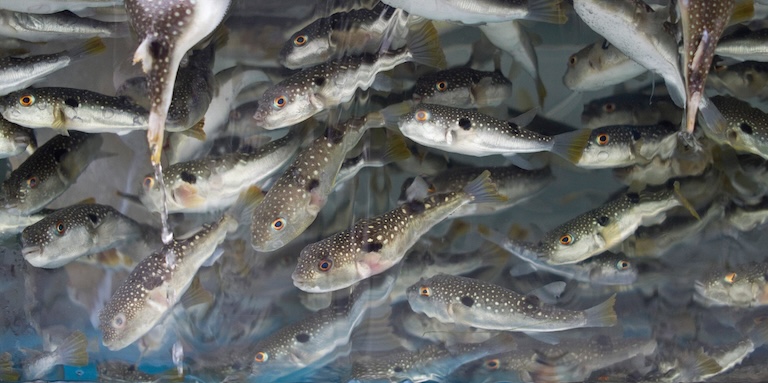
This name may seem curious at first, given that the panther puffer is exclusively a marine species. Indeed, most in the genus are either marine or prefer at most brackish water, but there are a couple of species that spawn in freshwater, too, and this is likely where the name comes from.
Of the 25 or so species in the genus, the panther puffer is pretty much medium-sized, growing up to 30 cm long, ranging from the coast around Hakodate in Japan to the East China Sea.
As a puffer fish, the panther puffer is instantly one of the most recognisable types of fish in the world, but they are also outstanding on a molecular level!
3. They have tiny genomes!
A genome is a complete list of all your genetic instructions. But this manual for cellular reproduction isn’t fixed – it grows over time. Every sustained mutation, every retroviral infection, every genetic adaptation to new environmental conditions over the history of your lineage, is mapped out in these instructions. So, a lot of it is junk.
It’s easy to assume that something as big and complex as a human has a lot more of this information in its genome than something as basic and small like a nematode worm, but sometimes the opposite is true. Many parasitic nematodes have ludicrously complex genomes, asly as a result of their long evolutionary history of avoiding detection in the host’s body.
Conversely, the puffer fish, millions of times larger than a parasitic worm (and host to many), has the smallest genome of any known vertebrate. This is a fascinating case of efficiency, in which the animal is able to express a pretty normal number of genes using far fewer instructions.
For comparison, humans have 3 billion base pairs in their genomes; the horse roundworm, Parascaris univalens, has around 2.1 billion; and the panther puffer likely has only around 450 million, based on the number in its close relative! 2
4. But deadly testicles
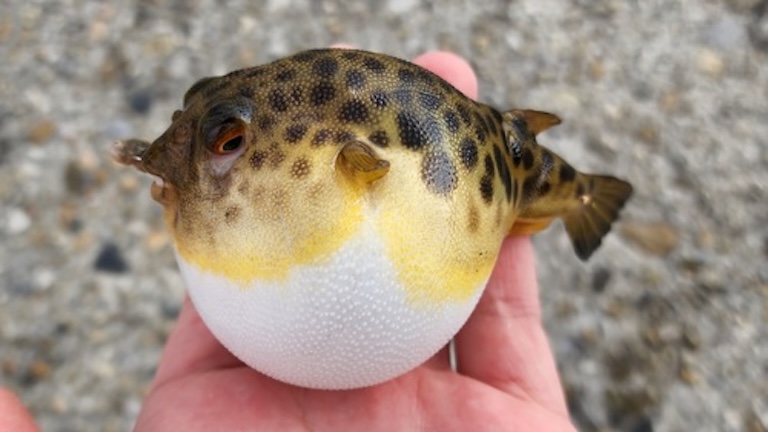
Like most, if not all, puffers, this one manages to express some very significant genes when it comes to self-defence. Not only are panther puffers able to suck in water and inflate into a spiky ball to avoid being eaten, should they be swallowed, they contain one of the most potent neurotoxins in the natural world.
Their livers, ovaries, skin and intestines are all highly toxic, and in the males, the testes are also somewhat dangerous. It’s widely believed that their flesh is the safe part to eat, but even this can be a gamble.
The puffer poison, named after the animals themselves, is called tetrodotoxin and it is the same chemical found in the infamous blue ringed octopus.
Like the octopus, then, the puffer has the ability to shut down the muscles in the human body and cause death by asphyxiation.
The good news is that since it only paralyses and doesn’t appear to cause any tissue or nerve damage, as long as the victim has someone around to breathe for them for a while, their body should be able to process and remove the toxin well enough to make a complete recovery.
Still, for many folks, this isn’t a risk worth taking. But try telling that to those who like to live dangerously. 3
5. Fugu fisheries
Fugu, from the flesh of the puffer fish, is a popular dish in many parts of Japan, and its popularity has led to a decline in abundance in the wild.
China, too, is prone to overfishing, and while the panther puffer is currently listed as Least Concern by the IUCN, their fate is still uncertain. 4
6. They’re kept in captivity
Puffer fish have a lot of character, so can make popular captive species, and are able to breed in captivity.
There are problems and solutions that come with this: captive populations undergo genetic drift over time, which results in them being genetically distinct from their wild counterparts. This isn’t a problem on its own, but could cause issues if they are released back into the wild.
On the other hand, the more captive breeding that occurs, the less pressure there is on wild populations to provide the infamous fugu dish. 5
Panther Puffer Fact-File Summary
Scientific Classification
| Kingdom | Animalia |
| Phylum | Chordata |
| Class | Actinopterygii |
| Order | Tertraodontiformes |
| Family | Tetraodontidae |
| Genus | Takifugu |
| Species | pardalis |
Fact Sources & References
- Temminck et al (1850), “Takifugu pardalis”, WoRMS.
- Aparicio et al (2002), “ Whole-genome shotgun assembly and analysis of the genome of Fugu rubripes ”, National Library of Medicine .
- Shao et al (2011), “Panther Puffer”, IUCN Red List.
- Stump et al (2018), “Global conservation status of marine pufferfishes (Tetraodontiformes: Tetraodontidae)”, Science Direct.
- Kajino et al (2025), “Genetic differentiation between captive and wild populations induced by selective breeding in morphologically diverse Takifugu pufferfish”, Frontiers.