
Peppered Moth Profile
In the second half of the 1800’s, Gregor Mendel defied nominative determinism. Turning down a role as a care taker in a Romanian bell tower, he became a geneticist instead. Mendel is the reason that millions of bored, would-be zoologists, yawning at high-school desks, are forced to study the genetics of pea plants using punnet squares.
Around the same time, a mischievous heretic with an ironically God-like beard was uncovering evolution, and almost 100 years after both of these incredible men had laid the groundwork, E.B. Ford provided a much more exciting example of genetics in the form of an animal. Finally, Mendelian inheritance could be explained using the only kind of biology that’s interesting: zoology!
Enter: The Peppered Moth. An animal whose simple genetics proves, once and for all, that God is totally fake.
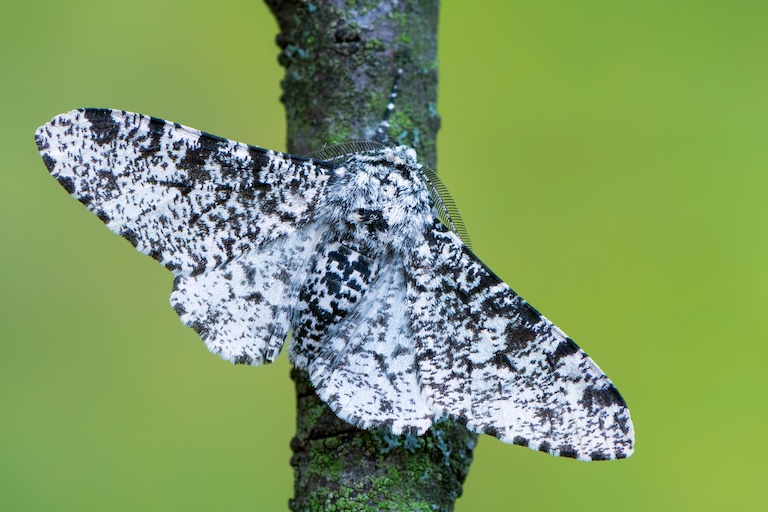
Peppered Moth Facts Overview
| Habitat: | Birch and alder woodland |
| Location: | Widespread across Eurasia and North America |
| Lifespan: | Around a year, sometimes two |
| Size: | 45 to 62 mm (1.8 to 2.4 in) wingspan |
| Weight: | Not listed |
| Colour: | Usually white with peppered grey spots but ranging through grey to dark brown or black |
| Diet: | Leaves, nectar |
| Predators: | Birds, bats, lizards |
| Top Speed: | Moth speed |
| No. of Species: | 1 |
| Conservation Status: | Not Listed |
As boring as they may appear, the peppered moths are some of the most important organisms in modern ecology. Not only are they kinda cool in their ability to hide against trees, they can change colour, explain natural selection and come in various flavours. Even their larvae are neat.
Interesting Peppered Moth Facts
1. They’re inchworms
It is generally considered that there are more moths than you really need. The insect order Lepidoptera contains all the 180,000 or so moths and butterflies, and most of these are moths. In fact, 10% of all species with names in books are members of this order.
There are 126 families of moths, many with tens of thousands of species in them.
So the peppered moth’s family, Geometridae, is not particularly unusual for containing 23,000 or so species.
The name translates to “Earth measurers” and this refers to their caterpillars, whose means of locomotion looks a bit like they’re marking out the distance, inch by inch. Of course in Europe, where most of these are found, they call them 2.54 cm worms, but this doesn’t have quite the ring to it.
The peppered moth is not just a member of a widespread family of moths, but also very widespread itself, and is found all over China, Russia, most of Europe and North America. And it would be a pretty standard, uninteresting animal if it weren’t for a stroke of luck and a torrent of air pollution that brought it to light. 1

2. They’re bark mimics
As an adult, this species of moth is typically some combination of white and dark, with specks of pigment all over it, hence the name peppered.
This colouration has evolved as a way to hide in the daytime, often on birches and willow trees, whose bark has a similar blend of shades. The moth will sit with its wings flat against the trunk or branch of these trees and will be incredibly difficult to spot.
It’s a hard life for a meaty, non-toxic insect like the peppered moth: all day, birds and spiders want to eat it; all night, bats are cruising around looking for a meal. So, being camouflaged really helps in the daytime, at least. In the evenings, males will spend all night on the prowl for a female, who, when she is found, will be guarded by the male until she agrees to have sex with him.
The female will lay up to 2,000 eggs in and around the host tree, and the inchworms that come out of them are every bit as cryptic as their parents!
3. Even their caterpillars look like plants
The caterpillars of this moth are arguably more interesting than the adults. They move strangely, they grow nobbly extras and they can change colour.
All of this is to mimic the twigs they need to traverse to reach their leafy food, without being eyeballed by all the flying dinosaurs around. Quite recently, it has been discovered that they can sense the colour of the branch they’re on and adjust their body colour accordingly! 2

4. Bivoltine
Whether the peppered moth breeds once or twice a year seems to be determined by where they live. The UK and Ireland have some of the most northerly populations of this species and here, they reproduce just once a year. The standard primary school process is involved: eggs, larvae, pupa, moth!
When an animal has a single reproductive cycle per year, the technical term for this is univoltine, and when there are two such cycles in a year – as the peppered moth exhibits in the warmer regions of North America – it’s called bivoltine.
When barley malt is ground up and sold as a powdered hot drink, it’s called Ovaltine. But this is unrelated.
5. They come in different flavours
The peppered moth species varied in colour. There is a range of melanistic and non-melanistic morphs of this species, and this is where Mendelian inheritance comes in. To avoid triggering distant classroom traumas, we can keep it short and sweet:
The melanistic allele dominant and the light one is recessive. This should mean that a moth needs to inherit the non-melanistic gene from both of its parents or it will necessarily be dark. And if you do the box thing, you’ll find that Mendel predicts a 3:1 ratio of black to white moths in any given population.
But it was this law, and the way it was broken, that led to the peppered moth explaining to us just how natural selection works!
6. They defined evolution
Technology always arrives before the regulations against it can be designed, and at the beginning of the Industrial revolution, we went through a dark period of child labour, spontaneous amputations and smog. Lots and lots of smog.
The peppered moth had been going about its business hiding in the lichens on birch trees. Their genetics should have resulted in a majority of melanistic moths, but these were easy to spot and would have been picked off by predation. This was already a process of negative selection on the population.
But with all that smog, not only did the air pollution kill those lichens, it also made trees darker with soot, and suddenly, white moths were illuminated against their dark background, and it was the black moths’ turn to hide from birds.
Suddenly, the anomalous black moth shot up to 90% of the population! And once those clean air regs finally kicked in in the 1950s, the predictable reversal of this ratio soon followed.
So, while the colour of this animal can be explained using genetics, the population dynamics is a product of natural selection, both of which function with various other factors to determine who does what in an ecosystem!
This system also shows how evolution works by way of rapid shifts in environments that suddenly favour traits that were previously detrimental. Even more, this explains why diversity – both within the genes of each species and of the variety of species within an ecosystem – is so important to the continuation of life in the presence of environmental shifts.
The peppered moth is, therefore, a mascot for the various building blocks of ecology, and allows you to study genetics without having to deal with boring plants. Hooray! 3

Peppered Moth Fact-File Summary
Scientific Classification
| Kingdom | Animalia |
| Phylum | Arthropoda |
| Class | Insecta |
| Order | Lepidoptera |
| Family | Geometridae |
| Genus | Biston |
| Species | betularia |
Fact Sources & References
- , “Family Geometridae – Geometrid Moths”, Bugguide.
- Eacock et al (2019), “Adaptive colour change and background choice behaviour in peppered moth caterpillars is mediated by extraocular photoreception”, Communications Biology.
- , “Peppered Moth and natural selection”, Butterfly conservation.