
Pacific Spaghetti Eel Profile
Reef ecosystems are perhaps the most biodiverse regions our planet has to offer. They are phenomenally dense with life – home to around a quarter of all marine species despite making up 1% of the ocean.
But just off the reef, there is a group of derpy-looking fish who bury themselves in the sand and catch the bits and pieces that drift off from the chaos. These are not as glamorous or as well-known as their beautiful reef equivalents, but they occupy a significant position in the ecosystem and what’s more is that their congregations form vast noodle fields under the sea.
These are spaghetti eels, and the Pacific spaghetti eel specifically, is in today’s spotlight.
Pacific Spaghetti Eel Facts Overview
| Habitat: | Marine sand flats, near reefs down to 30 metres |
| Location: | Northwestern and southwestern Pacific Ocean |
| Lifespan: | Unknown |
| Size: | Up to 1 metre (3 ft) long |
| Weight: | Not recorded |
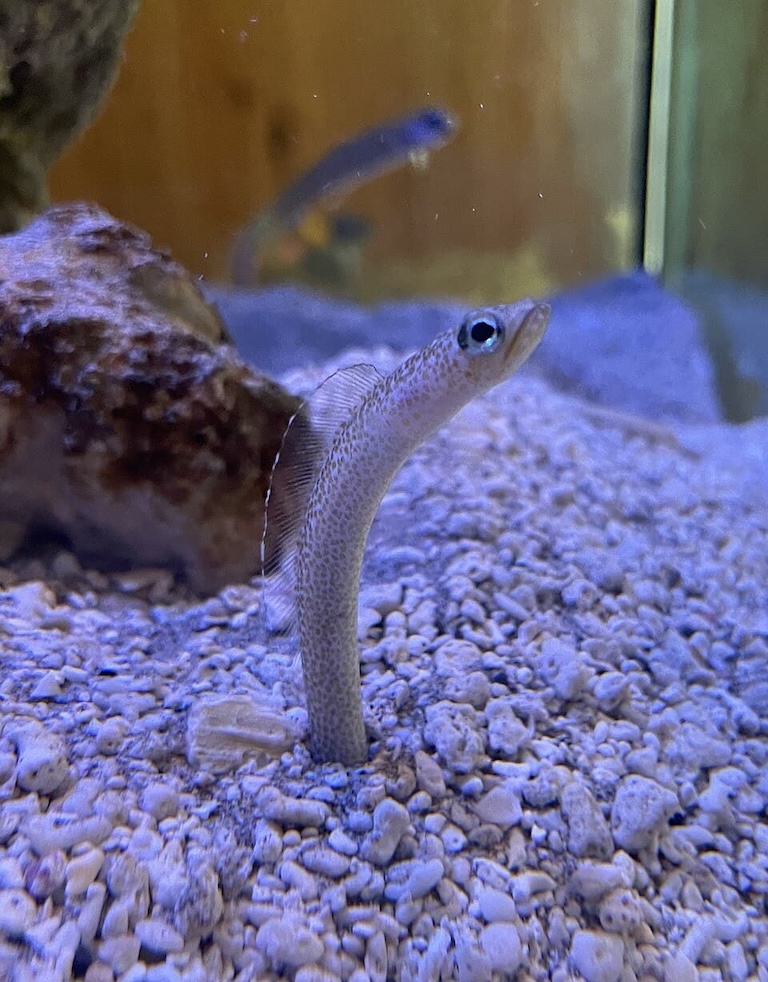
| Colour: | Sandy brown, creamy on the belly, with flecks of white and black |
| Diet: | Plankton |
| Predators: | Probably tiger fish and larger, free-swimming eels. |
| Top Speed: | Sedentary |
| No. of Species: | 1 |
| Conservation Status: | Least Concern |
Spaghetti eels are the true dorks of the reef-adjacent seabed. They share a family with the very well-known predatory giants of the Conger eel genus, but live very different lives. These slender, mostly buried, detritus and plankton feeders, gather in vast fields of surprising-looking wormlike animals poking out of the sand.
Despite being members of an incredibly widespread group of such eels, Pacific spaghetti eels, like all spaghetti eels, are still poorly understood, but it’s thought that these humble little weirdos supply a valuable dose of fertiliser to the sea bed and are probably quite important to their ecosystems.
Interesting Pacific Spaghetti Eel Facts
1. They are congers
The Congridae family of eels is best known for its 3 metre, 160 kg king: the conger eel. The whole family is contained in tropical and subtropical waters, but widespread all over the world, and is distinguished as a fish by a total absence of scales.
As eels, Congrids are true, bony fish, and the conger itself is a free-swimming animal, just as most bony fish are. But the spaghetti eels are really quite different from these icons of their family, as they are much less massive, and much less mobile.
Pacific spaghetti eels are members of the subfamily Heteroconrinae, and these are better known as garden eels.
2. Garden eels
There are two genera in the Heteroconrinae subfamily. Heteroconger is the obvious one, and contains around 25 known species of garden eels, but the Pacific spaghetti eel is in the other genus, Gorgasia, which not only sounds much better but is no slouch with the species richness either.
There are 14 or so species in Gorgasia, almost all of which are found in the Pacific Ocean, popping their dorky faces out of burrows to catch plankton and nutritional bits and pieces floating by.
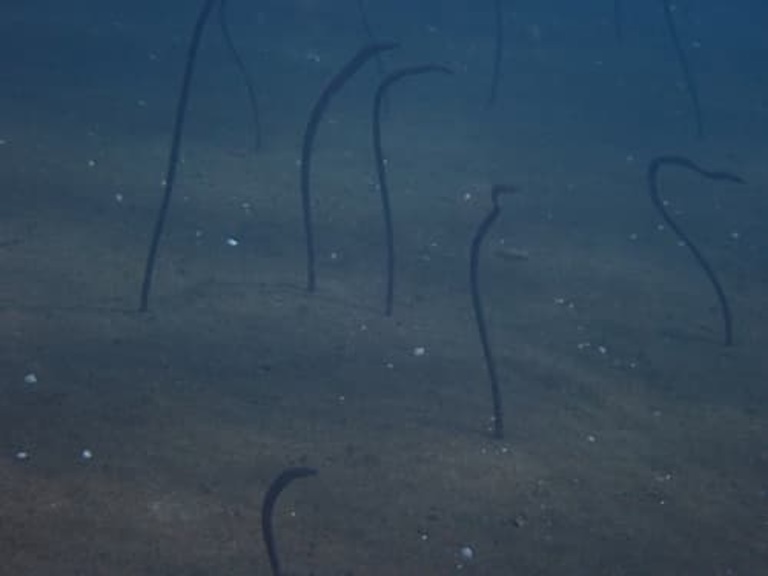
Garden eels are well known for forming dense fields of odd, wormy protrusions, and the Pacific spaghetti eel is no exception.
3. They congregate
There’s a pun to be had here, if you can force it, and for these congregating congrids it is one of the most recognisable features.
These eels bury 75% of their bodies in the sand, poking the remaining quarter up into the water column. And they do this all together in quite dense groupings.
In any square metre of habitat there can be up to 40 of these strange fish, all bobbing about in burrows like grass, waving in the current.
This serves a few purposes: first, multiple eels means multiple eyes to detect predators. It also means they don’t have to travel far, or really at all, to find a mate.
Adults will rarely if ever leave this burrow, but they can sort of shift their burrows closer to one another if they want to. At night, or whenever they want to rest, they will retreat into the burrow and cap it off for security.
4. They have a peculiar distribution
This species in particular is found in two locations that appear nowhere near one another. As their species name, Gorgasia japonica, suggests, they are found off the coast of Japan. But there’s another population of this species described from all the way over in New Zealand.
Why this separation occurs isn’t clear, but it could be related to these two locations having similar water quality, while the vast expanse of Australasia in between gets much warmer. How they got there may seem like a mystery as well, but their life cycle could explain this quite easily. 1
5. They metamorphose
Judging from similar species, and what little data there is available on the Pacific spaghetti eel, this animal likely goes through a planktonic stage after hatching from the egg. Soon after this, it will become a small, free-swimming larva, but during either of these stages it’s likely at the mercy of the currents until it’s large enough to decide where to go. 2
Perhaps during this stage it could be dispersed by way of the North and South Pacific gyres, and perhaps again this would predict a population could be found all the way up to North America, though the reef-adjacent habuitats may be lacking.
Or perhaps it will turn out that the New Zealand population is genetically isolated enough to be relabelled as its own species or subspecies, and the two are self-sustaining.
If this seems like a lot of speculation for a so-called factual animal blog, good instincts! The fact is that there just isn’t much to go on, yet, and this is therefore a fantastic species to do your marine bio dissertation on, if you can get the funding!
6. They’re not well known
This species is listed as Least Concern, but its population trend is a mystery. Its assessment, as of 2026, ten years out of date, but not much more about this species has come up in that time.
There are no known threats to the species, and even no known predators, though from other species in its range, it’s a safe bet that the pacific snake eels is one of its major demons.
This scary eel burrows under the same substrate and infiltrates the spaghetti eels’ burrow from below. Triggerfish are also known predators of other garden eel species, and dig them out from above.
6. They probably fertilise the sea bed
This species appears to feed mostly on plankton and detritus. They are small, but plentiful, and being obscure is no reason to assume that they are worthless; on the contrary, these fish likely play a very important role in their ecosystems.
At the very least, they deposit their waste into the sea bed, which facilitates energy flow from the reef into the adjacent sandy beds. 3
Pacific Spaghetti Eel Fact-File Summary
Scientific Classification
| Kingdom | Animalia |
| Phylum | Chordata |
| Class | Actinopterygii |
| Order | Anguilliformes |
| Family | Congridae |
| Genus | Gorgasia |
| Species | japonica |
Fact Sources & References
- Tighe et al (2016), “Gorgasia japonica”, IUCN Red List.
- Solomon N. Raju (1974), “Distribution, Growth and Metamorphosis of Leptocephali of the Garden Eels, Taenioconger sp. and Gorgasia sp.”, JSTOR.
- Donham et al (2017), “Natural History Observations of Hawaiian Garden Eels, Gorgasia hawaiiensis (Congridae: Heterocongrinae), from the Island of Hawai’i ”, Project Muse.