
Pike Profile
From the vast African plains to the microbial battlegrounds on your kitchen sponge, every ecosystem has its monsters.
As humans, the vast majority of life forms have always been thousands of times smaller than us, which grants us an almost unique privilege to go almost anywhere we want to without fear of being plucked from our lives by a thousand different predators.
But take baby ducks, for example. In northern freshwater ecosystems, perhaps. They definitely don’t have this privilege. They are in danger from the front and sides – everything that size is – but also from the top, and even more ominously, from below. Because the most terrifying monster of this realm has to be the Pike. A large, predatory fish whose cold, dead eyes make it a freshwater Jaws.

Pike Facts Overview
| Habitat: | Temperate and cold freshwater systems: rivers, lakes, streams, canals, artificial pools |
| Location: | Circumpolar distribution |
| Lifespan: | Usually around 25 but can live to 100 |
| Size: | Up to 150 cm (59 in) |
| Weight: | Up to 28.4 kg (63 lb) |
| Colour: | Greenish brown with spots, sometimes stripes, and a greenish/creamy belly |
| Diet: | Mostly other fish, but also amphibians, invertebrates, and some water birds. One was recorded attacking a dog |
| Predators: | Humans, raptors, other pike, sometimes otters |
| Top Speed: | 16 km/h (10 mph), but capable of alarming acceleration and bursts of speed |
| No. of Species: | 7 |
| Conservation Status: | Cisalpine pike is Vulnerable; all others Least Concern |
Pike are popular among anglers, and absolutely vilified by pretty much every other animal they come across. These spear-like hunters are killers from the moment they leave the egg, hanging motionless in the dappled sunlight, camouflaged by their mottled, tiger-striped skin, waiting in ambush for pretty much any animal that will fit in their mouths.
And sometimes, they bite off more than they can chew. Pikes are tremendous, apex predators whose role in their ecosystem across all tiers of animals cannot be understated. They’re tough, too, and most are doing well, but some are starting to falter, and it should be our role to intervene in this – to support a fish that has beguiled our people in the Northern Hemisphere for centuries and now needs our help.
Interesting Pike Facts
1. They’re Salmoniformes
It’s easy to forget what enormous predators salmon are, since they’re far more commonly associated with dill and butter, but their order of bony fish, Salmoniformes, contains some very large killers, and the pike is one of them.
Salmon and pike diverge at the suborder level, with salmon and trout in Salmonoidei suborder and pike in the only other one: Esocoidei. They share this suborder with the umbrids, who make up a different family, and pike share their own family, the Esocidae, with a Russian mudminnow genus called Dallia.
But of all these fish mentioned, only the pike holds the title of apex predator. There are seven species in the genus Esox, and each of them is a perfect killer. The largest of them may not quite match the largest of the salmon, but they have been known to get disturbingly large, nonetheless.

2. They get enormous
Fishermen aren’t known for their honesty when it comes to how big their fish are, but some records do exist (as do some stuffed monstrosities hanging above fireplaces in old pubs all over Europe) that give an insight into just how large these fish can get.
The largest caught pike on record appears to have weighed around 25 kg. There’s a photo of this one, and many more photos of anglers holding up similarly-sized beasts for the camera, so it’s easy to assume they reach even larger scales (get it?) as well.
But even more impressive than their sheer mass is how quickly they can overcome its inertia.
3. They’re danger rockets
The scientific term for a danger rocket is “Obligate ambush predator”, and the pike is such an animal. This means it has no appetite for long, drawn-out chases or tactical hunts, and instead opts to hang silently among the weeds, peering out and perhaps gently stalking its victims.
Once within range, the pike goes from zero to murder in a phenomenally short span of time. This acceleration is estimated to be around 25g almost immediately, and apparently faster than any manned vehicle does on purpose (crashing into a wall or the ground is a form of acceleration but it doesn’t count).
The pike is named after the medieval weapon, and its long, slender body is perfectly designed for darting rapidly towards something. Pike sacrifice stability for acceleration and so can’t swim far at speed while maintaining accuracy, but they don’t need to – the pike uses keen eyesight and ambush tactics to bolt at its prey, following up with a C-shaped body formation to stop as quickly as it got started.
Pike digest quickly and eat a lot, and so engage in multiple ambushes per day. And their base impulses are programmed accordingly. 1
4. They can be aggressive
Aside from bald monkeys, the pike’s only other major predators are its kin. Pike are known to be very aggressive feeders, and young pike must navigate a gauntlet of larger pike, which is a lot harder when food is scarce. This forms a sort of self-regulating population dynamic, but by way of cannibalism, which gives us the ick.
As pike get larger, the amount of weedy cover that it needs to hide in reduces, and by the time a pike is around 2 years old, the hunted becomes the hunter.
Pike are notoriously aggressive when feeding, and will attack anything they deem sizeable enough to eat. Sometimes they get it wrong, as did one pike who washed up dead with a baby grebe stuck in its throat, or on the rare occasions when they’ve latched onto someone’s ankle before realising it’s a bit more than they can chew.
Large pike have little to fear and don’t require as much aquatic vegetation to hide in. They can patrol the deeper, open waters, and pluck not only fish and amphibians, but birds and even mammals from their resting places. The largest species, the northern pike, has been documented at least once attacking a husky.
As adults, they’re just large enough to cause some serious lacerations, but quite big enough to be a lethal threat to a person. 2

5. They eat everything
While the largest of the adult pike may reach more than 1.5 metres long, they begin life as rather small animals – small fish in a large pond. In their early stages they feed on water fleas and other small invertebrates, and as they grow in size, so does their prey.
Starting with the tiny Daphnia water fleas, they move onto larger arthropods like the Asellus isopods. Eventually, the tiny little predators reach 7 or 8 cm long and begin moving onto vertebrate food in the form of small fish.
As mentioned, if they survive, they then move onto much larger food, but the sheer scale of prey items in the pike kingdom makes them a formidable downward force on the populations of their community and therefore a significant member of their ecosystems.
6. They were once a delicacy
But the pike isn’t entirely without its enemies, even at full size. A 1.5 metre pike generally has only humans to worry about, but they are quite hardy by this point and are likely to survive being released back into the water.
One thing they most definitely won’t survive is an otter attack. Otters look cute and playful, but they are mustelids, and mustelids don’t worry about very much at all. This makes them incredible at killing, and one of the only animals to take a large pike without breaking a sweat.
Modern anglers don’t typically eat pike – it’s full of bones and not all that tasty to begin with. But back in the day, pike was considered a delicacy and was a centrepiece in pompous medieval banquets in Europe between the 11th and 17th centuries. 3 4
7. They’re doing quite well
Of the seven species of pike, all but one remain of Least Concern to the IUCN. The smaller, Cisalpine pike, is the only one truly struggling, and is listed as Vulnerable. It’s threatened mostly by hybridisation with the larger Northern pike and by the introduction of popular sport fish that have become invasive in its realm. Climate change is also bringing more predatory birds into some of their range over the winter, which may pose a sustained threat as well.
This species, and the Northern Pike, are both considered to be in decline, but all other species were last assessed as stable. In general, these hardy and charismatic beasts are pretty adaptable and tough, so with any luck, they will continue as apex predators in our northernmost freshwater systems for as long as we’re around. 5
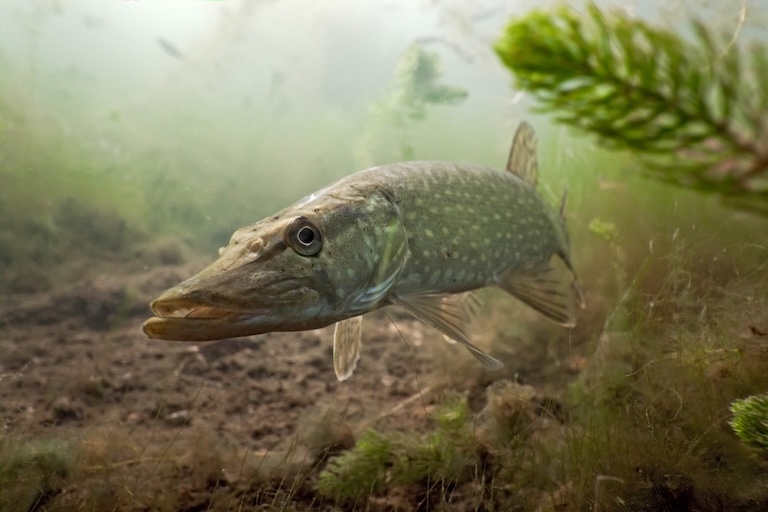
Pike Fact-File Summary
Scientific Classification
| Kingdom | Animalia |
| Phylum | Chordata |
| Class | Actinopterygii |
| Order | Salmoniformes |
| Family | Esocidae |
| Genus | Esox |
| Species | 7 species |
Fact Sources & References
- Chengcheng et al (2011), “The Mechanics of Fast-Start Performance of Pike Studied Using a Mechanical Fish”, MIT Libraries.
- Dean Taylor , “Do Pike and Muskie Attack Humans?”, The Fish’n Canada Show.
- (2008), “A Prodigious Pike.”, The Old Food.
- Angela Maccarinelli (2021), “Was pike on the menu? Exploring the role of freshwater fish in medieval England”, Springer Nature Link.
- (2023), “Cisalpine Pike”, IUCN RedList.