
Painted Reed Frog Profile
Across much of sub-Saharan Africa, especially around water, the daytime chorus of birds segues at dusk to the deafening tones of millions of little frogs. Together, they sound like the distorted buzz of a cicada or mole cricket, but on closer inspection, each individual is making a tiny clicking chirp, much like the tapping of a little glass bell.
These are reed frogs, and they are highly adapted to surviving in arid conditions across terrestrial and arboreal habitats. And they can be stunning! One of the prettiest is a small, patterned frog called the Painted reed frog.
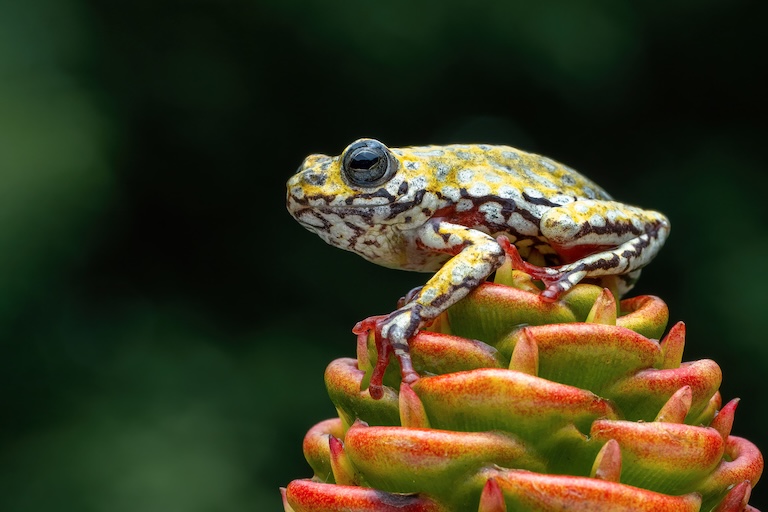
Painted Reed Frog Facts Overview
| Habitat: | Humid, wet areas, such as swamps, but also cultivated or developed land near water |
| Location: | Eastern and southern Africa |
| Lifespan: | Just under 5 years |
| Size: | Around 4 cm long |
| Weight: | Not listed |
| Colour: | Extremely variable: spotted, striped, banded, browns, blacks, whites, reds |
| Diet: | Insects – mostly mosquitoes and other flies. |
| Predators: | Birds, bats, crocodiles, terrapins, snakes, and other larger amphibians |
| Top Speed: | 300 metres per hour |
| No. of Species: | 1 |
| Conservation Status: | Least Concern |
Painted reed frogs, also called marbled reed frogs, are one of eastern and southern Africa’s resident reed frogs, and they’re absolutely thriving. Owing to a toughness rarely seen in amphibians, these remarkably adapted generalists can survive in ways other frogs can’t, and it has served them – and the varied ecosystems they inhabit – very well. These are an indicator species, as where you find them, you find a lot of other species as well. So they’re not just pretty, they’re very important!
Interesting Painted Reed Frog Facts
1. Hyperioliids
Frogs form the amphibian order Anura, and are a relatively ancient order of animals dating back to at least the Triassic – possibly even the Permian – long before dinosaurs existed.
Today, almost 90% amphibian species are in this order, and there are 60 or so families of modern frogs. The Hylidae family is the largest, with over a thousand species, but somewhere in the middle of this size spectrum are the Hyperoliidae frogs, known as Hyperoliids.
These are commonly known as sedge or bush frogs and there are around 250 species of them. The vast majority are arboreal, found in Sub-Saharan Africa, and of the seventeen genera, the marbled, or painted reed frog belongs to Hyperolius. This genus contains somewhere around 140 to 160 species, and if that seems vague, it’s partly because they’re all so varied in colour that it’s hard to tell which species is which without opening them up.
This genus, as with the whole family of frogs, has spectacular colouration that we’ll cover a little more shortly, but another thing they have in common is that they spend most of their time out of water. Some Hyperoiliids are purely terrestrial, but the majority climb trees and more or less stay up there.
The painted reed frog is in the former group.
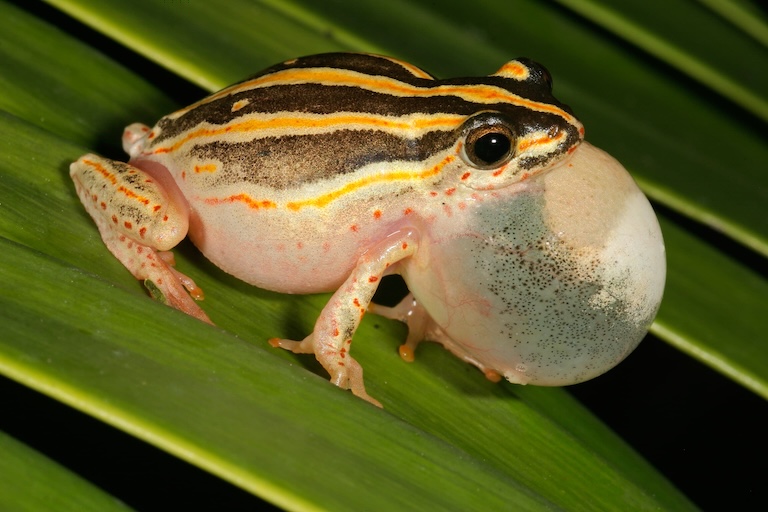
2. They’re terrestrial (mostly)
Painted reed frogs have specialised toe pads for climbing, which they do a lot, but not so m,uch in the trees as through the undergrowth.
This species is mostly terrestrial, staying primarily on land but also able to traverse great distances on account of their fantastic ability to climb through grass. It’s said that one of these little frogs can cover 300 metres in a single hour, which, while not the fastest frog known, is a pretty solid speed and allows the species to disperse from their hatching pools into the wider ecosystem very effectively. 1
3. They make crystals
This species is also known as the “marbled” reed frog, and this refers to its pretty skin. Being a terrestrial species, it has evolved protection against sun exposure, which would otherwise dry the animal out. The first line of defence against water loss is behavioural: they will elect to move less during the hottest part of the day, therefore using less water and minimising sun exposure. During the day it can also engage in a sort of short-term hibernation called aestivation, in which its metabolism drops and more water is conserved this way, too.
Thirdly, though, it can sequester chemicals from its diet which are converted to purine platelets, sort of like crystal pigments which are then presented on the skin of the animal and placed between its natural pigment cells. This reflects warming radiation from the sun and is the third line of defence against drying out.
All of these features combine to allow this species to thrive in environments far too dry for most amphibians, and this frog even lays its eggs from the bank of the water. The eggs, when deposited, plop into the water to mature, but once the mature frogs leave the pool, they may never go back again.
And the crystals come with incredible aesthetic perks!
4. They are pretty!
Painted reed frogs are incredibly diverse in their colouration. Individuals of the same species can present with any number of different colours and patterns, making them look like entirely different species from one another.
Stripes, spots, and base colours are all variations of a theme, and some researchers use these differences to group populations into subspecies, meaning there is a genetic element to this diversity. 2 3

5. They handle us pretty well
Being tough little buggers, capable of handling dry weather, long distances between water bodies and lengthy periods of time between rainfall or access to water, these are adaptable frogs, far less sensitive than many other frog species.
In fact, they thrive in recently disturbed habitats, where humans have removed trees around water bodies and emergent vegetation is taking over. Pool size doesn’t seem to matter all that much to these frogs, either, so the toughness and adaptability of the painted reed frog has resulted in a species that has no recorded threats to its conservation.
Even its popularity in the exotic pet trade seems to have had little impact on its success in the wild. 4
6. They’re more important than they look
Being such little troopers, the painted reed frogs have an enormous potential to impact their varied environments. They are vital components of wetland ecosystems, controlling insect populations as well as feeding their innumerable predators.
As such, they are considered ecosystem indicator species, meaning that their presence and abundance can be used to measure the health of the ecosystems they’re found in. Conversely, any measured decline in these metrics can be a warning that the ecosystem is failing.
So, this is a frog that’s far more than just a pretty face!

Painted Reed Frog Fact-File Summary
Scientific Classification
| Kingdom | Animalia |
| Phylum | Chordata |
| Class | Amphibia |
| Order | Anura |
| Family | Hyperiolidae |
| Genus | Hyperolius |
| Species | marmoratus |
Fact Sources & References
- Letlojane et al (2024), “Marbled Reed Frog”, SANBI.
- Jessica High (2003), “Hyperolius marmoratus”,Animal Diversity Web.
- “Painted Reed Frog (Hyperolius marmoratus)”, iNaturalist.
- (2013), “Painted Reed Frog”, IUCN RedList.