
Panther Grouper Profile
Normally, being spotty and hunchbacked would be a turn-off, but in the warm, shallow lagoons of the Indo-Pacific there’s an animal that pulls this off flawlessly. Polka-dot cod, humpback grouper and barramundi cod are all titles given to this fish, the Panther Grouper and even with a wobbly gait, this is a very pretty and quite adorable fish to spot in the wild.
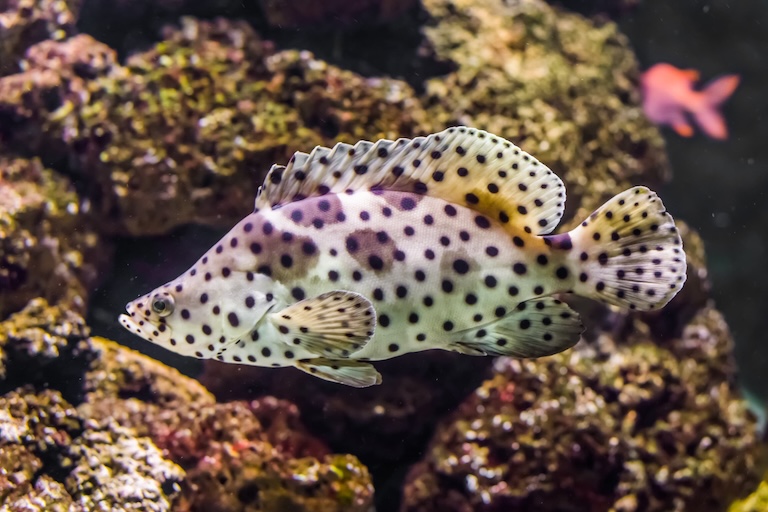
Panther Grouper Facts Overview
| Habitat: | Dead or silty reef areas, shallow tropical waters, lagoons |
| Location: | Indo-Pacific: Southern Japan to Palau, Guam, New Caledonia and southern Queensland |
| Lifespan: | Likely more than 20 years |
| Size: | 50 to 70 cm (20 to 28 inches) long. |
| Weight: | Up to about 7 kg (15 lb) |
| Colour: | Greenish white to light greenish brown with scattered round black spots |
| Diet: | Small fish and crustaceans |
| Predators: | Larger fish, humans |
| Top Speed: | Slow, wobbly |
| No. of Species: | 1 |
| Conservation Status: | Data Deficient |
Panther groupers are no longer considered true groupers, since they got expelled from the family, and this seems to be a running theme of rejection – they are relegated to dead reefs and sheltered lagoons, wiggling around on their own, in pairs or in very small groups. These are shy, but stunningly pretty fish, and voracious predators of reef crustaceans and smaller fish.
But as rejected as they appear in the ocean, they are welcomed by the human population, to their detriment. This is a species in decline as a result of illegal pet trading, and the data is still insufficient to truly put a ranking on how bad this is.
Interesting Panther Grouper Facts
1. Polka dot cod
Until fairly recently, groupers as a whole were thought to be a subfamily of basses in the Serranidae family, but have since been moved to their own group, the Epinephelidae. There are two main genera in this family, and the Panther grouper, also called the humpback grouper or Polkadot cod, doesn’t belong to either of them.
Instead, it belongs to its very own genus, Chromileptes, but a lot of its old information would have it labelled under the old genus, Epinephelus. The species name, altivelis, is retained, but its status as a true grouper may not be, as the old family, Epinephelidae, is what most would consider to be true groupers.
As such, this is a fish that doesn’t truly fit in, and that might explain why they’re always hiding in small groups.
2. They’re shy
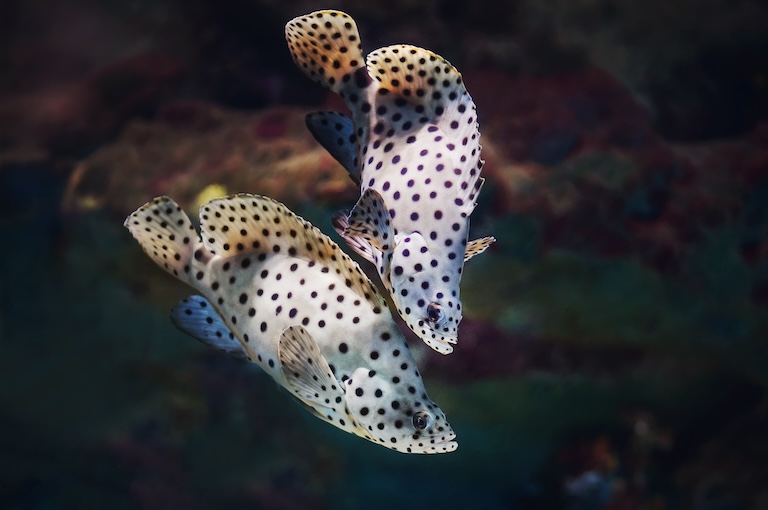
This species is found around the shallow coasts and lagoons of the Indo-Pacific. It’s a shy animal, despite being quite big, almost self-conscious about its arched back and bright, spotted skin. This species inhabits dead reefs and shallow, warm water down to only 40 metres and potters about in the shelter of these habitats, often only in pairs or very small groups.
Aggregations have been recorded of up to 6 individuals, but they’re most commonly less social than this, and it’s not often you’ll see more than two at a time. They hide in sea grass, ambushing prey. 1
3. They’re predators
This cute and somewhat awkward fish is, nonetheless, a fearsome predator. Being a mid-sized fish, they’re well aware that there are more fearsome predators to worry about as well, but for the small fish and crustaceans they feed on, they are a true sea monster.
It’s hard to really think of them this way at average human size, though, as they are smart enough to stay out of the way of almost anything larger than they are.
4. They’re intelligent
This species is described as curious, but afraid of anything new. When approached by a diver, they will dart off but will still stay close enough to be inquisitive.
Their strange swimming pattern gives them a characteristic wiggle, as if the colour and flamboyant fins weren’t iconic enough, and perhaps this is a cunning way of dazzling their prey as they hunt among the rocks.
It could also be a way to look sexy, though the desired market for this sexiness changes depending on the age of the fish.
5. They’re sequential hermaphrodites
Panther groupers are all born female, which sounds like a bit of a malfunction for a sexually-reproductive animal, but isn’t all that uncommon in fish.
As they grow, they produce eggs, which are spawned into the water and then totally ignored. Sometime later, the females will then change their sex and become male, at which point their role in producing gametes flips, and they change from fertilisee to fertiliser.
This serves many species well, but it’s starting to look like the panther grouper may need some help in keeping it up. 2
6. They’re in decline
Being beautiful shallow water fish, panther groupers are popular among live fish markets, and are easy enough to collect from the wild.
Frustratingly, population data isn’t sufficient enough to identify a conservation ranking according to the IUCN, but it is clear that the species is in decline.
How bad this decline is, and whether it’s reversible, is a huge question mark in the scientific literature, but ongoing illegal smuggling into Hong Kong from Indonesia seems to be the main issue, and concerns are that once the Indonesian population disappears, the supply side of this arrangement will move into Philippine waters and beyond. 3
Panther Grouper Fact-File Summary
Scientific Classification
| Kingdom | Animalia |
| Phylum | Chordata |
| Class | Actinopterygii |
| Order | Perciformes |
| Family | Epinephelidae |
| Genus | Cromileptes |
| Species | altivelis |
Fact Sources & References
- (2016), “Humpback Grouper”, IUCN Red List.
- Diana Zepeda (2001), “Cromileptes altivelis ”,Animal Diversity Web.
- Sadovy et al (Year), “Humpback Grouper”, IUCN Red List.