
Painted Stork Profile
We’ve said it before, and no doubt we’ll say it again: a stork will far faster eat a baby than bring one, swaddled in cotton, into the embrace of a mournful elephant. Storks are a dinosaur’s closest impression of a pterosaur, and while the painted stork may have a pretty name, it doesn’t deviate from its cold, reptilian roots when it comes to hunting prey.
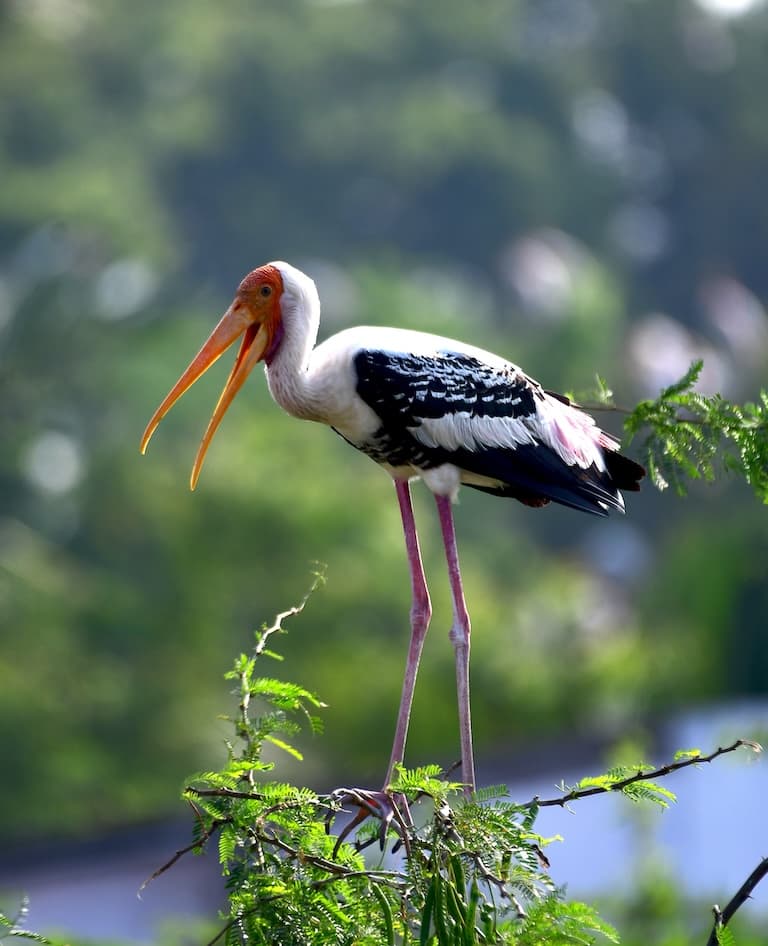
Painted Stork Facts Overview
| Habitat: | Wetlands, tropical. Coastal and freshwater |
| Location: | Across the Indian subcontinent, from Sri Lanka to Indochina and southern China |
| Lifespan: | 28 years |
| Size: | Up to 102 cm (40 in) tall with a 160 cm (63 in) wingspan |
| Weight: | 2–3.5 kg (4.4–7.7 lb). |
| Colour: | White body and neck with black and white wings, pink legs and face and a yellow beak |
| Diet: | Small fish, frogs, crabs, large insects and grasshoppers |
| Predators: | Tigers, leopards, hyenas, crocodiles and raptors. |
| Top Speed: | Around 30 km/h in flight |
| No. of Species: | 1 |
| Conservation Status: | Least Concern |
The painted stork is a perfect example of its kind: silent, ominous, able to soar gracefully on the late morning thermals, blocking out the sun as it descends to kill.
Fortunately for us, they’re only big enough to kill fish and other similarly-sized prey, but this is still a species nobody should be comfortable taking their eyes off for long, and they are on the rise!
Interesting Painted Stork Facts
1. They’re not ibises
Ibises are a similar group of ground-poking birds with pretty names, generally differentiated from storks by a curved beak, but since the painted stork has a bit of a curve to its killing spear, it has historically been grouped among them.
It was at one time known as the Pelican Ibis, and the pelican being another cold-blooded killer of fish, this was somewhat apt, but more recent improvemebts in our understanding resulted in this bird being plonked among the wood storks, with the yellow-billed, milky, and wood storks being its closest relatives.
Regardless of what you call it, though, the painted stork is one of those success stories that goes to show you don’t have to be dignified to do it right.
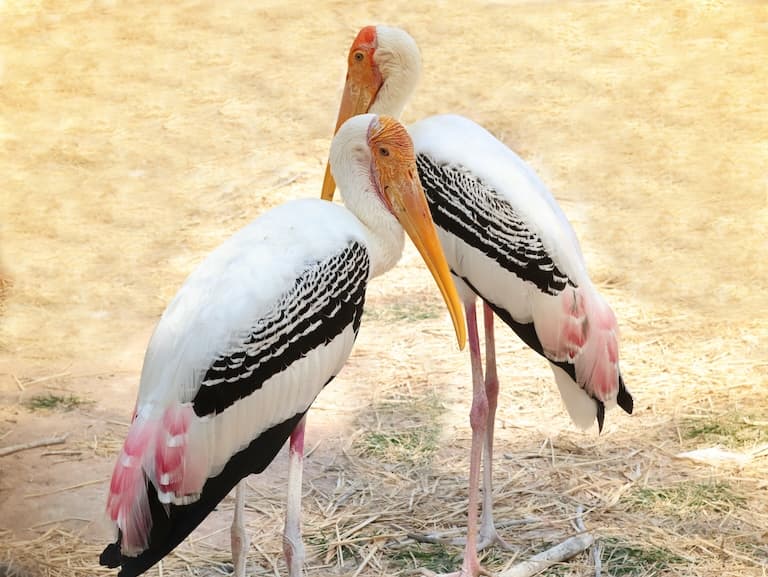
2. They’re adaptable
Painted storks are mid-sized storks and classic waders. But its restriction to watery realms is about its only restriction, at least when it comes to what it likes to eat.
This is a fish hunter primarily, and will stalk around freshwater wetlands and marshes, striking like a heron at anything juicy enough. But it will also be just as happy around the coast, doing much the same to the local worm and crustacean communities to boot.
It is a predator, but a very opportunistic and adaptable one, so it can be found in a variety of habitats, and in large numbers!
3. Muster and phalanx
Painted storks are colonial birds, and will gather in flocks of up to two hundred individuals. When foraging, they are either alone, or in much smaller groups of up to around 15 to 18.
Their social habits appear to be limited to tolerating each other for safety from the variety of predators that consider them food. Painted storks live in a world where hyenas, leopards, crocodiles and even tigers might eat them, so they gather in large numbers for more eyes on the problem.
A collective name for storks is a muster, or sometimes a phalanx, and they share these groups with other birds like egrets and herons.
When it comes to mating, the painted stork doesn’t appear to struggle to find a partner, despite its toilet habits.
4. They crap on their legs
Females may prefer larger males to mate with, but stork sociality, particularly in this species, seems to be poorly ubnderstood.
Breeding begins in late August in the north of its range and not until November in the south of India, and involves monogamous pairs among 100 or so nests placed in just 5 to 6 trees, so it is a busy affair and there is a lot of poo.
In fact, much of that poo is channelled down the legs of the stork itself, and is used to moderate body temperature. This is not uncommon in storks, and it actually works in humans as well, though since humans have sweat glands, it’s a bit redundant.
The evaporating water from the faeces on the legs of the stork helps keep it cool, and the ladies appear to love it.1
5. They’re surprisingly light
When it’s time to move, these lumbering birds make use of the rising heat from the late morning sun to ride thermals into the sky. They are not fast flyers, but they don’t appear to want to be either, and cruise around silently, waiting for their next meal.
This medium-sized stork is still pretty big for a bird, standing around a meter tall when on the ground and longer still when stretched out in flight. Yet, it’s only around 3 kg in mass! One of the largest flying birds and also a stork, the Marabou has about three times the wingspan of the painted stork and only weighs 9kg, so storks are pretty good at limiting the extra baggage, even as they get large.
When the time comes to eat, they land. And this is where they exhibit the most urgency you’ll get out of a painted stork.
6. They’re adept predators.
Painted storks feed best on animals in very shallow water, around 7 cm deep. They mostly pick out small fish in these shallows, which for a bird this big is pretty impressive. They sweep their partially-open beaks slowly through the water and rely on touch to find their prey, at which point the beak snaps shut with alarming speed.
This stalking behaviour is some of the creepiest means of predation you can come by in vertebrates, and reminds us that dinosaurs were so much more than just the overt monsters like T-Rex, and would also have included every survival strategy you can imagine.
There’s just something about a monstrous predator blindly feeling around in the dark so slowly that all its victims experience is the slightest brush of aquatic weed against their skin before the beak snaps shut around them.
Painted storks can be seen basking in the sun after a morning of murder, presumably feeling pretty good about how well it went. And they’re right!
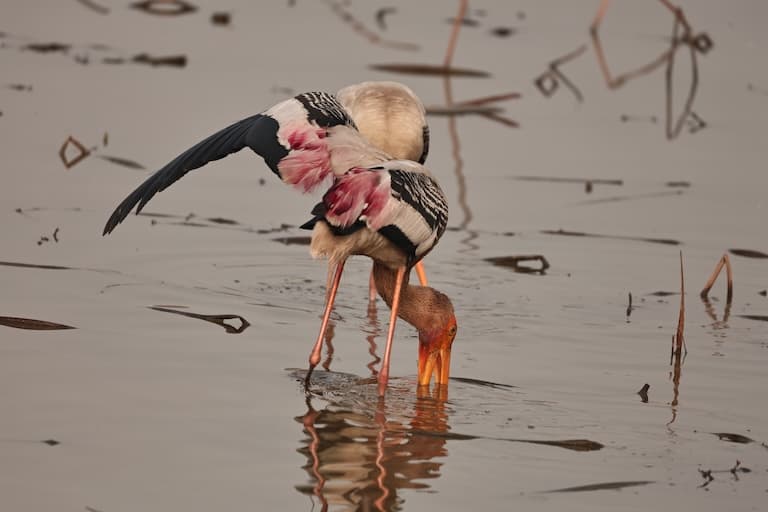
7. Local threats are no match for them
The population of painted storks is thought to be on the rise.
Human impacts on this species include pollution, habitat destruction, wetland drainage, and direct persecution, but none of this seems to be baking a dent in their numbers.
The IUCN has them listed as Least Concern and increasing, which in all honesty is exactly what they deserve for being such incredible, cold-blooded, poo-covered killers.2
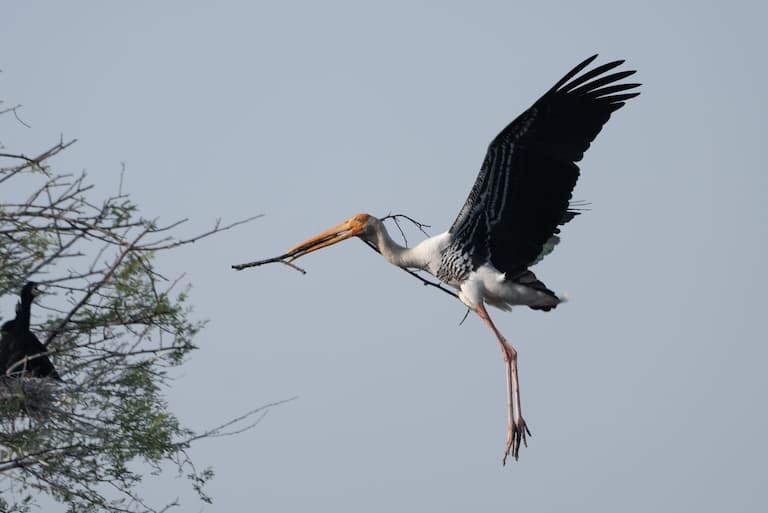
Painted Stork Fact-File Summary
Scientific Classification
| Kingdom | Animalia |
| Phylum | Chordata |
| Class | Aves |
| Order | Ciconiiformes |
| Family | Ciconiidae |
| Genus | Mycteria |
| Species | leucocephala |
Fact Sources & References
- Julian et al (2023), “Keeping cool with poop”, Research Gate.
- “Painted Stork”, The IUCN Red List of Threatened Species in 2023.