
Pacific Hagfish Profile
As vertebrates, adjectives like “Slimy” and “Spineless” are thrown around as insults, but as the Pacific hagfish would tell you (if it had jaws), these are features in its success story as one of the oldest forms of vertebrate on the planet.
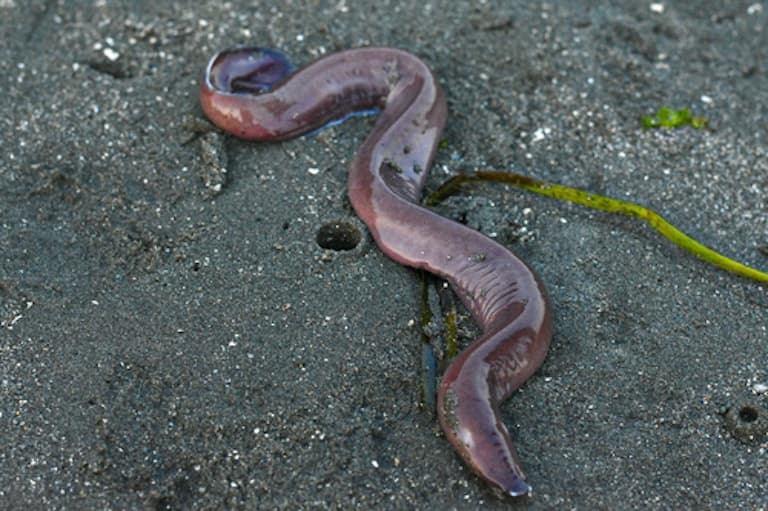
Pacific Hagfish Facts Overview
| Habitat: | Marine, benthic, on the continental shelf from 16-966 m deep |
| Location: | Northeast Pacific Ocean, also likely as far south as Costa Rica |
| Lifespan: | Unknown |
| Size: | Up to 63 cm (25 in) |
| Weight: | Up to 450 g (1 lb) |
| Colour: | Reddish grey/brown |
| Diet: | Worms, crustaceans |
| Predators: | Few |
| Top Speed: | Unknown |
| No. of Species: | 1 |
| Conservation Status: | Data Deficient |
If you ever thought the lamprey was the mascot of the Silurian, chances are the hagfish can do you one better. This is the “other” jawless fish and a modern version equipped with modern solutions for being jawless in a jawed world. The Pacific hagfish is one of a whole bunch like it, and comes packing slime, loose skin, and the habit of squirming into crevices you don’t want them in.
Interesting Pacific Hagfish Facts
1. They’re old
Hagfish and lampreys may look similar, but they are separated by twice the evolutionary distance as you and the earliest reptiles.
In the Silurian period, vertebrates were offered the choice: evolve jaws or die out and move over. Hagfish and lampreys rejected both options and just continued in defiance, being traditionalists in the sense that they have changed far less in the time since than almost anything else.
Pacific hagfish are just one of 83 known species still around today, and the world has changed so much around them that it has made them look very weird in relative terms.
One way to not evolve much, is to not metabolise much. And hagfish have this down pat.
2. They are cold
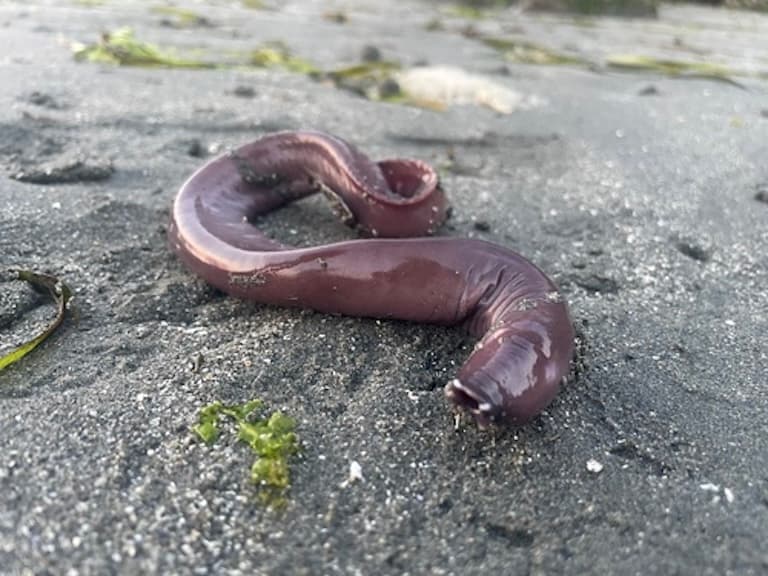
Hagfish metabolism is remarkably slow, even for a fish. They have the lowest known metabolic rate among fishes, and this means they use almost no oxygen and so can live in water where most other fish can’t even breathe.
As we’ll discuss, this grants them special access to a wealth of decaying anuses that other species can’t exploit, but it also means they can live a long time and change not a lot. In fact, when vertebral columns came on the market, they refused those, too.1
3. They’re spinless
Hagfish are the only known animals to have a skull but no spine. Usually, it’s both, sometimes it’s neither, but in this case, they have chosen to be weird again.
Their skin is loose on their spineless figures, and this makes it very hard to bite into one – not that you’d want to – and keeps them relatively protected from jawed predators.
It also means they can squeeze into tiny openings only half the width of their bodies, and we’ll talk a bit more about that soon, too.
4. They’re slimy
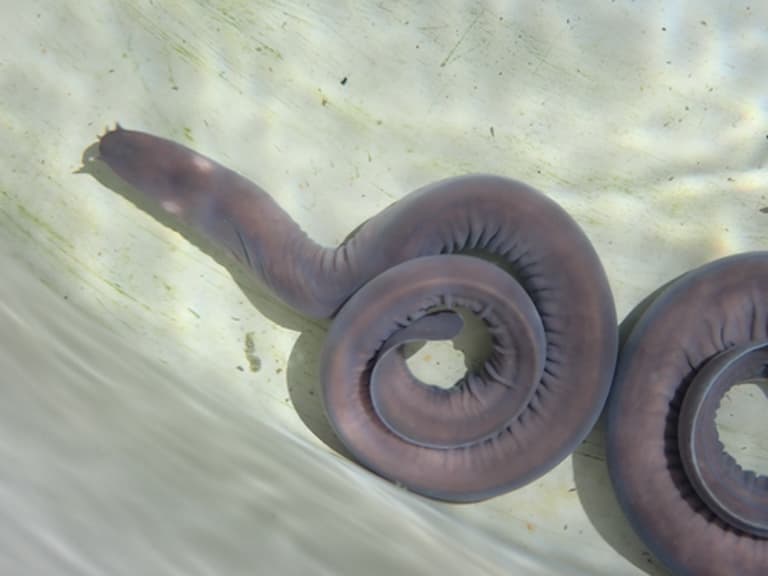
The thing hagfish are best known for by fishermen is their incredible slime. When bothered by a predator or YouTuber, the hagfish releases special proteins from its weird skin that blend with the water and create a slime that’s so thick it can clog the gills of a fish and suffocate it.
This also ruins fishing nets, which means hagfish are not traditionally respected in the fishing industry either.
This slime is difficult to remove, weighs a whole load because of all the water in it, and probably doesn’t taste good either.
But it’s an expensive defence! It can take a month for the hagfish’s protein supply to fully recover from a good sliming.2
5. They have bad eyes
One feature of this animal that isn’t primordial is its eyes. As crap as they are, the reduced eyes of the hagfish actually come in later on in its evolutionary journey. It’s as if the hagfish got overconfindent with the lack of spine and jaws that it volunteered its vision as well.
It was once thought that the skin-covered eyeballs of this ancient slimeball were indicative of some kind of basal eye in vertebrates, but on closer inspection, a lot of the hardware for a complex eye is still there – only reduced and vestigial.
So, this is an animal that dabbled in modernity, but didn’t really care for it. And when a lot of your feeding behaviour involves wriggling up bums, you don’t really want to be able to see them anyway.
6. They will wriggle up your bum
If it ever turns out that cetaceans beach themselves to die in peace, this animal might explain why.
Hagfish are scavengers and predators of small animals, but are very enthusiastic about feeding on big ones, too, if they get the chance. That opportunity primarily comes when a large animal is dead or dying, at which point it’s incapacitated enough for the hagfish to bypass its thick skin and enter the body to eat its soft tissues.
The best way into a fresh corpse or dying animal is through the mouth. The second-best way is through the anus. Hagfish have no shame and come with their own lube, meaning that the final moments for a large, sick animal in hagfish territory are perhaps the most unpleasant of its life.3
Hagfish are able to tie themselves in knots to create leverage to shear off tissue from their prey, and will patrol the sea bed just waiting for the chance to do so.
Their mouths are unique in that they have no jaws but are able to leverage their weird, flat faces to create a biting force nonetheless. Their dental plates are symmetrical and hinged, and unlike jaws, close laterally, making them even more alien than the superficially-similar lampreys.
Unlike lampreys, hagfish don’t have a juvenile stage though, and are born this weird from the get-go.4

Pacific Hagfish Fact-File Summary
Scientific Classification
| Kingdom | Animalia |
| Phylum | Chordata |
| Class | Myxini |
| Order | Myxiniformes |
| Family | Myxinidae |
| Genus | Eptatretus |
| Species | stoutii |
Fact Sources & References
- Georgina et al (2010), “Anoxic survival of the Pacific hagfish (Eptatretus stoutii)”, Springer Nature Link.
- Sarah et al (2018), “Cellular mechanisms of slime gland refilling in Pacific hagfish (Eptatretus stoutii)”, Journal of Experimental Biology.
- Clark & Summers (2011), “Ontogenetic scaling of the morphology and biomechanics of the feeding apparatus in the Pacific hagfish Eptatretus stoutii”, Wiley Online Library.
- Mincarone (2009), “Pacific Hagfish”, The IUCN Red List of Threatened Species in 2009.