
Paddle-tailed Darner Profile
Birds are pretty cool up there, making us feel slow and lumbering on the ground. Bats even do it in the dark! But vertebrates are relative newcomers to aviation, having first developed flight sometime around 220 million years ago. That sounds like a long time, but by then insects had already been at it for 100 million years or longer.
Some of the first animals to take to the skies were ancestors of the dragonflies, and today, animals like the paddle-tailed darner are still showing us the upper bounds of flight. They are fast, agile, can fly backwards and even tactical in a dogfight. And if you’re unaware of how these prehistoric predators ruled the skies, the Paddle-tailed Darner is a wonderful example to start with.
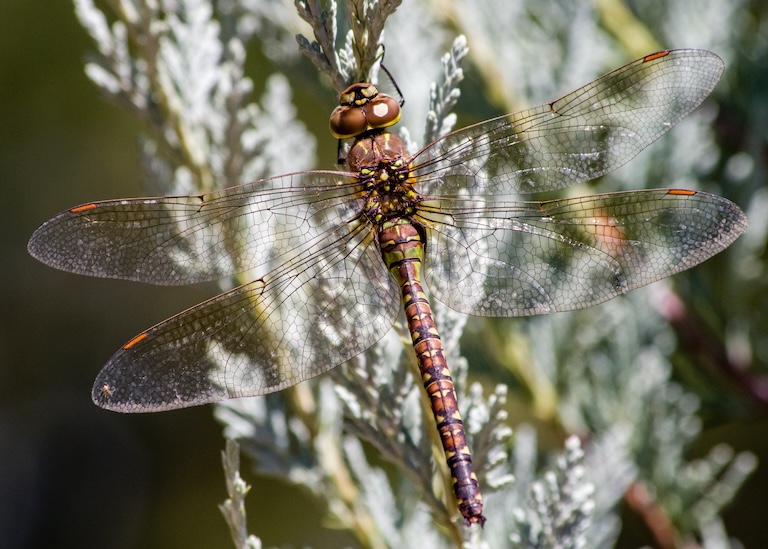
Paddle-tailed Darner Facts Overview
| Habitat: | Forested landscapes around lakes, ponds, and slow streams, usually with dense shore vegetation |
| Location: | Western Canada and the United States |
| Lifespan: | Likely around 3 years |
| Size: | Around 75 mm (3 inches) long |
| Weight: | Unknown |
| Colour: | Blue with black bands and some yellow markings on face and thorax |
| Diet: | Insects, other invertebrates, even fish and tadpoles |
| Predators: | Birds and bats |
| Top Speed: | Very fast! Top speed unconfirmed but they are some of the fastest flying insects. Another darner species was recorded at 58 km/h (36 mph). |
| No. of Species: | 1 |
| Conservation Status: | Least Concern |
Interesting Paddle-tailed Darner Facts
Paddle-tailed Darners are some of the largest dragonflies around. As darners they are chunky, extremely fast and ruthless predators of smaller animals. We should all be very grateful for the fact that they’re not big enough to pose a threat to us, as there is very little in the sky that could ever compete with one.
This species is a worthy member of a proud genus of mosaic dragondflies, making it as pretty as it is lethal.
1. They’re Mosaic Darners
Dragonflies are insects, belonging to one of the coolest orders of insect there is: Odonata. The name comes from the Greek for “tooth” as their mandibles, unlike those of ants or wasps, are distinctly toothed on the cutting surfaces.
And that’s because these are top predators of the insect world. The order contains the dragonflies, but also the damselflies, and these two are distinguished from one another in general the same way you judge someone on the tube: dragonflies splay their wings out to the side, while damselflies hold theirs together neatly to avoid taking up too much room.
Dragonflies are grouped as an infraorder beneath Odonata, with around 3,000 species in five families. The Aeshnidae family makes up about 450 of these and are known as the hawkers, or darners. These are some of the largest dragonflies you can find, with a few reaching over 8 cm long.
The paddle-tailed darner is a large dragonfly, but not quite that big. It’s a member of the genus Aeshna, known as the mosaic darners, and sit comfortable at around 7 cm long. 1
2. They’re forest dragons
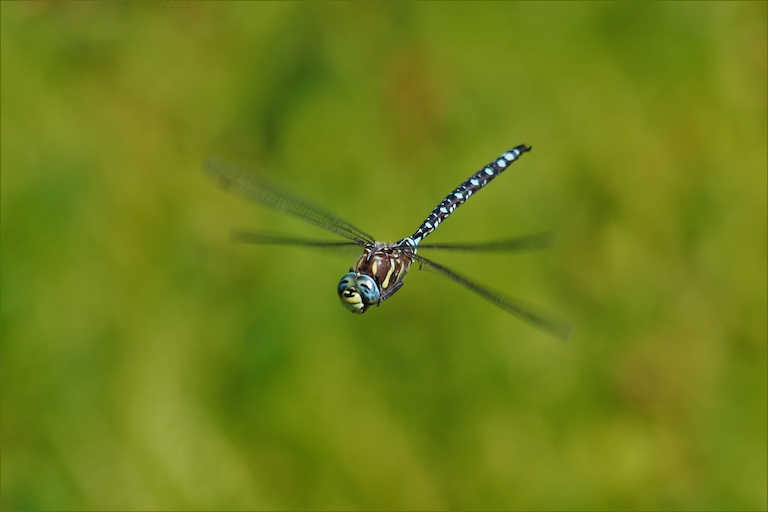
The paddle-tailed darner, like most dragonflies, prefers the edges of waterways. Its larvae are as dangerous as the adults, spending their time terrorizing the inhabitants of ponds, slow streams and lakes.
Adults prefer dense vegetation in forested regions, and this gives them a kind of Carboniferous quality, as if they are echoing their pioneering insect ancestors who first took to the air uncontested 400 million years ago.
These are not fussy animals, though; they will happily colonies suburban ponds, but there is no question that the paddle-tailed darner is carrying the torch for the longest aerial predator lineage the world has ever known. 2
3. They’re big!
The largest of these dragonflies reaches over 7 cm long, perhaps as much as 8 cm, and this is really quite beefy for a modern dragonfly.
They’re stunningly coloured, loud when in flight, and perhaps the most worrying fact about them is that they are large enough to kill vertebrates.
This nimble killer preys mostly on insects, but will take a frog or two when it can, and has powerful enough jaws to saw through human flesh as well. Fortunately for human flesh, they don’t see us as food and won’t attempt this unless you catch one, but this is definitely one of the few dragonflies large enough to make you bleed if you let it.
This size doesn’t appear to have come at a cost to its speed, either. 3
4. They’re fast!
The aquatic nymphs of this species patrol the freshwater vegetation for tadpoles, mosquito larvae and other soft critters, but the glorious adults they will one day become are hunters on the wing, and they are some of the best to do it in over 400 million years.
Dragonflies are up there with the fastest insects known to our kind, and an Australian relative of this one was clocked moving at 58 km/h, so the chances are good that this one is similar.
But speed is only one context around this animal’s greatness. What makes it truly outstanding is what it can accomplish at speed. 4
5. They’re badass.
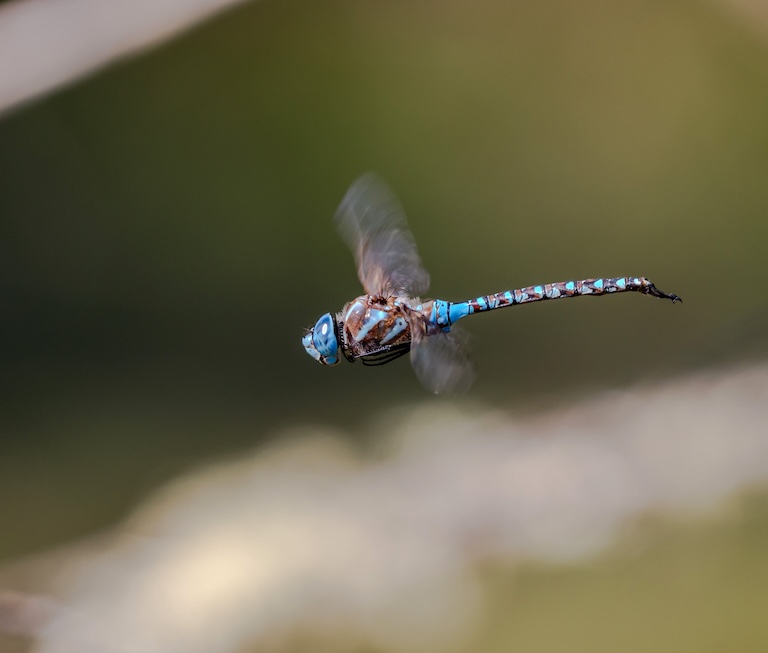
Male Paddle-tailed Darners are territorial and aggressive animals. Their feuds occur with such swiftness, however, that we struggle to compute what’s going on with our fatty brains and require technology to really get a handle on it.
When battle commences, fighting dragonflies adjust their flight paths to maintain a bearing on their opponent. That means that from their enemy’s perspective, they don’t change position. The hapless subject of the attack would only notice its rival getting larger in its field of vision, camouflaging its direction as it approaches. And it does this despite the victim itself being on the move at pace.
Dragonflies like the paddle-tail darner can hover, fly sideways, and even fly backwards to accomplish such feats, and this alsomakes them the most accomplished predators on record: up to 97% of their attempts result in a kill.
For perspective, the tiger, who is arguably the only predator sexier than the dragonfly, has a kill percentage of around 5%.
Even dragonfly young are nippy! They shoot water out of special valves in their abdomens to rocket through the water, snatching prey by way of an extensible jaw like Geiger’s Alien. 5
6. They’re still doing great.
Paddle-tailed darners haven’t been assessed recently enough, but back in 2014 when they last were covered by the IUCN they had a stable and healthy population spanning much of the western US. There were no significant threats are assigned to them, and they were listed as Least Concern.
With any luck, they’re still thriving in the same way, outclassing all other flying animals who dared try to compete with the Carboniferous kings. 6
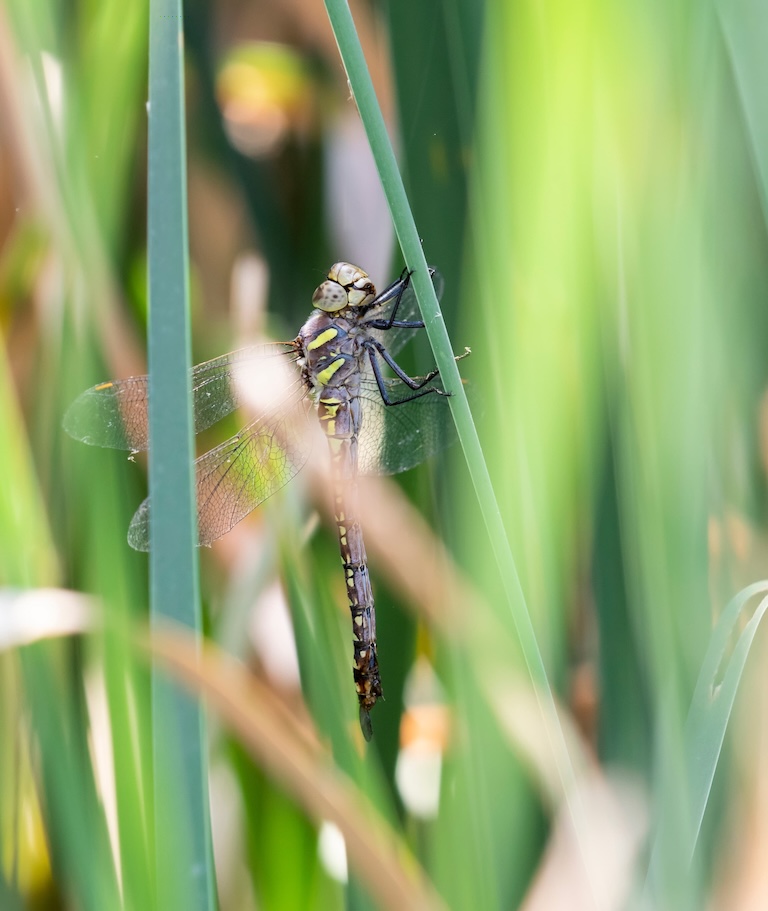
Paddle-tailed Darner Fact-File Summary
Scientific Classification
| Kingdom | Animalia |
| Phylum | Arthropoda |
| Class | Insecta |
| Order | Odonata |
| Family | Anisoptera |
| Genus | Aeshna |
| Species | palmata |
Fact Sources & References
- (2025), “North American Odonata”, Puget Sound.
- Department of Environment and Natural Resources, GNWT (2025), “General Status Ranks of Wild Species in the Northwest Territories”, Research Gate.
- Dan Nelson (2023), “Aeshna palmata (Paddle-tailed Darner)”,10000 Things of the Pacific North West.
- Christy Solo (2024), “Crawlies with Cri: Paddle-tailed darner”, Illinois Valley News.
- (2026), “Paddle-tailed Darner – Aeshna palmata”, Montana Field Guide.
- Paulson et al (2014), “Paddle-tailed Darner”, IUCN RedList.