
Pacific Lamprey Profile
The benefit of the hyphen is never more apparent than when describing the scary-ass monsters that are lampreys. Without it, they become even worse, and it’s bad enough that the Pacific Rim is teeming with them!
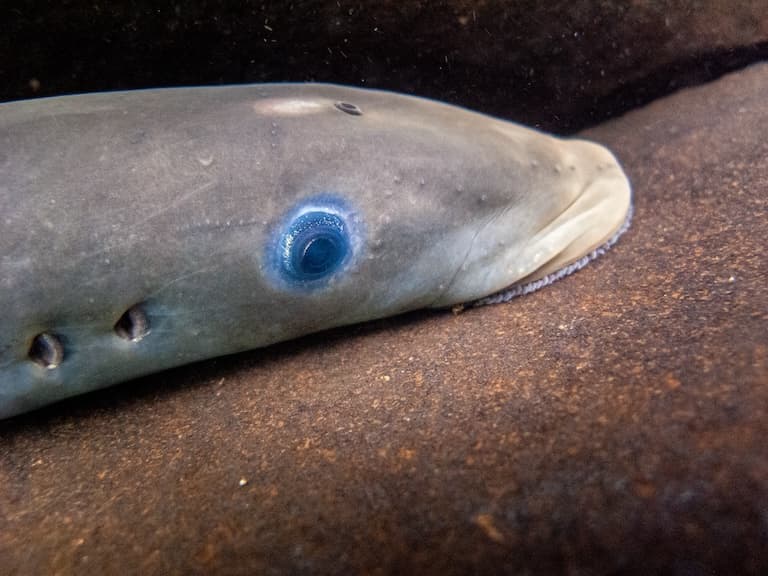
If there’s ever a word you don’t want associated with the word “rim”, it’s Lamprey. Yet, here we are. But once the discomfort passes, and you gaze into the steely, blue eyes of the Pacific Lamprey, you might realise that you’re looking back over half a billion years into an animal that knows exactly what it’s doing.
Pacific Lamprey Facts Overview
| Habitat: | Near the shore or in deep water of up to 1,508 m (4,946 ft) deep |
| Location: | Pacific Rim, from the surface down to 1500 metres |
| Lifespan: | Up to 17 years |
| Size: | 80 cm (31 in) long |
| Weight: | Up to 450 g (1 lb) |
| Colour: | Dark blue on top and silver or white underneath, becoming reddish brown during mating season |
| Diet: | Algae, microorganisms as larvae; |
| Predators: | Many fish, birds and mammals |
| Top Speed: | Not reported |
| No. of Species: | 1 |
| Conservation Status: | Least Concern |
Pacific lampreys look a lot like they were made as an afterthought. They are long, featureless and slimy, and seem to generally suck. But these are some of the oldest archetypes of vertebrate morphology around us today, and they’re still around for a reason. Pacific lampreys are better at life than they appear to be, and the proof is in their resilience, their simplistic approach to life, and their substantial contribution to every level of their ecosystems.
Interesting Pacific Lamprey Facts
1. They’re Agnathans
The jaw is something we vertebrates take for granted, but it came at a huge cost. While 99% of vertebrates now have one, this wasn’t always the case, and for a long, long time, our kind had flat, sucker-like faces that were great for sticking to windows but useless for eating an apple with (neither apples nor windows had been invented at this time, though).
Modern vertebrates evolved jaws from gill arches around 420 million years ago. Most did, anyway. Many of the jawless branches simply died out, but one group of vertebrates, the agnathans, or “jawless fishes,” are still around after five mass extinction events, and are refusing to budge.
Hagfish and lampreys are they, and as gormless as a missing jaw makes them look, they are a testament to a truly primordial evolutionary solution that still works.
Lampreys are similar to hagfish in appearance, but not much genetically. They are separated at the order level, with the lampreys granted their own order: Petromyzontiformes – thought to be 500 million years apart from the hagfish order. This means they are even more distant from hagfish than you are from a coelacanth.
2. They’re an orthodontist’s nightmare
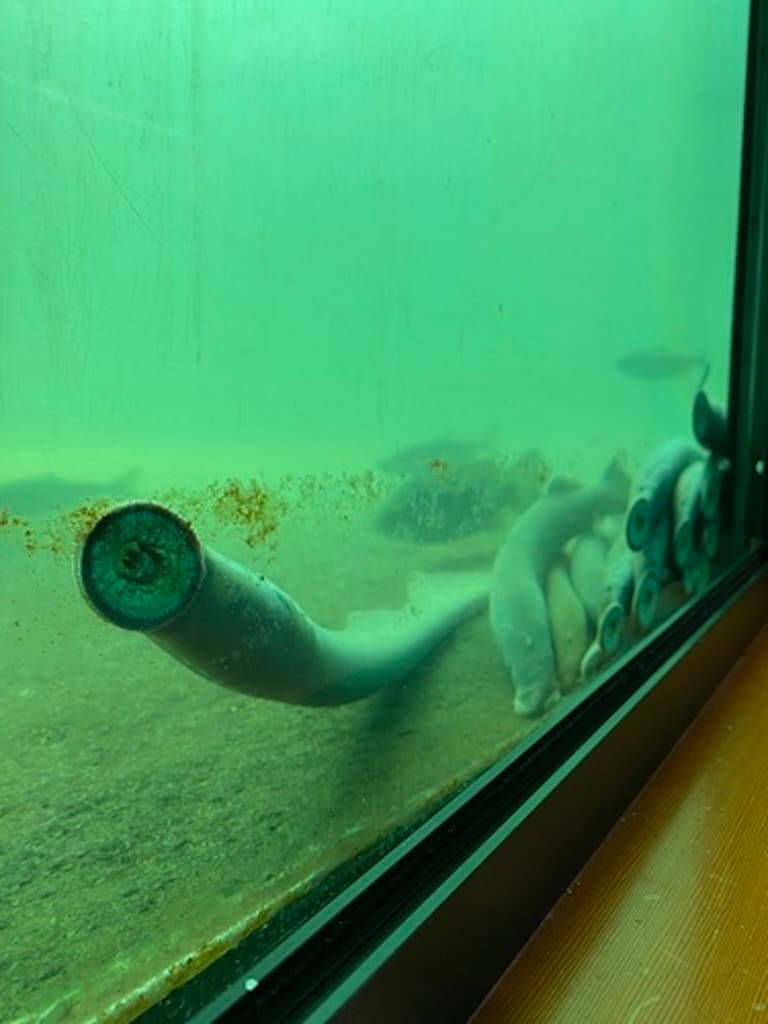
Having no jaws, lampreys instead have to place their weird teeth around a circle of tissue on the front of their heads.
As strange as this may appear, it’s a winning strategy, and each species has a slightly different way of doing it. Lamprey species, then, can be identified by counting and picking out the specific arrangement of their weird teeth.
Pacific lampreys have three large front-facing teeth and several “posterior” teeth behind them on the oral disc. These three teeth give the species its name: tridentatus.
But this only works once they reach adulthood, and this can take some years1!
3. They’re babies for a long time.
When we describe a beetle, we are belying a human bias towards adulthood as the animals whose reproductive stages make up the majority of their lives. Yet the beetle is perhaps better defined by the 95% of its life spent burrowing into food as a grub, and not the brief but recognisable stint as an armoured hexapod.
Likewise, Pacific lampreys have a larval stage that takes up most of their lives, and this can be many years. They hatch from one of up to 250,000 eggs (though more commonly 100,000 or fewer) released by their mother 19 days earlier and stay in freshwater for up to 17 years (in extreme cases, all thew time in their larval stages).
Throughout most of this time, they burrow into substrates on the river bed and filter nutrients out of the water, from algae to tiny microorganisms.
When they’re ready – and only then – they will go through a metamorphosis and adopt their final forms2.

4. They’re semelparous.
As the larvae develop into adults over several weeks, they grow eyes, change colour, and grow their characteristic disc-shaped mouths. This generally takes from summer to winter, and the adult emerges, ready to suck on stuff.
They emerge from the river bed and make their way to the ocean, latching onto fish as they go.
Lampreys are known as semelparous, which refers to the fact they only breed once, and then die. This final form is short-lived, and will carry them into the ocean to spawn, after which they’ll give up being lampreys and become food for other animals instead.
And being that they are so nutritious, they are very important snacks for wildlife!3!
5. They’re fatty
These basic-looking animals are far from it, as we have discussed. But not only are they remarkable in their own right, they are incredibly powerful as contributors to their ecosystems.
Fields of lamprey larvae in rivers clear the water of detritus and help keep the waterways clean. And as they do, they put on weight. Lampreys are incredibly fatty animals – four times richer in omega-3 oils than salmon!
Sea lions have not missed this fact and will leap at the chance to eat one. As will any number of other vertebrate predators.
So, the role of the lamprey is – as it has been for half a billion years – a critical one for their ecosystems. Yet, our presence threatens to do what five previous mass extinction events couldn’t.4
6. They’re in decline
Lampreys are in serious trouble in many local populations.
Globally, they are still in the green, listed as Least Concern by the IUCN as recently as 2020, but their numbers are dropping, and it’s our fault.
Primarily, our impact on Pacific lampreys comes from blocking their migration channels by building dams and other obstructions. Hydropower and irrigation have seen lamprey numbers plummet in the Columbia and Snake River systems.
Being fatty animals, they also have a high value in tribal human communities across their range, and have been commercially harvested to their detriment as such.
It remains to be seen how well this ancient mascot of the Silurian will adapt to our presence, but there is plenty we need to do to take better care of it in the meantime!5
6Pacific Lamprey Fact-File Summary
Scientific Classification
| Kingdom | Animalia |
| Phylum | Chordata |
| Class | Petromyzontida |
| Order | Petromyzontiformes |
| Family | Petromyzontidae |
| Genus | Entosphenus |
| Species | tridentatus |
Fact Sources & References
- “Pacific Lamprey”, U.S. Fish and Wildlife service.
- “Pacific Lamprey”, Alaska Department of Fish Game.
- “Pacific Lamprey”, U.S. Fish and Wildlife service.
- Oaster (2022), “Humble suckers: Pacific lamprey have survived 5 mass extinctions but are now under threat”, High Country News.
- Bogutskaya (2022), “Entosphenus tridentatus”, The IUCN Red List of Threatened Species 2022.
- Author Name (Year), “Article Name”, Publication.