
Palm Rat Profile
Some estimates suggest there are around 7 billion rats on the planet, which is one reason you’ve likely never been to the zoo to look at one. But ignoring the baselessness of these estimates, we also forsake rats to a tragic degree, and all because of a few tiny cases of them almost wiping out humanity with plagues.
In reality, rats are affectionate, intelligent, good-natured (not to mention remarkably successful) animals who just cause a bit of a pandemic here and there when there are too many of them in one place.
So, a lot like us. But unlike us, they generally have a very positive impact on their environments, so wiping them out causes more harm than good, and there might be no better example of the impacts of ignoring rats than the plight of the Nicobar native, the Palm Rat.
Note: There are almost no images of this species of rat anywhere online, so this is a great one for niche photographers to go out and snap!
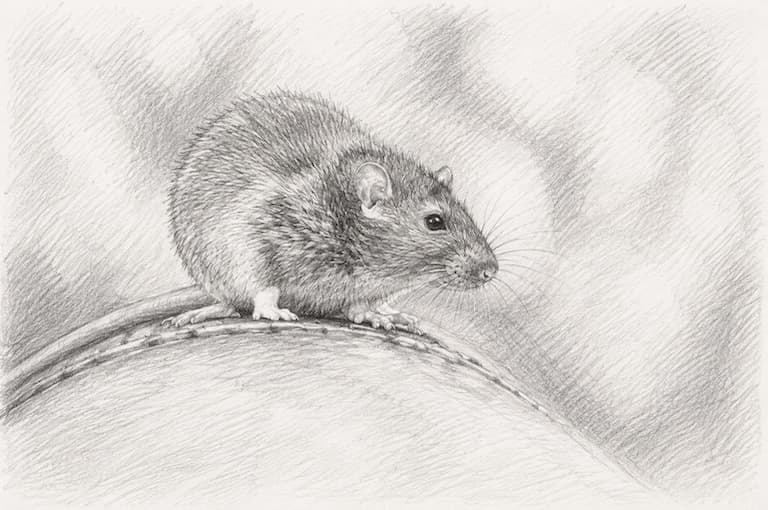
Palm Rat Facts Overview
| Habitat: | Dense vegetation, plantations, and subtropical mangrove forests. |
| Location: | Nicobar Islands |
| Lifespan: | Not recorded |
| Size: | Up to 20 cm (8 inches) long, including tail |
| Weight: | Up to 350 g (12 oz) |
| Colour: | Dark grey, blackish |
| Diet: | Plant material, insects, and small animals |
| Predators: | Raptors |
| Top Speed: | Scurrying |
| No. of Species: | 1 |
| Conservation Status: | Vulnerable |
The furious drive to succeed that rats possess, is another trait that resembles our kind’s approach to reproduction. Whether the island they find themselves on is ecologically prepared for them or not can be the difference between a thriving population and a rampaging one. The Palm Rat and species like it are both perpetrators and recipients of this phenomenon, which makes them equally fascinating as examples of how easily ecosystems can be disrupted.
Interesting Palm Rat Facts
1. No Nonsense Rat
Just 550 km or so west of Phuket lies a string of islands known as the Nicobar Islands. The archipelago is known as the Andaman and Nicobar Islands – a cluster of 836 islands, only 31 of which have people living on them!
Palm rats are found on several of them, most prominently on the main two, Great Nicobar (the largest) and Car Nicobar (the northernmost). They are sometimes referred to as Car Nicobar rats for this reason, but they should not be confused with another native of the archipelago, and the palm rats’ closest relative, the Nonsense rat.
Both rats are true rats, in the genus Rattus, the palm rat being R. palmarum, and the Nonsense rat being R. burrus. The origin of this species’ name is a bit of a mystery, but their habitats overlap. Both are threatened, but the poor Nonsense rat even moreso.
Before we go more into that, though, let’s look at where they live.
2. They live in one of the weirdest places on Earth
The Nicobar Islands make up only 22 of the Andaman and Nicobar Islands chain, but they are characteristic of remote tropical islands in that they contain some of the strangest and rarest animals in the world.
During the ice ages, the sea level dropped and these islands were connected to the mainland and to one another, and in that time they hosted a lot of wildlife that has since diverged in special ways. The Nicobar Pigeon is one of the better known ones, and one we’ve covered here before, but there’s also the elusive Nicobar Megapode, Nicobar spiny shrew, feral Indian elephants and 25 other species of rat.
Around a third of the species found on the islands are found nowhere else, making 1100 endemic species. The Palm rat is one of them. 1
3. They’re arboreal.
If you can get past the potential pathogens and (for some, the bald tail), rats are objectively excellent animals. They can swim, they can climb, they can talk, laugh and love; rats are successful for many of the same reasons we are, so to hate them is to shine a light on one’s self!
With all the traffic on these islands, it’s no wonder the palm rat needs to find a niche. This species in particular is an expert climber, to the point where it’s primarily arboreal. Palm rats scurry effortlessly through the tree branches, up walls, along vines – they are the murophobe’s worst nightmare. They have long tails, larger hands and feet, and are as intelligent, tenacious and crafty as you should expect from a true rat. Not to mention, adorable.
4. They have cool predators
Staying off the ground keeps the palm rat away from some of the terrestrial predators, both native and invasive, such as crocodiles and some snakes, but this is a lush, tropical wilderness, so there really are no safe places for a tasty little bite-sized mammal.
Water monitors are members of perhaps the coolest genus of reptiles since the Cretaceous, Varanus. Monitor lizards in general are pretty all-terrain predators, and these ones will climb trees in search of food if they don’t succeed in the ocean. 2
Pythons, too, are well known for climbing, but one of the coolest predators of the palm rat would have to be the Nicobar scops owl Otus alius. This little owl has bright yellow eyes and always looks either furious or rather surprised, depending on what it’s doing with them.
It’s not clear which of these threats is most troublesome to the palm rat, as the islands are not deeply studied. For example, the Nicobar scops owl is known from only two samples.
While palm rats are endemic to these special islands, arboreal rats and their ability to thrive in vertically arranged habitats have begun to cause a ruckus in ecosystems they have been brought to on human ships. 3
5. They could so easily be invasive
Florida’s semi-tropical climate has rendered it with a host of invasive species from both cooler and warmer climes around the world. Among the 500 or so invasive species, there are Burmese pythons, green iguanas, cane toads, and a pest commonly known as the roof rat.
This arboreal little rodent scurries effortlessly up buildings and devastates palm growers’ gardens.
Sound familiar? Roof rats in Florida are the European species Rattus rattus, commonly called the black rat or palm rat. This is considered to be part of the same species complex as our friend the Nicobar palm rat, though listed as a different species. To be clear, the Nicobar species, R. palmarum, cannot be blamed for destroying Floridians’ gardens directly, but the two species are remarkably similar in their ecology and biology, and likely originate from the same Asian mainland ancestor.
The Rattus genus is so widespread and prevalent that its taxonomic history is not clear, but it’s very obvious that the Nicobar palm rat would be perfectly evolved to wreak havoc in Florida if its sister species hadn’t gotten there first.
As it happens, unfortunately, the palm rat is experiencing invasive species from the other side of the fence.4
6. They’re forsaken
The Nicobar Islands are now home to a large amount of protected lands, but historically this was never a concern to the humans who arrived there, and they have their own invasive species such as pigs, rats, and snakes that were introduced by various groups who visited the archipelago on ships.
Cultivation of the land on these islands has also reduced the Palm rats’ habitats and the remaining population was confirmed to be very fragmented because of this.
Tsunamis in the last decade have further damaged their ecosystem, and when this species was last assessed in 2016, it was considered vulnerable.
Unfortunately, being a rat among birds, this species is well overdue an updated assessment, and its conservation status may well be a lot worse by now. On the other hand, an increase in palm cultivation could well have led to a boom in palm rats. So far, it’s hard to tell. 5
Palm Rat Fact-File Summary
Scientific Classification
| Kingdom | Animalia |
| Phylum | Chordata |
| Class | Mammalia |
| Order | Rodentia |
| Family | Muridae |
| Genus | Rattus |
| Species | palmarum |
Fact Sources & References
- Sankaran (1998), “The Impact of nest collection on the edible-nest swiftlet collocalla fuciphaga in the andaman nicobar Island”, Salim Ali center of Ornithology and Natural history.
- Butchart et al (2005), “Lost and poorly known birds: targets for birders in Asia”, Oriental Bird club.
- Denver et al (2015), “Nicobar Scops-Owl”, CornellLab.
- r/LilGrabbies(Year), “Fatty the baby Roof Rat eating a nut. She really earned her treat this time.”, reddit.
- Molur (2016), “Zelebor’s Nicobar Rat”, The IUCN Red List of Threatened Species in 2016.