
Paddletail Newt Profile
Newts are a funny group of lizard-like amphibians belonging to the Salamander group. They’re poorly understood, and in many places are disappearing at an alarming rate.
In China, there’s a group of newts that are hurriedly being studied with this in mind. These are Paddletail newts, and while some are being discovered as we speak, others are at risk of going extinct at any moment!

Paddletail Newt Facts Overview
| Habitat: | Freshwater systems |
| Location: | China |
| Lifespan: | 20 years in captivity |
| Size: | 19 cm long |
| Weight: | Not Recorded |
| Colour: | Brown to dark brown, sometimes with orange or red flecks; orange blotches on belly that fade as they mature |
| Diet: | Earthworms and aquatic invertebrates |
| Predators: | Birds and mammals |
| Top Speed: | Not listed |
| No. of Species: | 11 to 12 |
| Conservation Status: | Critically Endangered |
Paddletail newts are best known from the pet trade, as they are incredibly obscure in the wild. But this comes with its own issues, namely that collectors are far laxer about record keeping and naming schemes, and so information about them is somewhat inaccurate.
Still, there are some studies on wild populations, mostly from the one species that isn’t in the genus! But for Paddletail newt taxonomy, it’s best to wait and see, as their evolutionary relationships are still being figured out.
Interesting Paddletail Newt Facts
1. Spotless smooth warty newts
Newts are an interesting branch of the amphibian line. They’re very lizard-like (which is a bit backwards, since amphibians were this shape before reptiles even existed), though they are separated from lizards by almost 350 million years.
Newts are true salamanders, as they belong to the family Salamandridae, but not all true salamanders are newts; that name is reserved for members of the subfamily Pleurodelinae. These are the semi-aquatic members – the rest being fully aquatic – and make up around 100 species in eight genera.
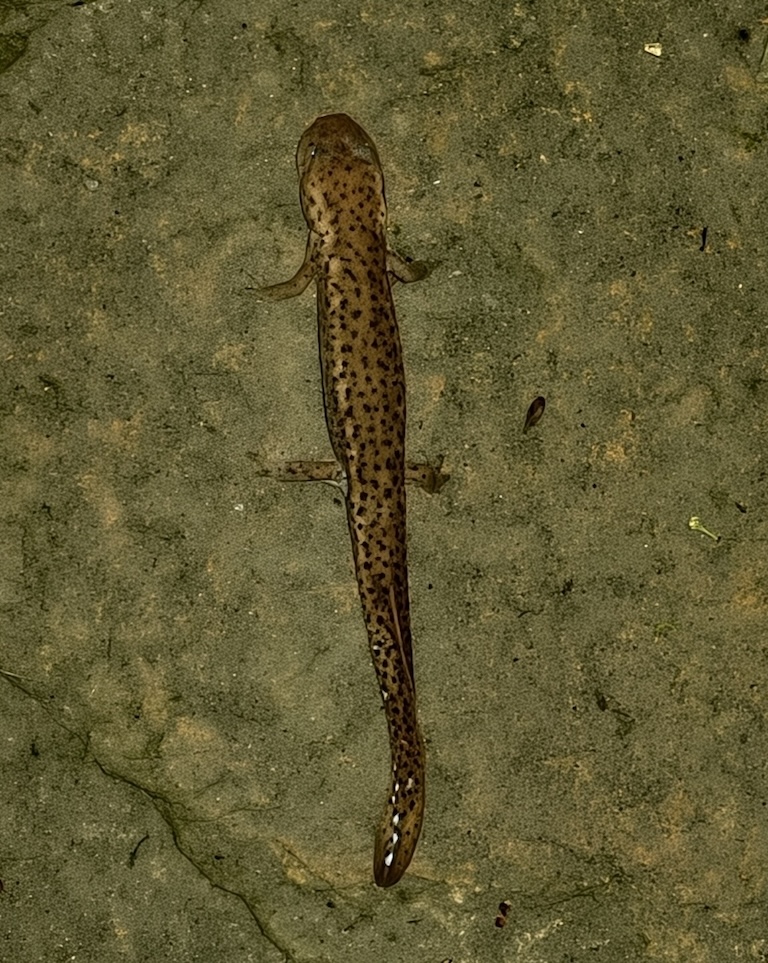
One of these genera is the dubious Paramesotriton, commonly known as warty newts, but they have one exception: Paramesotriton labiatus, the “spotless smooth warty newt”, and this is commonly called a paddletail newt.
But this is a bit of a red herring, as the Paddletail newts belong to an entirely different genus in the same family, known as Pachytriton.
Part of the reason for the confusion, and why the taxonomy of this group is still a bit of a muddle, is down to how rare they are.
2. They’re obscure
China has seen a surge in conservation efforts in recent decades, and so newt fans from all over the world have been rushing in to document as much as possible. But some of these species are incredibly obscure. For example, Paramesotriton labiatus, the spotless smooth warty newt, is currently only known from a single stream in a forest in China.
This of course limits the data available on it, but plenty more species are similarly restricted. And since these are popular animals in the pet trade, they get misnamed by amateur collectors and sold under various common and erroneous scientific names.
New species are still showing up, such as the 2025 arrival Pachytriton cheni, found at high elevations and making the 11th named species in the genus1.

3. They live for a long time
Paddletail newts are known from captive specimens more than they are in the wild, so their longevity in their natural habitat remains a mystery, but those kept by enthusiasts and researchers are said to live for up to 20 years!
That’s a very long time for such a small animal, which adds to their enigmatic aura, but, as we’ll discuss shortly, captive notes muddy the waters a bit when it comes to information on these salamanders.
Speaking of water, these semi-aquatic newts are relatively versatile relative to their other family members.
4. They are tough
One species with a fair amount of notes to its name is the very species that isn’t in the genus yet, Paramesotriton labiatus. This Paddletail is more aquatic than members of the Pachytriton genus, but its breeding habits can give us clues about the group in general.
It lives in a range of watery habitats, from pools to streams many metres across, and varying in depth and turbidity as well. These are nocturnal newts (another reason why it’s hard to study them!) and spend November to April hibernating under rocks.
So, they handle quite a range of temperatures and habitats as it is, and their namesakes spend even more time out of the water, presumably making them even more adaptable.
Mating occurs in the water, with the male approaching the female with a display of tail-fanning. If she’s interested, he’ll leave his deposit on the substrate and then she’ll follow behind him to pick it up. Females can lay up to 40 eggs, stuck to the lower surface of rocks. They will incubate for a whole two months and be guarded by the female throughout this period. She won’t hunt or leave the area during the incubation period, but may eat any eggs that die in the process.
5. Death Roll
This parental care has some resemblance to that of the crocodiles, whose powerful mothers guard nests on land, and who are also quite lizard-shaped.
And Paddletail newts – at least, this species of smooth warty newt – have another trait in common with their doppelgangers: the death roll.
But, this is on a much smaller scale, of course! This species has been seen hunting earthworms, and when two of their kind latch onto the poor worm, they begin furiously barrel-rolling.
This may be a feeding strategy, as it is in crocs, or it might be a defence mechanism to escape capture or attack by a rival. Other defences described included the release of a sulphurous odour and vomiting up food, both of which were described as a result of capturing wild newts.
Threat displays, too, include raising the head and legs and showing off the red underbelly as a deterrent.
6. They’re better known as pets
As we mentioned, paddletails are more commonly investigated in the comfort of the homes of those who keep them.
They’re said to be aggressive towards other newts, and best kept alone, but make decent alternative pet for beginners and children due to their low maintenance. They’re cute, interesting, and not remotely dangerous unless you’re a mealworm, and it’s said they even have individual personalities.
But this comes with a huge caveat: captive species are commonly mislabelled, so data about them is jumbled and species often can’t be accurately determined.
Another consideration is that the pet trade might be one of the threats to the wild populations on account of local people selling them2.
7. Threats
Chinese medicine is the first threat to consider, as this is usually based on relentless ignorance rather than therapeutic benefit, so it’s not only destructive to wild newt populations, but pointlessly so.
But pet traders, too, harvest newts from the wild, and this is thought to be having some effect, though the data is so thin on the ground that it’s hard to know how bad the situation is.
Logging, dams, and the destructive nature of local fisheries are all recognised as threats as well, and the assessments for the various species are either out of date or entirely non-existent, so this is a group of amphibians with a fairly urgent need for an update.
According to the IUCN, most members of this genus are threatened by habitat destruction due to deforestation and tourism and by climate change. The good news though, is that the protection of forest habitats has reduced deforestation to the point where it is no longer a threat to those species living in protected areas3.
Three of the listed species are of Least Concern, but the remaining 8, including the exceptional smooth warty newt, are in more trouble. Three are Endangered, three more Critically Endangered, and the rest are either Near Threatened or Vulnerable.
Paddletail Newt Fact-File Summary
Scientific Classification
| Kingdom | Animalia |
| Phylum | Chordata |
| Class | Amphibia |
| Order | Urodela |
| Family | Salamandridae |
| Genus | Pachytriton |
Fact Sources & References
- Zhirong (2025), “A New Species of Pachytriton (Amphibia: Caudata: Salamandridae) from Anhui, China”, MDPI.
- (2012), “Paddle Tail Newt Care Sheet”, Publication.
- (2022), “Pachytriton airobranchiatus”, The IUCN Red List of Threatened Species 2022.