
Polish Chicken Profile
Chickens are the most populous vertebrate on land, and all because of humanity’s preference for kievs and omelettes. Good farm chickens provide meat, eggs and fertiliser to all who need it, and millions of tonnes of avoidable greenhouse gases from those who don’t. Some breeds lay a lot, others get huge and meaty. And some do nothing of the sort.
Today’s chicken is one that doesn’t lay well, isn’t meaty, doesn’t play well with others and readily gets covered in parasites. So, why have them at all?
Well, some say this is the royalty of poultry, and their spectacular crest and colour variations makes it clear why. The Polish chicken is a rare example of a chicken kept on (or despite) its own merit, and not because we like to consume the things that come out of its bottom.

Polish Chicken Facts Overview
| Habitat: | Domestic |
| Location: | Mostly in Europe but found worldwide |
| Lifespan: | Around 8 years |
| Size: | Around 40 cm (15 inches) tall |
| Weight: | Up to 2.7 kg (6 lb) |
| Colour: | Varied including: white, black, blue, and cuckoo/mottled |
| Diet: | Chicken feed, grass |
| Predators: | Foxes |
| Top Speed: | Not listed |
| No. of Species: | 1 |
| Conservation Status: | Not Threatened |
The Polish chicken is said to be kept all over the world by an ever-increasing selection of very serious breeders. “Serious” in this context must be subjective, since it’s a ridiculous animal to have anywhere near you. Polish chickens aren’t strong layers, get pecked to pieces if kept with other hens, need a surrogate to incubate their eggs and are scared of their own reflection to the point of bolting out of the area and getting lost if given too much freedom.
Some say they’re the royalty of poultry due to their appearance, but it’s equally likely to be down to their history of inbreeding and a need to be held aloft by the less glamorous masses.
Interesting Polish Chicken Facts
1. Nobody knows where they come from
You’d think the name would give it away, but the Polish chicken isn’t a native of Poland, at least as far as anyone knows. The truth is, the origin of this distinctive breed is a mystery.
Chickens that look a lot like it are in paintings from the 1400s, found in the Netherlands and Italy, but where it came from before that is unknown. The name may stem from the Dutch pol for “head”, referring to its incredible crown.
A Roman archaeological dig brought up a hen looking much like this one, suggesting they could have been brought in by the Romans to begin with, and if so, this would make them the oldest breed still present in Europe.

2. Bearded, Non-bearded and Frizzle
This is a soft-feather, lightweight chicken, and this means they’re not for eating, as they simply don’t have much meat on them at all.
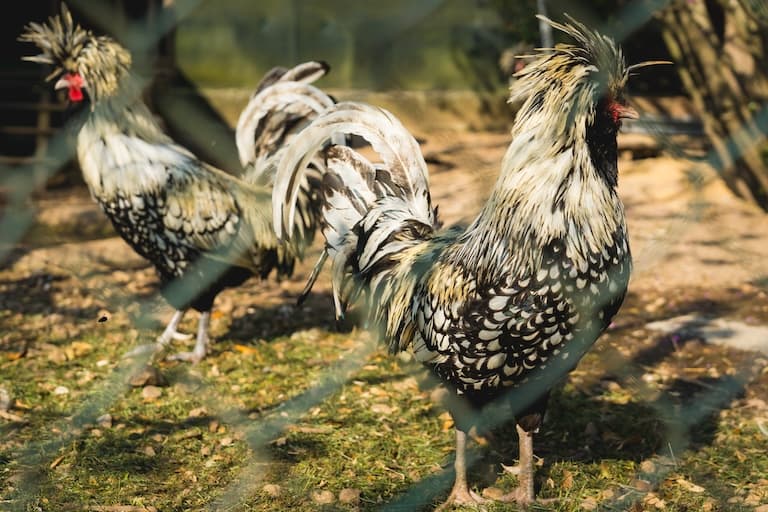
These are feather balls, coming in a variety of colours from the most common: black, blue, and cuckoo, to the less common partridge and buff.
Most are plain coloured, but some individuals come with patterns! They are, of course, well known for their glorious locks, but some also come with beards. There are bearded, non-bearded, and frizzle varieties on top, frizzle being the condition of their feathers being extra fluffed up and slightly curly1.
3. High maintenance breeds
As you’d expect from all this, these chickens have a lot going on, and their super fluff is a great substrate for a variety of chicken parasites.
Lice and mites love to live on Polish chickens, so keepers have to take extra care to keep the flock healthy.
Their crests can be trimmed to reduce this risk, but that really leaves no reason to get them at all2.
4. They can be panicky
Polish chickens are said to do better inside smaller enclosures, and secure ones at that. They are easily confused, get lost, and are prone to panicking if they’re given too much space, and this adds to the maintenance requirements of the breed as a whole.
And even keeping them contained comes with its drawbacks if you want to have any other breeds with them.
5. They get bullied
The wonderful crests that are the primary selling point of this animal, are also primary targets for other chickens. Chickens love to bully one another, often to death if they are able, and the lightweight, pompous Polish chicken is ripe for the pecking in this regard.
Some even suggest they don’t see very well, which might be a product of their in-breeding, which has resulted in a bird that doesn’t seem to even want to reproduce.
6. They kill their own babies
While these chickens aren’t for meat, they don’t produce a lot of eggs, either. They’re slow layers, but when they do have a clutch, they refuse to sit on it anyway. So, you need to bring your own incubator or surrogate mother if you want to breed them.
Occasionally, a hen will sit on a clutch, but even if they hatch, she is prone to attacking and killing them regardless. So, it’s really not an easy job to defend keeping these chickens in the first place3.
7. The Royalty of Poultry
Despite all their flaws, Polish chickens have been desired as the royalty of poultry. This, as we have mentioned, might be true in more ways than one, but they certainly seem to have a Game of Thrones approach to family matters, and a lot more glamour than brains4.
Still, among a flock of adults, they’re said to be gentle and docile chickens, curious, active but skittish. Their high maintenance seems hardly worth it unless you enjoy the work5.

Polish Chicken Fact-File Summary
Scientific Classification
| Kingdom | Animalia |
| Phylum | Chordata |
| Class | Aves |
| Order | Galliformes |
| Family | Phesianidae |
| Genus | Gallus |
| Species | gallus domesticus |
Fact Sources & References
- Smith (2020), “Breed Profile: Polish”, Back Yard Chicken Coops.
- Coop (2016), “Keeping Polish chickens ”, Backyard Chickens.
- (2025), “Polish Chickens Breed Profile”, Manna Pro.
- (2019), “The Polish Chicken: “The Royalty of Poultry”, Backyard Poultry.
- (2023), “Polish Chicken Breed”, My Pet Chicken.