
Pomeranian Goose Profile
If you have room for them, geese make excellent additions to a casual menagerie, whether it’s a farm or farmstead, or just a home that you like to share with other species. Geese have character, and this isn’t something many people can handle, as it’s often the character of being a complete jerk.
As bold as they are, though, they’re mostly harmless, and make sneaking onto your property almost impossible, so for some it can be worth the adjustment. And there are so many breeds to choose from!
This one, the Pomeranian Goose, is an all-rounder and a great place to start.

Pomeranian Goose Facts Overview
| Habitat: | Domestic livestock |
| Location: | Mostly Europe, but worldwide |
| Lifespan: | Sometimes more than 20 years |
| Size: | Up to 90 cm (35 inches) long |
| Weight: | Around 7.3 kg (16 lb) |
| Colour: | Barred, brown backs, bellies and heads, with white plumage elsewhere and a red beak |
| Diet: | Various grasses, clover, alfalfa, seed heads, wheat, maize, barley and beans |
| Predators: | Foxes, coyotes, raccoons, raptors, humans |
| Top Speed: | They’re poor flyers, on account of their weight |
| No. of Species: | 1 |
| Conservation Status: | Not listed |
Pomeranian geese, like the Pomeranian dog, mean different things to different people. Whether you find them cute and full of character, or obnoxious little shits, depends a lot on your social class and tolerance to snappy behaviours.
They’re an old, domestic breed of goose, a breed of greylag, designed to be heavier and with a very juicy bum. These
Interesting Pomeranian Goose Facts
1. They’re greylags.
There are 60 or so breeds of domestic geese all over the world, and they originate from two distinct species. In the Far East, most breeds come from what are often called Chinese geese, or Swan Geese. But the Pomeranian goose comes from the “other” branch: the Greylag.
Both branches have descendents that can now be found all over the world, but the majority in Europe, Western Asia and Northern Africa are from the greylag, too.
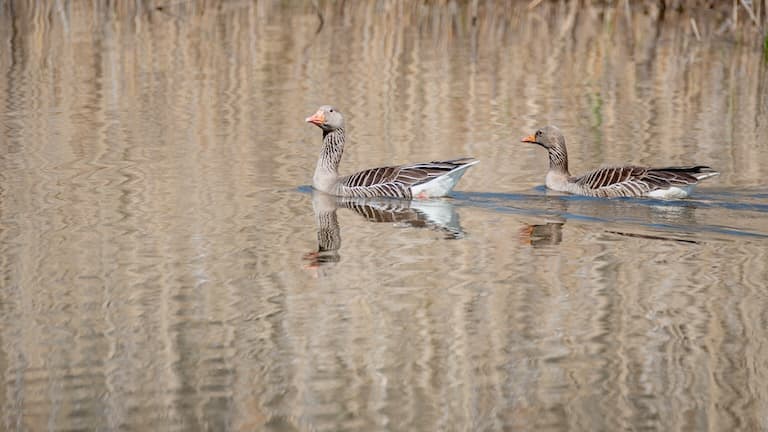
Pomeranian geese look very similar to their wild ancestors, but they have been bred to be much chunkier.
2. But heavier
A very fat greylag goose might reach around 4.5kg in weight. That’s a lot to carry on the wing, so they don’t get much heavier than that. But a domestic goose doesn’t need to do much flying at all and can afford to be heavier.
The Pomeranian goose reaches up to around 8 kg in weight, and is usually at least 7 kg when fully grown.
And like modern pop musicians, the preferred way of carrying this extra mass is to house it at the back.

3. They have one big arse
Geese naturally carry a lot of junk in the trunk, it’s how they store their energy reserves as fat. This fat hangs under their tail, usually as a pair of fatty lobes called a paunch.
A healthy paunch is a sign of a healthy goose, and in the Pomeranian, this comes as a single, big paunch, rather than two lobes. So, instead of a nice pair of buns they typically have one enormous one.
Some say this is the only goose breed to have such a trait, so it may well be a trend-setter in this regard. But this goose is more than just a bum, it’s a hard working animal1.
4. Dominant working goose
The breed dates back to the 1500s, somewhere around Germany or Poland. Today, it’s still the dominant breed in much of this region, ranging from the Czech Republic to northern Germany, down into Switzerland and up into Britain and most places in-between.
It has been described as the dominant working goose, and has also been gaining traction in North America as such. This is more than just a meat sack; it helps farmers protect their livestock!2
5. They’re good guard animals
Pomeranian geese lay quite well: around 70 eggs or so in a season, but they do more than provide food.
This all-rounder works security detail on the farm, creating a significant ruckus whenever something they don’t recognise comes near. This makes the breed excellent as guard animals, and ties into the classic goose attitude, which can be best described as “arrogant”.

6. They have a goose’s temperament
It’s said that this breed has a “variable” temperament, which, knowing geese, might be diplomatic terminology. What is certain is that they’re intelligent, chatty and “assertive”, the latter translating to a quality of bullying anything and everything.
This is a breed of goose whose behaviour shouldn’t surprise anyone, and while some can become friendly, you’re more likely to encounter hissing, biting and intimidation, as well as the aforementioned ruckus, which will not subside, even after years of hand-feeding.
Some would go as far as to call geese “hateful”, but geese have discovered that they can hide their vulnerability with a lot of bluster, and it seems to work well for them. As companions, they provide a lot of character, often loudly, and as long as you keep them away from baby chickens, they are generally harmless animals3.
Pomeranian Goose Fact-File Summary
Scientific Classification
| Kingdom | Animalia |
| Phylum | Chordata |
| Class | Aves |
| Order | Anseriformes |
| Family | Anatidae |
| Genus | Anser |
| Species | anser |
Fact Sources & References
- RebelsHope (2009), “single-lobed paunch”, Back Yard Chickens.
- Craig (2003), “Pomeranian Geese”, Feather Site.
- “POMERANIAN GOOSE”, The Livestock Conservancy.