
Pompano Profile
Warm, coastal waters are hotbeds of fishy diversity. Reefs are, of course, well known for this, but sandy, clear sea beds are also rich with fish species, and a huge proportion of these come in the form of the shoaling, flat-bodied fish that looks a lot like a Steve Vai guitar: the Pompano.
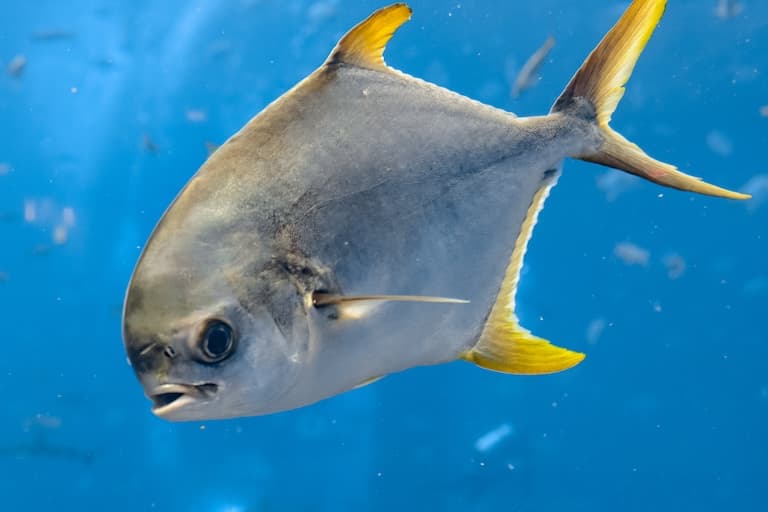
Pompano Facts Overview
| Habitat: | Coastal marine, shallow |
| Location: | Nearctic and Neotropical regions worldwide |
| Lifespan: | 23 years or more |
| Size: | Up to 1.2 m (3.9 ft) long, smaller species closer to 20 cm (9 in) long |
| Weight: | 23 kg (51 lb) maximum recorded weight |
| Colour: | Mostly silvery-grey, varying in darkness; occasionally with yellowish/orange tail fins |
| Diet: | Invertebrates and fish |
| Predators: | Larger fish, humans |
| Top Speed: | Unknown (claims of 35 mph are unsourced and improbable) |
| No. of Species: | 21 |
| Conservation Status: | Oyster Pompano is Data Deficient, all other species Least Concern |
Pompanos are instantly recognisable at the family level for having brilliant, long fins, rounded faces, and the tuna-like crescent tails that give a fish the ability to dart through water when needed. These are predators, but of generally slow-moving prey like crabs and shrimp, so their speed is an adaptation to surviving around sea monsters. Unfortunately, it does nothing to protect against land-monsters like us, but so far, all species with enough data seem to be doing quite fine.
Interesting Pompano Facts
1. They’re almost Jacks
Pompanos are members of a diverse order of ray-finned fishes called the Carangiformes. Members of this order seemingly come in all shapes and sizes, and they include the spear-like barracudas, the sucker-clad remoras, the ray-like flatfish and the iconic, frilly sailfish. It even contains the freshwater archerfish, known for shooting water at unsuspecting bugs sitting on overhanging branches.
So, this order is hard to generalise about, but when we go deeper to the family level, we start to see some similarities. The Carangidae family is one of more than 30 families in the order, and in it we find the Pompanos, Jacks and trevallies, which are all pretty similar in appearance.
All of these are medium-sized, predatory fish, laterally compressed (meaning they’re taller than they are wide), with the largest reaching around 2.5 metres. These groups are separated at the genus level, with Pompanos representing the genus Trachinotus.
Pompanos are generally fairly small, many are around 20 cm to 30 cm long. They do get larger – the biggest reaches around 1.2 metres across. All are fast-swimming predators, despite their cute appearance, and have rigid, powerful bodies for rapid bursts of speed1.
And this adaptation is what makes them so unusual-looking.
2. They’re funny-looking
Pompanos start life as tiny, silvery diamonds, found thriving in large shoals in warm, clear coastal waters.
As they grow, they really start to become differentiated by their strong, crescent-shaped tail fins and long dorsal and anal fins and these make pompanos and their kin quite recognisable. But they’re more than just for show – these fins are part of a powerful, streamlined body, and are equipped with strong reinforced spines to keep them rigid.
The dorsal and anal fins are stabilisers, and the symmetrical crescent tail fins are for sheer force generation and this is all part of being incredibly quick in the ocean. But they don’t begin life as hunters – the pompano diet changes drastically throughout their lives2.
3. They become toothy
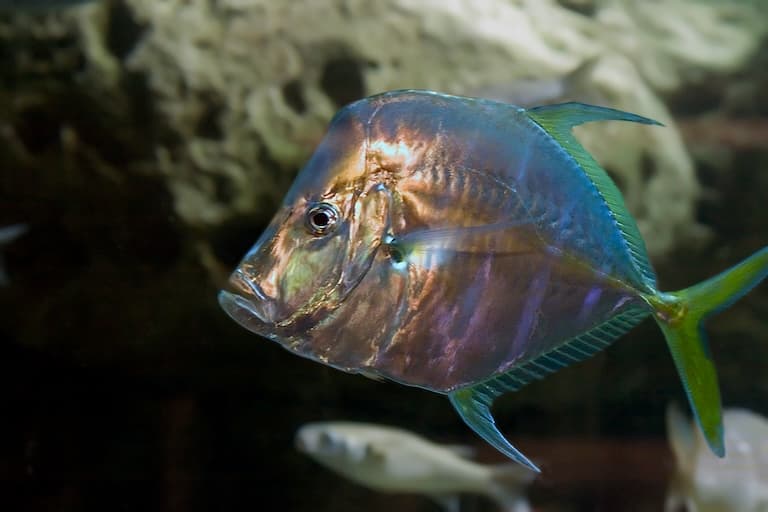
One of the largest of the pompanos is the so-called Permit, likely not named after the required documentation to catch it, but from a bastardisation of the Spanish word Palometa, used to describe all fish with this appearance.
The permit larvae eat plankton, which aren’t hard to catch at all, and don’t even require teeth to eat, so until they reach 3.5 cm long, they have none3.
As they start to mature further, they move onto harder prey like copepods and shrimp, and small, conical teeth begin to emerge. But as this large fish gets larger, reaching over a metre in length, it focuses on crustaceans, worms, and other sandy-bottom or reef-dwellers, and uses its conical teeth to crush shells, corals, and other crunchy bits to eat.
So, why the adaptation to speed?
4. They have a lot of predators
Unless you’re a whale shark, there’s always a bigger fish. And in an ecosystem with very little in the way of vegetation, marine animals primarily feed on other marine animals.
Pompanos, being somewhere in the middle of the food chain, has plenty of enemies, mostly in the shark and cetacean categories. These are meaty and probably quite delicious fish, so they have to be on high alert.
Pompanos have a well-developed “lateral line” which is a sensory organ that spans the length of their bodies and allows them to respond rapidly to pressure changes in the water. This, combined with huge eyes and the aforementioned adaptations for rapid acceleration, gives them a fighting chance in. world full of monsters that can attack from any angle!4
One of their best-known predators is a cunning, terrestrial monkey.
5. They’re popular among sport anglers
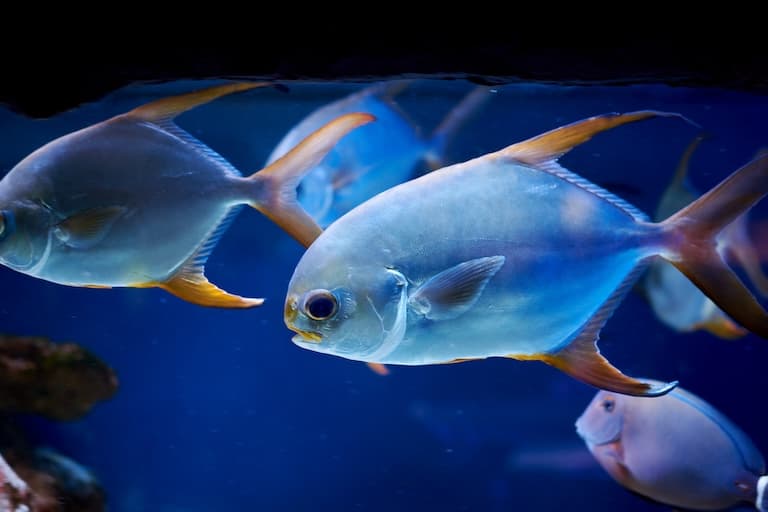
Pompano are primarily coastal, tropical, shallow-water species, with some that rarely spend time below 5 metres deep. They’re also large, fast, strong and pretty, which puts them close to the top of perfect targets for sport fishing.
To use Permit as an example again, these are common along the East Coast of the Americas, from Brazil to New York, and were commonly harvested in the hundreds of thousands of tonnes a year from Florida coastlines alone.
Some species now have catch limits on them as a result of perceived population declines, though their populations are hard to get a trend on. Ultimately, fishing poses a much more serious threat than predation for Pompanos, as it isn’t something that they can escape simply by being fast.
And while these fish most certainly are fast, they’re likely not as quick as people say they are5.
6. They’re not as fast as people think
It’s commonly repeated that the sailfish is the fastest fish in the ocean. This frilly predator has a reputation for exceeding 110 km/h in bursts, but by digging deeper, it seems that this is likely to be a complete myth. Not only are these claims unsupported by any meaningful evidence, there are at least two studies that suggest nothing can possibly swim that fast6.
The reason for this is cavitation. Beyond around 50 km/h, the fish is pushing through the water so fast that the water itself doesn’t have time to close behind it, creating pockets of low-pressure gas in its wake. The phenomenon of cavitation creates destructive forces that would shred the delicate membranes of an animal like a sailfish and certainly cause discomfort and pain to any tissue that could tolerate it.
This suggests that there is a “marine speed limit” for swimming that sits at or below this speed, and while an emergency burst of speed may nudge the animal past it, any higher speed is unlikely to be regularly attained.
So, claims of the pompano hitting 35 mph, or 56 km/h, are likely to be wildly exaggerated, as this would make them among the top fastest animals in the ocean and at risk of damaging their elegant fins through cavitation.
There is a caveat here, that cavitation at depth occurs at higher speeds, so this speed limit only applies to the shallows, but since pompano don’t occupy depths of more than around 100 metres, it’s not relevant to this example7.
7. They’re doing fine
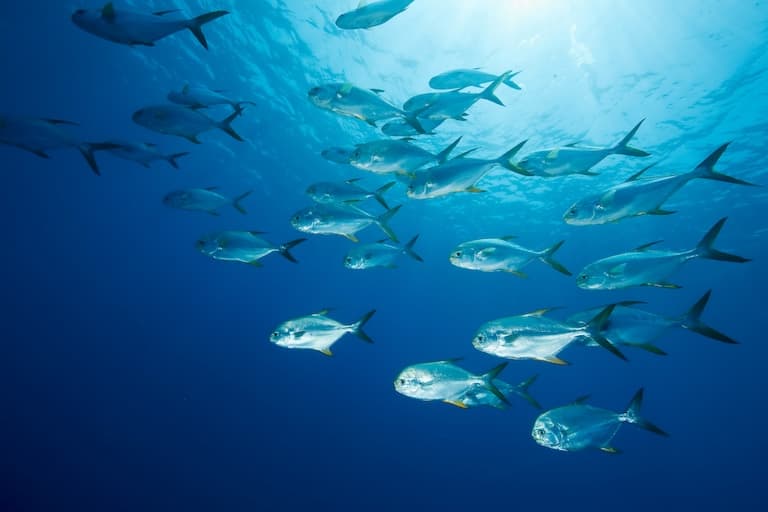
Despite their popularity as sport fish, and their proximity to the fishing industry in general, every one of these fish species seems to be doing well, according to the IUCN. The exception is the Oyster Pompano, or “giant oyster cracker”, which is listed as Data Deficient. This is an Australian species, said to be vulnerable to gill netting, but has no detailed assessment as of yet8.
The remaining 20 species listed are of Least Concern, and while the population trends of most are not known, the four species with this data – including the Permit – are said to be stable. It’s worth noting though, that many assessments are now long overdue; for example, the Permit was last assessed in 20129.
Pompano Fact-File Summary
Scientific Classification
| Kingdom | Animalia |
| Phylum | Chordata |
| Class | Actinopterygii |
| Order | Carangiformes |
| Family | Carangidae |
| Genus | Trachinotus |
| Species | 21 species |
Fact Sources & References
- “Fish Identification: Find Species”, Fish Base.
- McGrouther (2021), “Pennantfish, Alectis ciliaris (Bloch, 1787)”, Australian Museum.
- Shea (2011), “Trachinotus falcatus”, Animal Diversity Web.
- Shea (2011), “Trachinotus falcatus”, Animal Diversity Web.
- Shea (2011), “Trachinotus falcatus”, Animal Diversity Web.
- Iosilevskii & Weihs (2007), “Speed limits on swimming of fishes and cetaceans”, National Library of Medicine.
- Svendsen et al (2016), “Maximum swimming speeds of sailfish and three other large marine predatory fish species based on muscle contraction time and stride length: a myth revisited”, National Library of Medicine.
- (2025), “Trachinotus – Genus”, The IUCN Red List of Threatened Species.
- Smith-Vaniz & Williams (2016), “Oyster Pompano”, The IUCN Red List of Threatened Species 2016.