
Pool Frog Profile
It’s easy to forget that amphibians are the most frightening predators the land has ever known. This is a group of slime-covered, row-toothed, lumbering Permian behemoths, once weighing hundreds of kilograms, reaching over nine meters in length and being about as fussy about food as the US president is about the age of consent.
Today, they’re all a lot smaller than in their heyday, but much like the domestic cat, their small size and adorable appearance bely a primeval predatory instinct. And the pool frog is about as cute as these killers come.
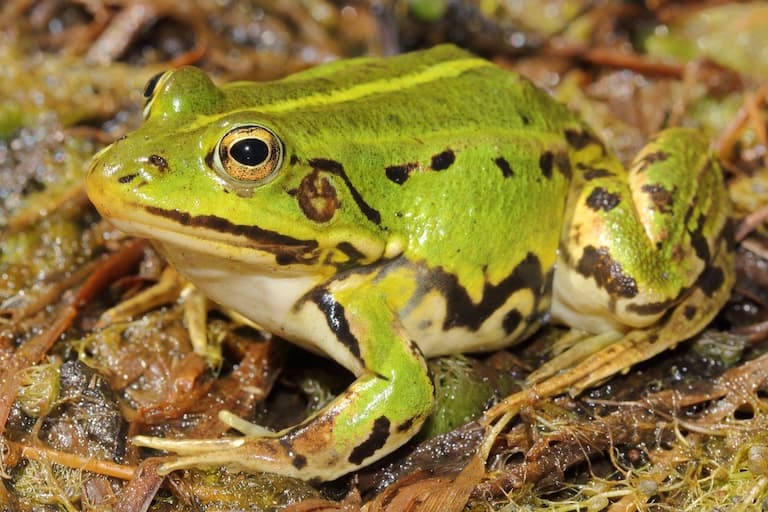
Pool Frog Facts Overview
| Habitat: | Shallow, stagnant waterbodies in forests and woodlands, lakes, ponds, swamps, large puddles, clay and gravel pits, and ditches, slow-moving rivers |
| Location: | Central and Northern Europe |
| Lifespan: | Unknown |
| Size: | Up to 9 cm (3.5 in) long |
| Weight: | Not listed |
| Colour: | Brown or green, with dark blotches, a cream or yellow stripe down the middle and a dark line either side |
| Diet: | Any animal smaller than a frog |
| Predators: | Birds and mammals |
| Top Speed: | Not recorded |
| No. of Species: | 1 |
| Conservation Status: | Least Concern |
Being seen as rare and beautiful is a huge privilege of being smaller than the beholder. Looking up at the pool frog as anything smaller than it, you’d find it a true primordial swamp monster with just enough brain power to lunge indiscriminately at its victims. These are tiny top predators, whose lack of smarts has not prevented them from an evolutionary strategy that puts them near the top of their watery worlds.
Interesting Pool Frog Facts
1. They’re Ranids
Frogs can be summed up as tail-less, carnivorous amphibians. They’re vertebrates, like us, and stem from a common ancestor of ours who was, too, an amphibian. They are members of the amphibian order Anura, which contains the vast majority (around 90%) of modern amphibian species and dates back in the fossil record to around the time dinosaurs were still at the bottom of the food chain, in the Early Triassic. But molecular studies imply they originate even further back than this, well into the Permian.
There are almost 8,000 anuran extant species described, in 59 families. The most populous are the tree frogs, in the Hylidae family, but the most widespread are the so-called “true frogs” in the family Ranidae, and the pool frog sits here.
Ranids are found all over the world outside of Antarctica. When most people in temperate regions picture a frog, they’re picturing a Ranid: brown-green, smooth-skinned, long legged, with webbed feet and large eyes. These are your classic frog archetypes, often pictured sitting on lily pads, and they come in a highly variable range of sizes.
The pool frog is medium-sized for its kind, reaching around 9 cm long. This one is strictly European, spanning Northern Europe in particular, from west to east.
And it’s adorable.
2. They’re cute
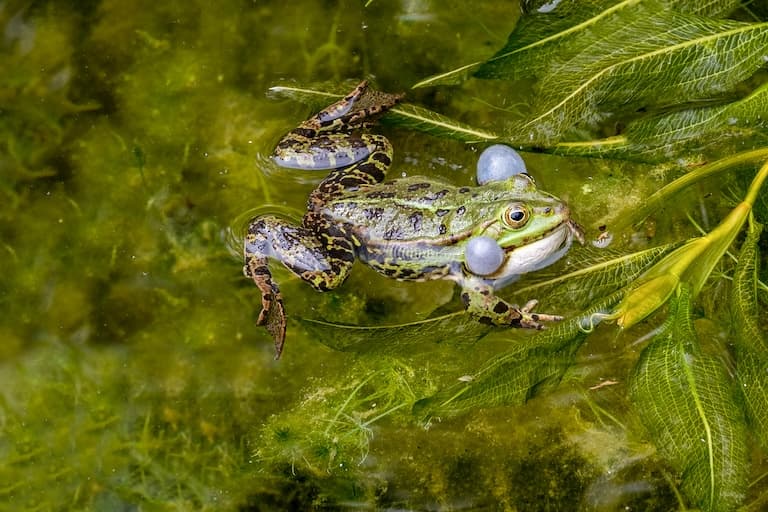
Pool frogs appear to show up whenever water sits out for long enough. They are small, quite green, and make a sweet little croaking sound, not dissimilar to that of a baby alligator. They’re not warted like the frogs commonly called “toads” and so are at worst inoffensive and more appropriately rather sweet little animals that contribute to a lovely pond soundscape and ecosystem.
They’re also quite hardy animals, especially by amphibian standards, and so tolerate the urban environment quite well and even seem to be doing OK in waterways that are becoming too toxic for many other species. But more on that shortly.
While they are seemingly abundant in most of Northern Europe, they are a lot harder to find in the UK.
3. They’re one of Britain’s rarest amphibians
There was a time, not too long ago, that the pool frog was considered a non-native species to Britain, thought to have been introduced from the mainland. This has led to its neglect in general, and perhaps in some contexts, even its persecution as an invasive species, but new-ish research, as of 2005, suggests that this was a mistake1.
The pool frog is now considered part of a distinct clade of native frogs that we are suddenly realising have been entirely overlooked. Even worse, they were presumed extinct back in 1995, before they were considered native, so nobody batted an eye. More recently, populations have been recovering in just a couple of places, but they are by no means common yet.
As such, they shoot close to the top of the charts for Britain’s rarest amphibians. They are not reported in Northern Ireland, Wales or Scotland, and are likely in a treacherous situation still, but this is a hardy frog, so if any can make it, the pool frog can2.
4. They’re tough.
For a country as devoid of wildlife as the UK, their tenacity is really saying something. Britain has an ecological travesty on its hands and rampant pollution is one of the key contributors.
In England, only 14% of rivers meet standards for good ecological status, according to the Troubled Waters report from the RSPB3. But the pool frog persists, and it does so, in part, because it’s relatively unfussy about its watery habitat. In fact, it prefers water with no competition4.

5. But they’re top predators.
When you look at this big mouthed, almost smiley little green cutie, it’s easy to imagine its role is just to sit on lily pads and sing Beatles songs, but that huge smile is a tool of one of the most sinister and ancient predators in the history of terrestrial vertebrate evolution.
Inside this gaping mouth, on its roof, is a pad of small, sharp, conical teeth called Vomerine teeth, and these aren’t teeth used for processing food, as much as they are for holding struggling prey in place.
Because like all frogs, this one is a killer, and it sits, emotionless and still, until a potential victim is unlucky enough to pass by. Being such a small predator, its victims are mostly insects, but being a frog, it will try to eat anything that moves, as long as it’s deemed small enough to fit inside its maw.
Pool frogs are not only predators, they are top predators, and they maintain this status by living in places with little competition.
6. They like areas with no fish
Pool frogs live in classically froggy places, often where the water is decidedly Permian. Algae, sludges, slimes and rotting leviathan cadavers would all be at home in the habitats of the pool frogs, as they choose stagnant, overgrown pools with little oxygen, and therefore, no fish.
This isn’t the exclusive habitat of the pool frog, but it’s a strong preference, and it ensures no pesky pescado is going to swallow their eggs or tadpoles.
And it’s served the species well. Pool frogs are incredibly widespread and still doing quite well, as they are of Least Concern to the IUCN; though their population trend isn’t known, they are thought to be thriving where other amphibian species are dropping like flies5.
But they’re not entirely in the clear.
7. They’re still at risk
This species faces threats from a plethora of forces. Primarily, they are threatened by habitat destruction and the increasing accumulation of toxins in water bodies from agriculture and traffic pollution. A lack of connectivity between its habitats means that populations become isolated from one another and in-breeding occurs, ultimately resulting in local extinctions.
In some countries, the culinary demand for frog-legs has created a decline, and invasive fish species like the Chinese sleeper, invade the tranquil pools of the frog, eating their young before they mature.
So far, the species as a whole appears to be resilient, but the population trend is unknown and habitat fragmentation may be shrouding the reality of their situation6.
Pool Frog Fact-File Summary
Scientific Classification
| Kingdom | Animalia |
| Phylum | Chordata |
| Class | Amphibia |
| Order | Anura |
| Family | Ranidae |
| Genus | Pelophylax |
| Species | lessonae |
Fact Sources & References
- Trevor et al (2005), “Neglected native or undesirable alien? Resolution of a conservation dilemma concerning the pool frog Rana lessonae”, Springer Nature Link.
- (2007), “List of UK BAP Priority Herptile Species(2007)”, UK Biodiversity Action Plan.
- Author Name (Year), “Why poor water quality is threatening some of our best places for nature and how we can fix it”, TROUBLED WATERS.
- (2021), “New report reveals pollution is biggest threat to wildlife on our waterways ”, The WildLife Trusts.
- Andreone et al (2022), “Pool Frog”, The IUCN Red List of Threatened Species 2024.
- Andreone et al (2022), “Pool Frog”, The IUCN Red List of Threatened Species 2024.