
Pony Profile
It’s a well-known fact that horse people are weird. But it’s not their fault – horse stuff is inherently weird.
Horses are measured in hands instead of feet; they canter instead of run (and tölt, if they’re Icelandic). Their fur isn’t brown, it’s bay or sabino, buckskin or palomino, flea-bitten, mouse dun or gold. So, it should be of no surprise that a pony is hardly definable.
This naturally makes writing a blog about it rather challenging, but we’ve never been ones to shy away from weird, so let’s tölt head-on into it.
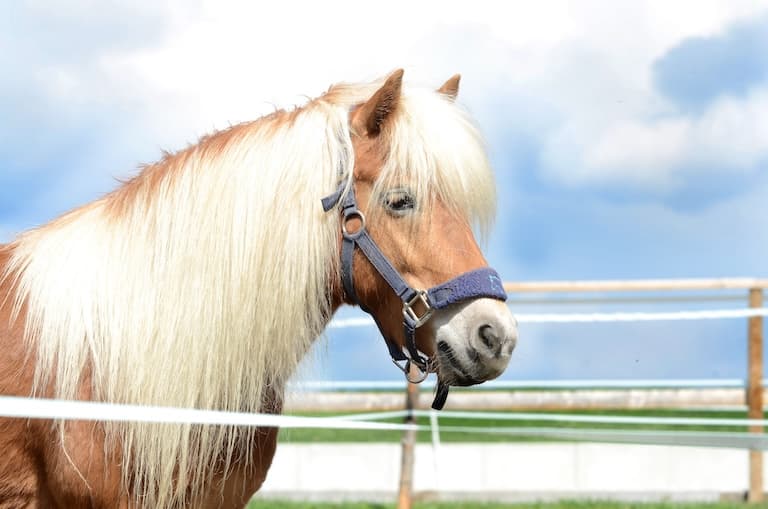
Pony Facts Overview
| Habitat: | Domestic |
| Location: | Worldwide |
| Lifespan: | Oldest was 56, usually around 25 to 30 years |
| Size: | Fewer than 14.2 hands at the shoulder. (58 inches or 147 cm) |
| Weight: | Generally 130 kg to 370 kg (300 to 800 lb), sometimes smaller, as in 180kg (400 lb) Shetlands |
| Colour: | We covered this in the intro |
| Diet: | Grass hay or pasture, forage |
| Predators: | Large carnivores: bears, cougars, sometimes wolves |
| Top Speed: | Generally under 15 mph (24 km/h); some smaller breeds up to 30 km/h |
| No. of Species: | 1 species, but 150 + breeds |
| Conservation Status: | Several breeds are endangered |
Ponies have a long history of being cost-effective working horses. Except they’re not horses, but a certain class of small horses. Though they’re not technically small horses, either, because they’re a slightly different shape.
Some big horses are horse shaped and called ponies, and some small horses are pony shaped, but still considered horses. But once you understand all of that, it makes perfect sense. Probably.
Interesting Pony Facts
1. They’re small horses
The word pony doesn’t refer to a specific species of animal, or even a taxonomic ranking within horses; it’s merely a term for a small horse. But a specific kind of small horse that mustn’t look like a small horse.
This seems straightforward enough. Horses are generally pretty large animals, commonly reaching around 1.6 metres at the shoulder, often 1.7m or more in the case of a racehorse. And other breeds have been selected to have smaller bodies to do smaller things, so it’s intututive to categorise them by size, and put all the smaller ones in another group.
In this group, called ponies, we find the iconic New Forest ponies, or the comical Shetland ponies, which represent the upper and lower bound for pony sizes, respectively.
But this isn’t a genetic grouping, and to make matters more complicated, if we keep getting smaller, we come back around to horses again1.
2. They’re bigger than miniature horses
Miniature horses are also horses, and these are bred to be very little. Usually, under a meter tall. They’re often smaller than the smallest ponies, yet they’re still called horses, and this is apparently because they’re bred to look like a full sized horse but smaller.
Ponies, on the other hand, change proportions as they shrink, and this makes them stand out from the longer-legged, athletic build of a large horse.
So, at the top of the size rankings, we have horses. At the bottom of the size rankings, we have horses again. And somewhere arbitrarily in-between are the ponies. Throw in giant ponies and it becomes very clear that this is mostly semantics2.

3. They were bred to work
Horses now number more than 300 recognised breeds, and are comparable to dogs in this regard. Ponies, being a subset of around 150 or so breeds, may look like a novelty, but like most dogs, they come from working stock.
Having shorter legs means ponies don’t lose as much heat as a horse, and being smaller also means they eat less, so ponies quickly became the draft horse of small farmsteads, where they were better suited than the monstrous draft horses of the pre-industrial age.
Ponies arose all over the place for similar reasons, each breed locally adapted to its specific environment, doing almost everything larger horses could do but cheaper. Later, some draft ponies were bred to be able to carry people on their backs too, while others were chosen to better specialise in either riding or drafting.
4. Some are very old
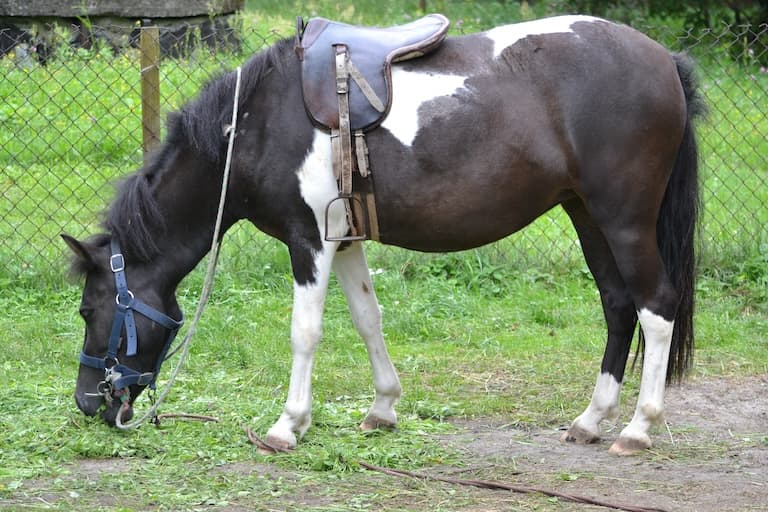
The Vikings and other Norse folk had ponies, and it’s thought it was they who brought a bunch of them over to the UK in around 800 AD. A tiny, shaggy breed known as Shetland ponies likely descended from this colony, and have been maintained on the Scottish archipelago of the same name ever since. But these weren’t the first ponies in the area3.
Some pony bones date back to the Bronze age, around 3,000 to 4,000 years ago.
Shetlands today are hardy, tough, cute little things, who sadly replaced the children in mines when it became obvious that having children in mines isn’t very nice. Today, there’s a strong stock in the Shetlands, but they can also be found all over the country and Europe as a whole, and the Americans have their own equivalent which is, of course, bigger4.
5. Pony of the Americas
Using Shetland genes, and mixing them with some local horse stock, the Americans have made their own version of a pony.
But of course, as an American breed, it was bigger and built for riding. Furthermore, they were bred to look proportionally like a horse, which technically makes it not a pony by anything other than in name and nature.
We told you horse people are weird.
Ponies only get a registration with the Pony of the Americas club if they have the spotted “Appaloosa” colouring visible from 12 m (40 feet), which is also known as “Loud” Appaloosa colouration.
6. They might have a thicker coat
One other common difference between horses and ponies comes from the mane and the coat itself. Some even have a shaggy coat. These are all cold-weather adaptations, of course, that have been carried over.
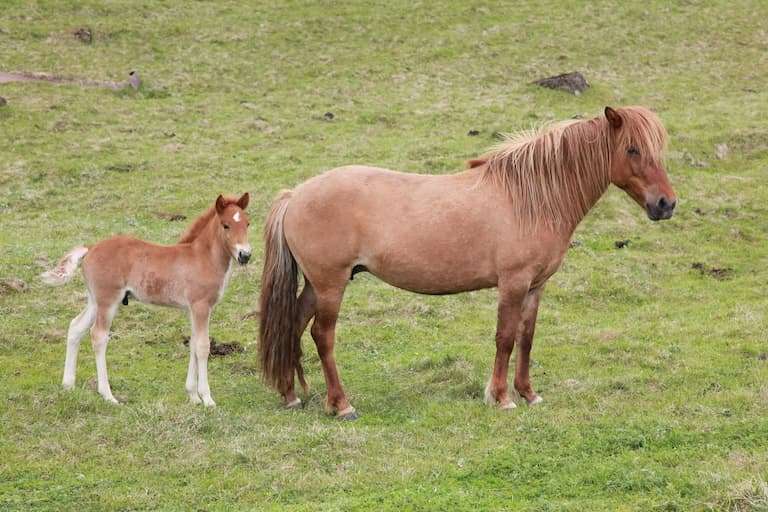
But when we look at Icelandic horses, those mohawky, töltlting little things, we are confounded again. Here’s a short, stocky, shaggy “horse” that fits most definitions of pony but is classed as a horse.
Apparently, that’s because they were bred from pony stock. Why they’re now considered horses can be answered by re-reading the intro.
Pony Fact-File Summary
Scientific Classification
| Kingdom | Animalia |
| Phylum | Chordata |
| Class | Mammalia |
| Order | Perissodactyla |
| Family | Equidae |
| Genus | Equus |
| Species | ferus |
Fact Sources & References
- Laura (2020), “New Forest Ponies”, New Forest Cottages.
- Oelke “Pony Breeds”, Patricia Crane.
- Laurie, “Shetland Ponies“, Shetland With Laurie.
- Whitington (2019), “Shetland Islands: the mammals”, Life in a Southern Forest.