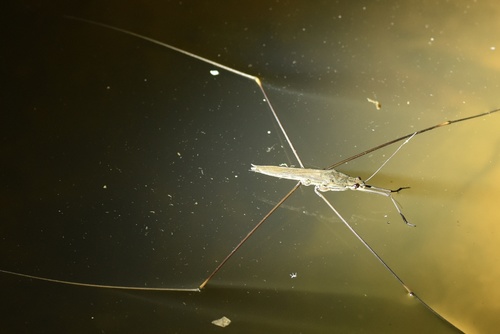
Pond Skater Profile
There are so few invertebrates that make it into popular culture in a positive light. Wasps are renowned for all the wrong reasons, and the humble worm is erroneously associated with everything gross.
But springtime on the ponds and rivers of upper-middle-class Britain provides a sprinkling of iconic inverts, perhaps none as characteristic of this world as the pond skaters. And this is sort of ironic, since they are exactly as murderous and predatory as people believe wasps to be. This Blighton-esque harbinger of picnic season is a true bug, in more ways than one.

Pond Skater Facts Overview
| Habitat: | Still or slow-moving freshwater, some marine |
| Location: | Worldwide |
| Lifespan: | Usually no more than a year |
| Size: | Usually no longer than 12 mm (0.47 in); largest is 320 mm (12.6 in) long |
| Weight: | Very light |
| Colour: | Usually grey or black |
| Diet: | Smaller invertebrates |
| Predators: | Birds, fish, amphibians |
| Top Speed: | Around 5 km/h (3 mph) |
| No. of Species: | 1,700 + |
| Conservation Status: | Not Listed |
Pond skaters are a family of biting insects in the true bug order. As true bugs, they pierce things, and these things vary across the incredible diversity of the 1700 or more species of pond skater described. But their prey all pretty much have one thing in common: they’re alive and wriggling. Pond skaters are icons of the tranquil, riverside picnic, but in their world, they are terrifying predators of the water’s surface.
Interesting Pond Skater Facts
1. They’re bugs
If you’ve followed us for any length of time, you should know what we mean by this, but just to reiterate, there is a whole order of insects characterised by being armoured and bitey, known as Hemiptera, and the common name for these is the true bugs.
“Bugs”, colloquially, can mean pretty much anything small that we don’t like, such as a code malfunction or a microbe infection, or pretty much any creepy-crawly, but in entomological circles, it is a word reserved only for members of this order, and pond skaters are worthy of it for this reason!
Hemipterans have dizzying diversity; they make up one of the largest orders of animals there is. Of course, being insects, this makes them only the fifth largest for their class – beetles, moths, (true) flies, and wasps have them beat – but Hemiptera is still a packed fifth, with around 80,000 or so species.
Within this clade is an even truer bug suborder called Heteroptera, which some consider to be the true bugs but might be better described as “typical bugs”. For this post, it doesn’t make a difference – pond skaters are members of the Heteroptera suborder anyway, and there are 40,000 of these!
So, it’s hardly surprising that pond skaters, forming one entire family within this order, are also pretty numerous.
2. There are loads of them
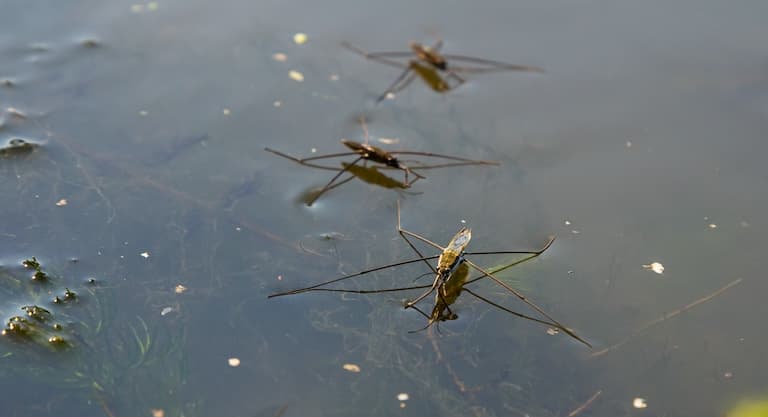
There are around eight subfamilies of pond skaters, two of which are the best known. These are the Gerrinae, containing 13 genera, and the Halobatinae, with two more.
It’s the Gerrinae subfamily that provides most of the literature on this family, and almost all research is done on its members as they are apparently the most easily studied. There are around 12 genera still around, and these likely contain the majority of species known
With such a range of species, it can be hard to generalise, but these bugs all have at least one common characteristic.
3. They Bite
Being true bugs, pond skaters have piercing/sucking mouthparts. That’s a bug thing, and the clade is split between those that use their piercing mouthparts to puncture plants and those who use them to puncture animals.
Aphids, cicadas, and the like, pierce plants with their mouths. Bedbugs, assassin bugs, and pond skaters go for flesh. And they’ll bite you, too, if you’re very unlucky, despite what the internet might have you believe. Pretty much all true bugs can give you a nasty poke, even the plant-suckers, but as far as pond skater bites go, they are not remotely common nor are they more significant than a little prick.
More commonly, these animals bite when hunting, which they do from the water surface, using the surface of the water like a spider uses a web, to pick up on vibrations on their legs, directing them to prey.
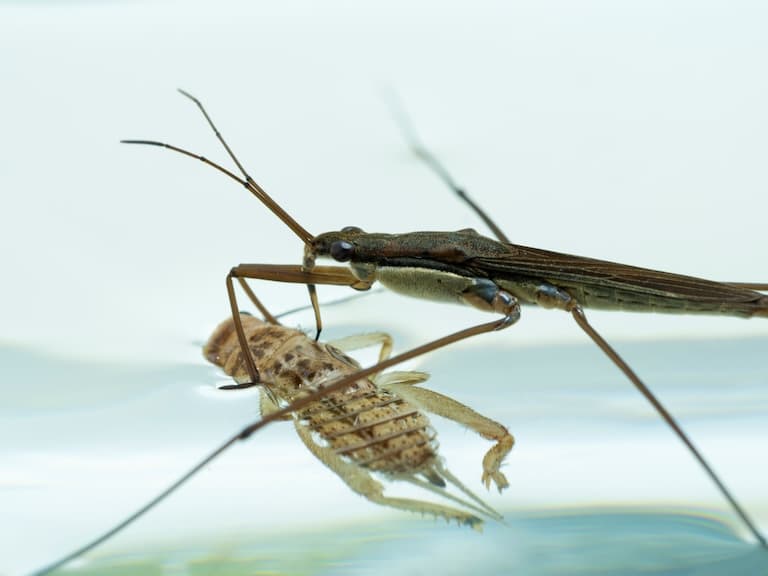
Pond skaters share a lot of similarities with spiders, in fact. They chase down struggling prey, pierce it, and inject a destructive toxin that breaks down the tissues inside to be sucked up as a fluid. They literally digest their prey to death. And they do it all while miraculously skating along the surface of the water. So, why does the pond skater’s food get trapped in water, while the pond skater itself stays dry? It’s all about the hair.
4. They’re super hairy
The pond skater is covered with hairs. Each millimetre of surface area has a thousand of more of them, grouped into what are called hydrofuge hairpiles. These are tiny hairs, covering their entire bodies, and they’re so packed together that water droplets don’t break on them and instead roll off.
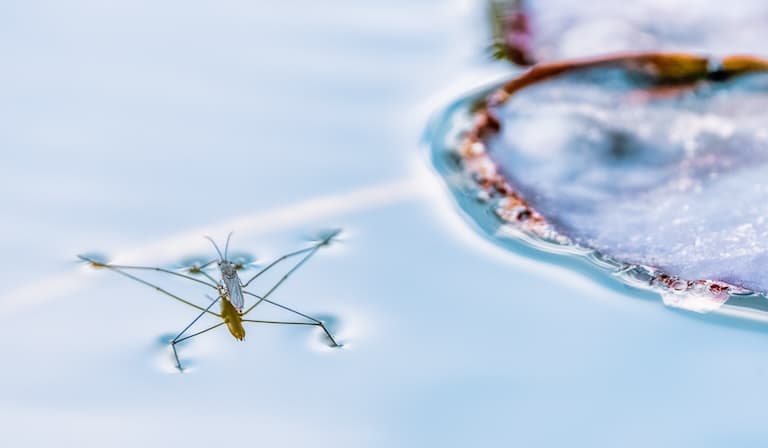
Their legs are splayed out and have retractable claws on them that can act as snow shoes, distributing the animal’s small mass across such a wide area that its overall density isn’t even enough to break the hydrogen bonds that hold the water surface together.
This is a mechanical method of repelling water and it allows the animal to literally walk on water. All water!1
5. They are the only open ocean insect
Inverts are usually quite cleanly divided between the oceans and the land. There are some exceptions: snails, which we often consider land animals, are actually primarily marine, and the ones we find in our gardens are rare outliers. Likewise, woodlice, the gentle mulch cows of our decaying sheds, are a rare example of a terrestrial isopod; a land crustacean.
Freshwater-saltwater ecosystems are more loosely divided, but primordial lore states that insects are banned from the ocean and insects themselves follow the adage from Ringu: frolic in brine, goblins be thyne.
Well, most of them, anyway. In fact, there are several hundred species of insects that brave the transitional zone between land and sea.
Pond skaters go one step further. Around 10% of species belong to the subfamily Halobatinae, which contains the “other” genus of well-known pond skater, Halobates. These are the “ocean striders” and make up at least 40 species of insect, some of which inhabit the open ocean!2
6. Some get quite big
While most of these insects are no more than 12mm long, the freshwater subfamily Gerrinae contains the largest of the lot, and one of the longest bugs in the world: Gigantometra gigas3.
This tremendous pond skater can reach more than 30 cm in leg span, all additional distribution of its relatively large mass. It may well be the largest animal to be able to walk on water, and that’s not all.
This species is interesting for a few reasons. One, despite it being one of the largest bugs in the world, it’s relatively unknown to science. What is known is that it can jump, making it also one of the most uncomfortable of the pond skaters to be around if you’re not into bugs. Finally, in this species, the males are larger than the females, and this is the reverse of the trend for most of the clade.
Pond Skater Fact-File Summary
Scientific Classification
| Kingdom | Animalia |
| Phylum | Arthropoda |
| Class | Insecta |
| Order | Hemiptera |
| Family | Gerridae |
Fact Sources & References
- Sun et al (2018), “The study of dynamic force acted on water strider leg departing from water surface”, ResearchGate.
- Cheng (1985), “Biology of Halobates (Heteroptera: Gerridae)”, eSchorlarship University of California.
- 桃子 (2017), “Photos of Gigantometra gigas”, inaturalist.