
Pygmy Python Profile
Pythons are some of the safest and most popular pet snakes on the market, and they come in all colours and sizes. With hundreds, possibly thousands of captive-bred morphs of the reticulated python alone, this can get confusing. There are even dwarf and super dwarf breeds, and in retics, this results in a more manageable 1.8-metre-long animal.
But in the ridiculously hot and arid regions of Northwestern Australia, there’s a species of python that needed no intervention to get little. This is the Pygmy Python, a member of a group of snakes known as the Children’s Pythons.
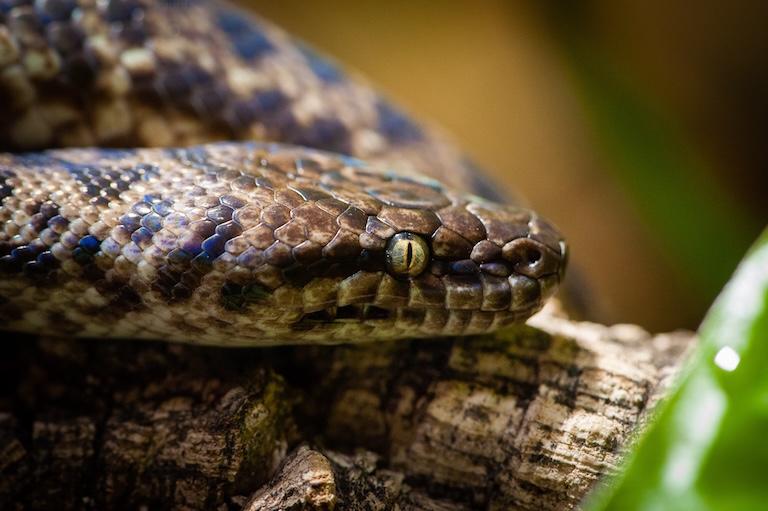
Pygmy Python Facts Overview
| Habitat: | Rocky outcrops, spinifex grassland |
| Location: | Pilbara, Western Australia |
| Lifespan: | 20 years |
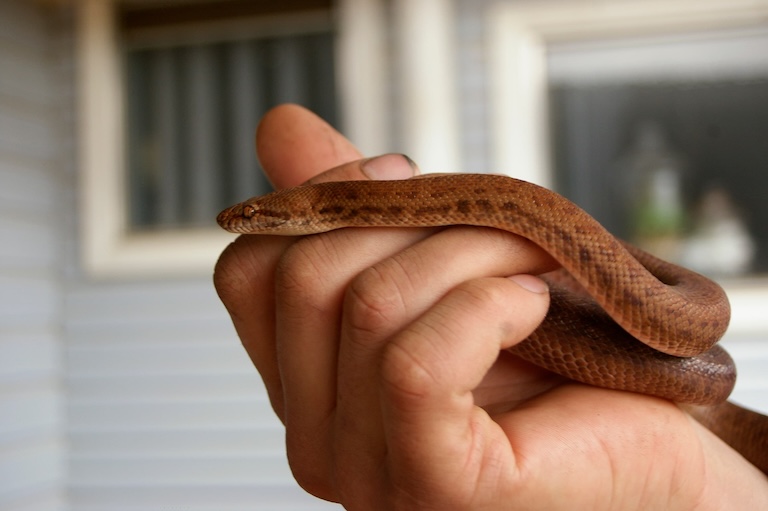
| Size: | Up to 60 cm (24 in) |
| Weight: | Up to 210 g (0.46 lb) |
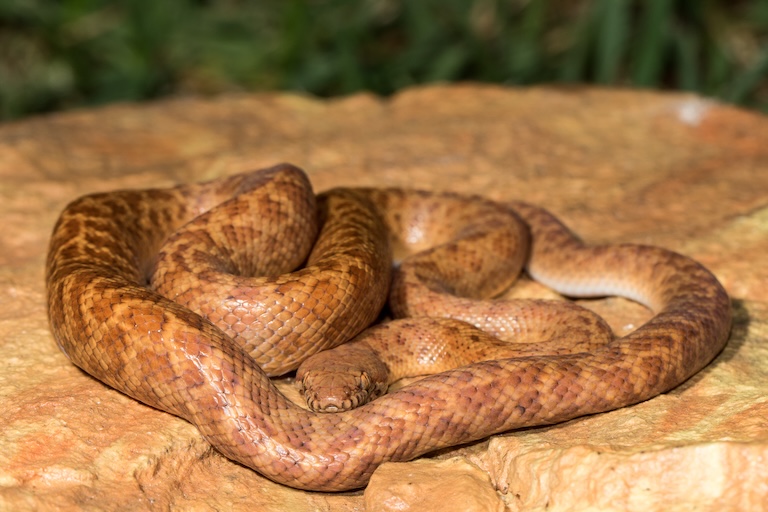
| Colour: | Reddish-brown, dark blotches |
| Diet: | Geckos, skinks, small mammals |
| Predators: | Raptors, feral cats, dingoes |
| Top Speed: | Unknown |
| No. of Species: | 1 |
| Conservation Status: | Least Concern |
Pygmy pythons are more than just a dwarf morph – they are their own thing! And they come packed with adaptations to a remarkably hostile environment. They also have two penises, so that’s another thing going for them.
This is a popular little snake, with a range of wild and captive-bred morphs to choose from, too. They’re doing well in the wild, far enough from human behaviour, and are easy enough to breed in captivity that this isn’t likely to change.
Interesting Pygmy Python Facts
1. Pythons for Children?
This might look a bit like a dud fact at first glance, but when we are talking about pythons there’s a lot of murk around the name. This is primarily on account of there being so many captive pythons and so many morphs.
For example, the Alpine python, Bengal python, goblin, gorgon and albino pythons are just all just a sprinkling of the available morphs of the ball python, Python regius.
Morphs are captive-bred phenotypes of the same species, and so two pythons of the same species can look remarkably different. So, it wouldn’t be a bad intuition to assume that the pygmy python is a captive-bred morph of one of the many popular pet species, but it isn’t!
The pygmy python is its own species. Typically, a tiny morph of a larger species would be referred to as a ‘dwarf’, so there are some clues, but the two terms are often used interchangeably.
Pygmy pythons are true pythons in the Pythonidae family, but not members of the Python genus. They are one of the ten other genera in the family, this one being Antaresia which are native to Australasia, and are commonly known as children’s pythons!
While these are popular pet snakes, they’re not recommended for children. And to make matters worse, the species name for this one, perthensis, adds another inaccuracy to the whole situation. 1
2. They’re not from Perth
The Western Australian state capital is where this snake gets its specific name. But it shouldn’t – this whole state is outside of the snake’s natural range, and they have not been documented anywhere closer than 680 km from Perth.
However, this is a Western species, found over much of the Northwest of the country and on some islands, too. It also comes in various natural morphs, making it hard to identify, at a glance, from colour or pattern alone.
One thing about its name that is true, however, is that it’s little. 2
3. They’re pretty small
Pygmy pythons reach up to around 60 cm long, which is certainly big enough to frighten people who are already afraid of snakes. But this is about the shortest you can get in an adult python, and at 200g, it’s around the lightest, too.
Being small, they’re quite low down on the food chain, even though they are predators themselves. They have no venom and they’re made of delicious meat, so they’re at risk of predation from birds, cats, dogs, and even other species of snakes.
So, they tend to specialise in areas with a lot of hiding places. Rocky outcrops, termite mounts and other cracks and crevices that larger hunters can’t access. This gives them free reign over various gecko and small mammal species that they can eat.
This is not a specialised diet – the pygmy python is an opportunistic feeder that will take what it can get. And, being that it’s quite comfortable in the desert, it has developed some coping strategies for arid regions.
[4] They’re arid condition specialists. This species of little python is native to the Pilbara region in Australia, which contains some of the hottest and most arid ecosystems in Australia. It has no wet season to speak of and is mostly flat with little vegetation. Even eucalyptus trees don’t do well in this region!
Only specialised animals can survive here, and the pygmy python has several adaptations that allow it to do so, many of which are behavioural.
One neat little trick is to burrow into termite mounds. Far from being the simple lumps of excavated earth that these mounds appear to be from the outside, termite mounds are miracles of insect engineering, with ventilation shafts, climate control, and all sorts of incredible architectural intricacies that researchers are only beginning to appreciate.
So, for the snake, they’re a fully furnished apartment, complete with meals. During daylight hours, the temperature in these mounds is a stable 38 degrees Celsius, which is pretty much bang on what a snake wants from its air conditioning. Inside the mound, it can also find ant-hunting lizards to eat, like skinks.
Interestingly, they team up here, and can often be found in balls of intertwined individuals, just basking in the warm air, preparing for their evening hunts. 3
5. They’re popular as pets
This is a popular python on account of its size and low-maintenance, and are kept all over the world.
Being experts at energy conservation, snakes don’t require the mental enrichment of more thoughtful animals, and are often happier with less room, as it makes them feel safer. So, the pygmy python can thrive in a 75-litre enclosure, and can be comfortably housed and even bred in a space like this.
They’re easy to feed, and unfussy eaters, and will generally accept any and all meals with the exception of during shedding cycles and breeding season.
6. Hemipenes
Small snakes like pygmy pythons often bunch up in loose breeding groups, with several males shadowing a female. The males are basically tracking her pheromones, which she releases when temperatures drop, seemingly triggering the whole process. Once close, the males rub along her cloacal spurs to stimulate her and get the breeding response going before copulation starts.
Male snakes have two reproductive organs, called hemipenes. These are essentially a paired set of trouser snakes, contained snugly inside the snake proper, normally stored inverted inside its tail. When needed (and sometimes just spontaneously when they wake up in the morning), these evert outward, and they’re often ridged, hooked, or slightly barbed so they can anchor securely inside the female’s cloaca during mating. 4
Pygmy Python Fact-File Summary
Scientific Classification
| Kingdom | Animalia |
| Phylum | Chordata |
| Class | Reptilia |
| Order | Squamata |
| Family | Pythonidae |
| Genus | Antaresia |
| Species | perthensis |
Fact Sources & References
- Wilson et al (2017), “Pygmy Python”, IUCN RedList.
- , “Pygmy pythons”, iNaturalist.
- Chelsea Blanchet (2011), “Antaresia perthensis ”,Animal Diversity Web.
- Chelsea Blanchet (2011), “Antaresia perthensis ”, Animal Diversity Web.