
Quail-dove Profile
Pigeons are underrated. For as much as they shit on London’s historical monuments and hobble about in cities with toes missing, their reputation as “winged rats” primarily comes from their being forced to live around us.
For one thing, most species don’t even live in the city. And many are tropical forest birds with beautiful plumage and cute little terrestrial nesting habits. Not to mention, it’s the calls of pigeon species that are some of the most characteristic of all the rainforest sounds. Introducing: the quail-doves. These sweet little pigeons represent what all pigeons could have been if we hadn’t plastered their homes in concrete.
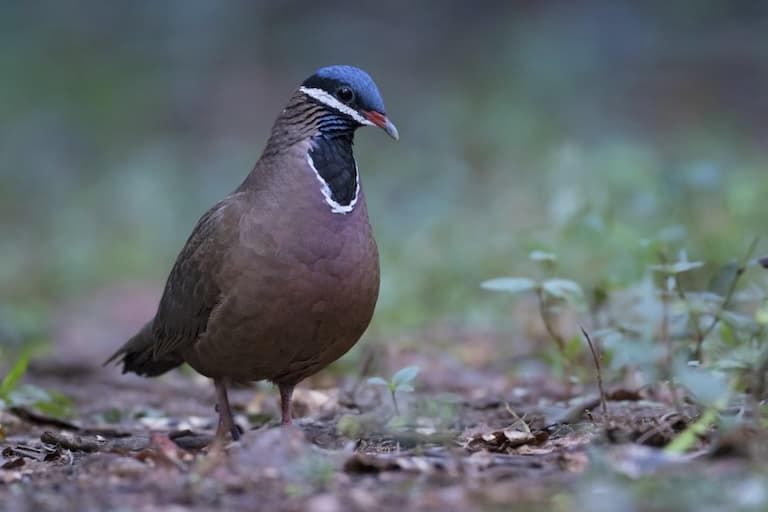
Quail-dove Facts Overview
| Habitat: | Woodlands, tropical forests and shady farms |
| Location: | Southern Mexico and Central America to the West Indies and South America |
| Lifespan: | Unknown |
| Size: | Around 25 cm (10 inches) long on average |
| Weight: | Around 140 g (5 oz) on average, the largest species 50% more |
| Colour: | Varied: many vibrantly coloured, some reddish-brown, purple, etc |
| Diet: | Seeds, berries, fruit, some insects and snails |
| Predators: | Cats, snakes, egg-eaters; some introduced species like pigs and dogs |
| Top Speed: | Fast runners, reluctant to fly |
| No. of Species: | 9 |
| Conservation Status: | Least Concern to Endangered, depending on species |
Quail doves are not quails! But they are doves. And by doves, we mean pigeons. These are mostly small, mostly terrestrial pigeons, most of whom are very pretty in their plumage and make outstanding noises that clearly belong to the tropical rainforests in which they live.
Unfortunately, these rainforests are under attack, and so, then, are the birds. Many are in such a critical condition that they will likely disappear in our lifetimes without some help. Others are doing better, but all still need intervention, at least locally, to stem the decline.
Interesting Quail-dove Facts
1. There are at least nine of them
Pigeons are an entire order of birds, known as the Columbiformes, and they come in all shapes and sizes. The dodo, from “dead as a-” fame, was a pigeon; another terrific example is the Nicobar pigeon, which looks like it was highlighted by children with pens; and, of course, there are countless human-created abominations among the domestic pigeon-breeding subcultures, too.
They are some of the fastest flying birds, some of the most sung-about birds, and some of the most iconic-sounding animals on the planet. They are found in deserts, on beaches, and in trees, on every continent – including Antarctica!
And Central and South America have a boatload of them. Among these, the genus Geotrygon includes some of the smaller, ground-dwelling pigeons, and these nine or so species are known as the quail-doves.
The genus has a natural range from Mexico to South America, but some blow in from the tropics and reach as far North as Texas and Florida on occasion. This is a very pretty genus of pigeons, and some also consider members of the genera Zenaidini and Leptotrygon to be quail-doves, as well, which would add another nine species to the fray1.
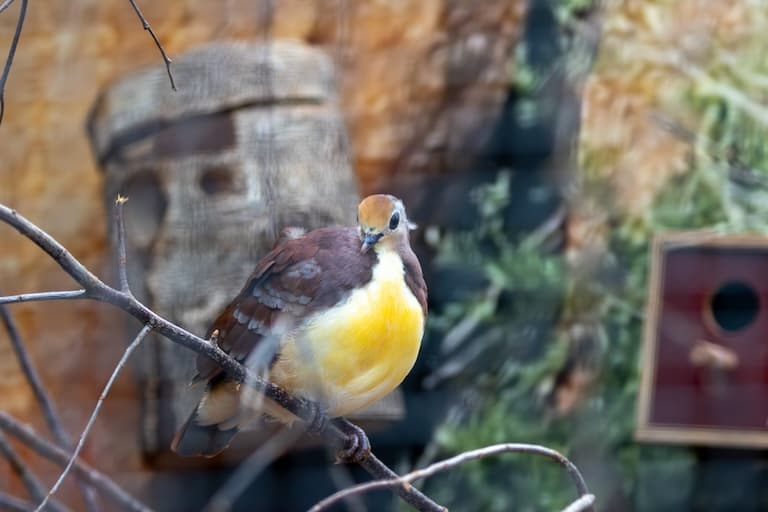
2. They coo
Regardless of where you draw the line, these are all pigeons, and they all make pigeon noises. In fact, the rainforests of Central and South America are some of the loudest terrestrial habitats on Earth (if you exclude all the noise we make), and this is in no small part due to the pigeons who live there2.
Quail doves may be small and ground-dwelling, but they make loud and arboreal noises that ring out through the trees nonetheless. Hoots and coos and a-woos are par for the course, and so the quail-doves are instrumental to the forest soundscape all across their ranges3.
3. Some live on islands
The quail doves are mostly known to be Central American species, and since Central America is primarily made up of islands, some species are fixed in place. The grey-fronted quail-dove is a Cuban pigeon, occupying primary forest on the island, which, sadly, is now in short supply.
The Key-West quail-dove is a poorly-named little bird found in the Bahamas, found on several islands other than Jamaica. The bridled quail-dove is another island species, found mostly in Puerto Rico.
These birds are called quail-doves on account of their terrestrial lifestyles, so once on an island, they rarely leave. But there are plenty of wider-reaching species, too.
4. Some have enormous ranges
Ruddy quail-dove is not nearly as annoying as its name suggests, and is one of the more humble in its colouration. This is a rusty brown bird, and very cute to look at, despite sporting the wide-eyed psychopathic glare that pigeons often wear on their faces4.
This species is primarily a South American native, but has an enormous range that reaches well into Mexico in the North and all the way down to Northern Argentina in the South. Despite this, it’s a hard bird to see and is known to be shy.
Unsurprisingly, this species is listed as Least Concern, but many in the genus aren’t as lucky5.
5. Lots of them are struggling
The Ruddy Quail dove is estimated to have between 50,000 and 500,000 mature individuals in its ranks, but even this species appears to be in decline.
Threats are the standard for all forest species: destruction and fragmentation of habitats and the introduction of invasive, nest-destroying species like pigs, dogs, cattle, and rats.
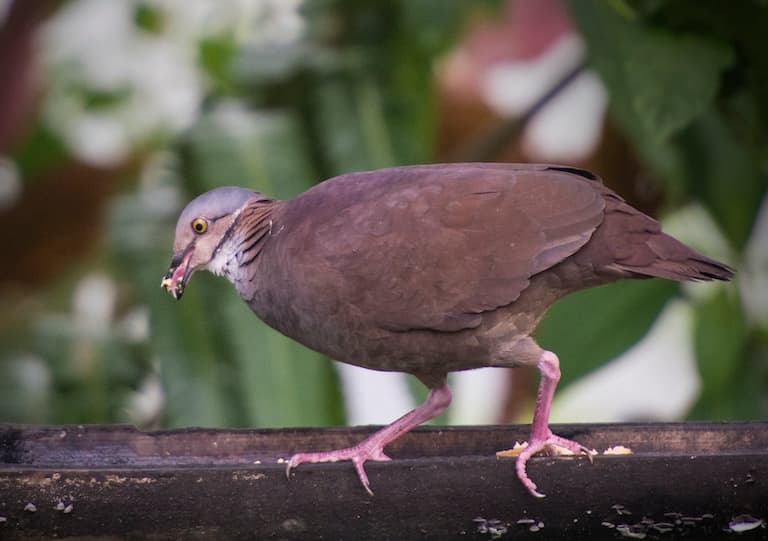
But species with much more limited ranges are faring even worse. Many of the island species are hit the hardest, such as the white-fronted quail-dove, found in Haiti and Dominica. This one may already be extinct in Haiti and was assessed to have a declining population from 600 to 1,700 in 2020.
Hunting is one factor, but commercial farming, by far the most devastating force on the planet, is the key contributor to its rapid decline. This species is now endangered, alongside several others like the Purple quail-dove in Ecuador, whose prognosis is almost identical6.
6. Some are faring better
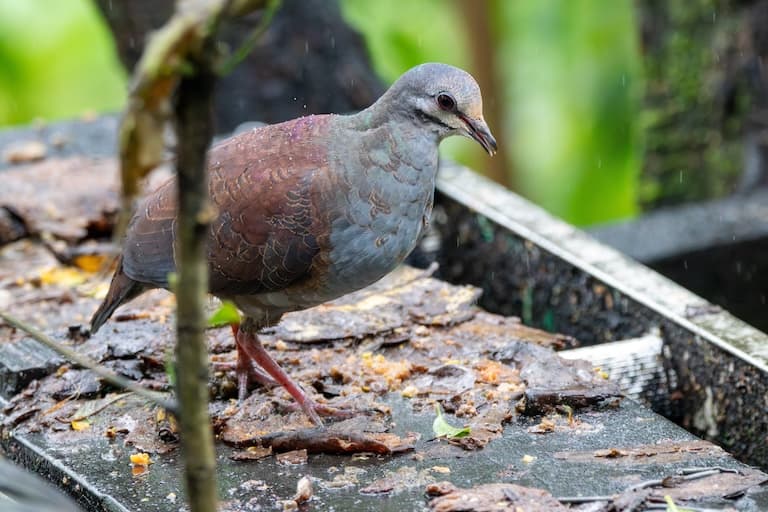
The bridled quail-dove is one island species that isn’t in such urgent need of help. This one is listed as Least Concern, although it is in decline, but being a little more mobile than many species, it appears to be able to island-hop from Guadeloupe to Antigua and the surrounding islands for seasonal breeding migrations7.
This might be what has kept it safe for now, and could also provide some useful data on how to keep other species safe, as well.
Conservation for these species isn’t limited to their global populations – the bridled quail-dove, despite being od Least Concern globally, is in trouble locally, and so there’s plenty of conservation work to be done, even within the better-faring species8.
Quail-dove Fact-File Summary
Scientific Classification
| Kingdom | Animalia |
| Phylum | Chordata |
| Class | Aves |
| Order | Columbiformes |
| Family | Columbidae |
| Genus | Geotrygon |
| Species | Nine species |
Fact Sources & References
- “H&M4 Checklist family by family”, The Trust for Avian Systematics.
- “Ruddy quail-dove”, Smithsonian’s National Zoo and Conservation Biology Institute.
- “Recordings”, xeno-canto.
- “Ruddy Quail-Dove ”, eBird.
- (2020), “Ruddy Quail-Dove”,The IUCN Red List of Threatened Species 2020.
- (2020), “White-fronted Quail-Dove”,The IUCN Red List of Threatened Species 2020.
- Clint & Hannah(2022), “Bridled Quail-Dove”, Cornell Lab.
- (2016), “Bridled Quail-Dove”,The IUCN Red List of Threatened Species 2016.