
Quail-plover Profile
The Charadriiform birds are an order renowned for pottering about in and around water, primarily in Asia and New Guinea. But there’s at least one very stubborn member who flat out refuses to toe the line. This is a bird that is more easily defined by what it doesn’t than by what it does. And that alone makes it quite punk.
So, it’s perhaps no surprise that this African species named itself after two completely unrelated birds. The quail-plover is neither, but then, it doesn’t make itself easy to classify in any sense.
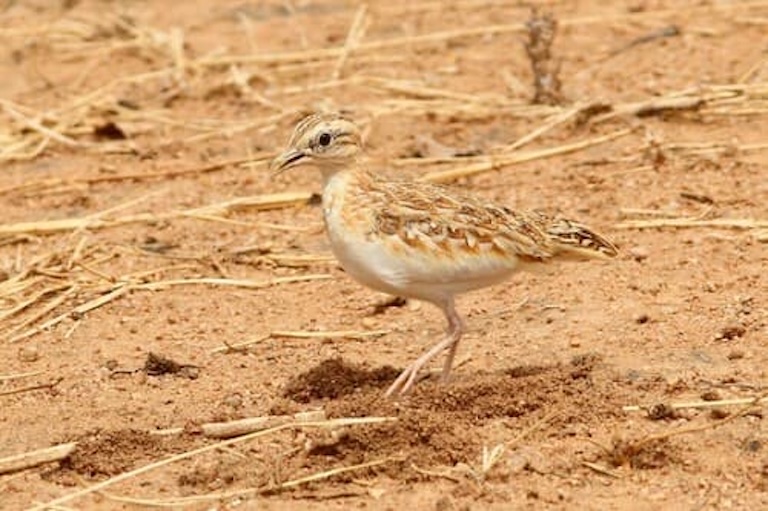
Quail-plover Facts Overview
| Habitat: | Arid deserts, semi-desert plains |
| Location: | Sahara & Sahel, North Africa |
| Lifespan: | Unknown |
| Size: | Up to 11 cm (4.3 in) |
| Weight: | Up to 20 g (0.7 oz) |
| Colour: | Sandy-brown, pale underparts |
| Diet: | Insects and small invertebrates |
| Predators: | Raptors, snakes |
| Top Speed: | Unknown |
| No. of Species: | 1 |
| Conservation Status: | Least Concern (IUCN) |
Quail-plovers are tiny but mighty birds, identified mostly by what they do differently from their kin. They are independent, tiny, quiet and trend-smashing little birds whose ability to thrive away from water has provided them with an immense range across Africa.
And whatever they’re doing, it appears to be working – this is a bird of least concern to conservationists, yet there is still a conspicuous lack of data about them, making this punky little species a great place for budding bird researchers to start!
Interesting Quail-plover Facts
1. They’re buttonquail
Quail-plovers become harder to define the closer you look. From a wide scope, it’s clear that they’re not quails – they belong to an entirely separate order, and are only named after quails on account of their running around on the ground a lot. This is likey also how they got the name “Lark buttonquail”, but they are, of course, not larks, either.
Instead, they belong to the order Charadriiformes, and this is an order of birds known for being primarily waders or water-adjacent. Some are even quite pelagic, and spend most of their lives at sea, but not the quail-plover; this little bird doesn’t bother with water very much at all, at least not directly; they eat termites and ants and other juicy invertebrates and get most of their hydration from these.
That makes them arid land specialists, and so they shun the dependence on large water bodies that the rest of their order is known for, and traverse much of Sub-Saharan Africa as a result.
Their family, the Turnicidae, are known as buttonquail, but even here, the quail-plover sets itself apart.
There are 18 species in two genera, with most species placed in the genus Turnix and a single species in the genus Ortyxelos. They inhabit warm, tropical grasslands of Asia, Africa, Europe, Australia and New Guinea.
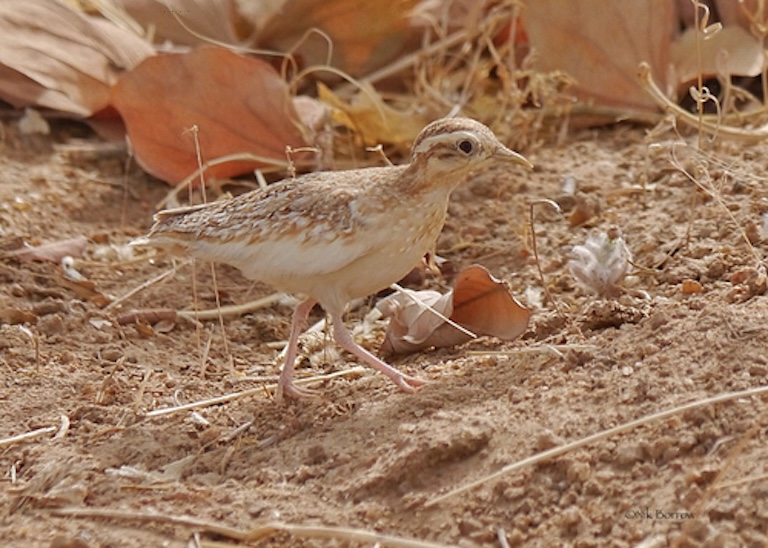
2. They’re the only ones in the genus
The quail-plover isn’t a quail, even remotely. It’s much closer to being a plover, but of the 69 species of plover recognised, this isn’t one. Quail-plovers and regular plovers are in the same order, but the former belongs to the buttonquail family.
So, the quail-plover is plover-adjacent, in the next family over. Buttonquails are also sometimes called hemipodes – Greek for “half-foot”, and this refers to the group’s lack of a rear toe. There are 18 species in this family, and two genera, but one of these genera contains just a single species, and you can probably guess which species that is.
While the 17 or so other species gather in the genus Turnix, the quail-plover is content to sit in its own genus, Ortyxelos.
3. They’re tiny
The quail-plover is also the smallest species of buttonquail, and grows to an adorably truncated length of around 11 cm and a total mass that’s usually under 20 grams. That’s less than an AA battery in weight, but they can run a lot faster.
So, not being big is another way that the quail-plover stands out from the crowd – or at least, hides under it. And in keeping with this theme, not being loud is another. 1
4. Booming
Like their namesakes in the Galliformes order, this unrelated family of buttonquails make unusual sounds called booms. They do this mostly for sex reasons, and they do it with a unique adaptation in the trachea of the females – one that even true quails don’t possess.
But again, the quail-plover defies convention because while buttonquails are known for booming, this one just doesn’t. It’s not clear if this is out of choice or because it doesn’t sport the modified organs for it, but the quail-plover is a very quiet animal overall, and this adds to its ability to stay under the radar.
Mating is really the only time they’ll show much of an interest in one another, and from the literature, it seems like even this is a quiet affair. 2
5. Males incubate the eggs
During breeding, the quail-plovers will rely more heavily on bodies of water. When it’s cool and dry, they’ll come to the coast to breed, and a shallow depression is formed in hard sand, around open vegetation – this will be the nest.
Sometimes they’ll encircle this with small stones, which is very sweet, and two eggs are placed inside. These will be incubated only by the male, and this is about where the information runs out. It’s likely by the context that the female will be off hooking up with more males in the meantime, but what happens once the chicks hatch is still a bit of a mystery.
Males of other species within this family are the ones responsible for rearing, too, but as we have discovered, nothing can be taken for granted with the quail-plover! 3
6. They’re doing great
One thing we know fairly well is that all of this contrarian behaviour appears to be working for the little bird, whose population and range seem to be immense.
The total population hasn’t been confirmed, but it’s thought to be well above the IUCN’s formal metric of “a buttload”.
The same is said about the population trend, as a result, but despite the absence of specific details, it’s a reasonable assumption that this bird species is not struggling. They are currently considered Least Concern by the IUCN. 4
Quail-plover Fact-File Summary
Scientific Classification
| Kingdom | Animalia |
| Phylum | Chordata |
| Class | Aves |
| Order | Charadriiformes |
| Family | Turnicidae |
| Genus | Ortyxelos |
| Species | meiffrenii |
Fact Sources & References
- , “Quail-plover”, eBird.
- Hoyo et. al (1992), “Handbook of the birds of the world”, Internet Archive.
- Janice Pappas (2002), “Ortyxelos meiffrenii ”, Animal Diversity Web.
- (2024), “Quail-plover”, Data Zone by Bird Life.