
Quail-thrush Profile
Australia, for all its modern aridity, was once a lush, green wonderland, covered in epic forests. It still has plenty of rainforest today, but where there once were trees, there is now a lot of scrub, and some of the descendants from those dried-up forests can still be found today.
The quail-thrush is one example. This is the result of an adaptive radiation from the dying, prehistoric forest into new, terrestrial habitats. And they’re doing it very well.

Quail-thrush Facts Overview
| Habitat: | Terrestrial: arid and semi-arid inland |
| Location: | Australia and New Guinea |
| Lifespan: | Up to 10 years (wild, estimate) |
| Size: | Up to 35 cm (14 in) |
| Weight: | Up to 110 g (3.9 oz) |
| Colour: | Brown, grey, rufous, patterned |
| Diet: | Insects, spiders, and small invertebrates |
| Predators: | Snakes, birds of prey, and feral cats |
| Top Speed: | Unknown |
| No. of Species: | Likely at least 7 (5-8) |
| Conservation Status: | All are Least Conceen |
Quail-thrushes aren’t quails or thrushes at all! These are ground-dwelling “perching” birds, closer to crows than either namesake.
They belong to a small but widespread and successful group of around seven species that evolved from forest ancestors as Australia dried, keeping camouflage and developing odd “leapfrog” colour patterns. Mostly terrestrial and very alert, they would rather hide than fly, and are doing broadly OK, with most species listed as Least Concern despite local declines.
Interesting Quail-thrush Facts
1. They’re not quails. Or Thrushes.
Quails aren’t strictly a single group, but they’re all members of the chicken order, Galliformes. They’re medium-sized, ground-running birds that make silly little eggs that are no use for anything other than making more quails and are only eaten by pretentious bipeds with status-signalling issues.
Thrushes are clever little songbirds, in the totally different order, Passeriformes, so not remotely related to quails.
Regardless, neither is related to the quail-thrush, which does share an order with the true thrushes, but instantly diverges from it on the next taxonomic branch.
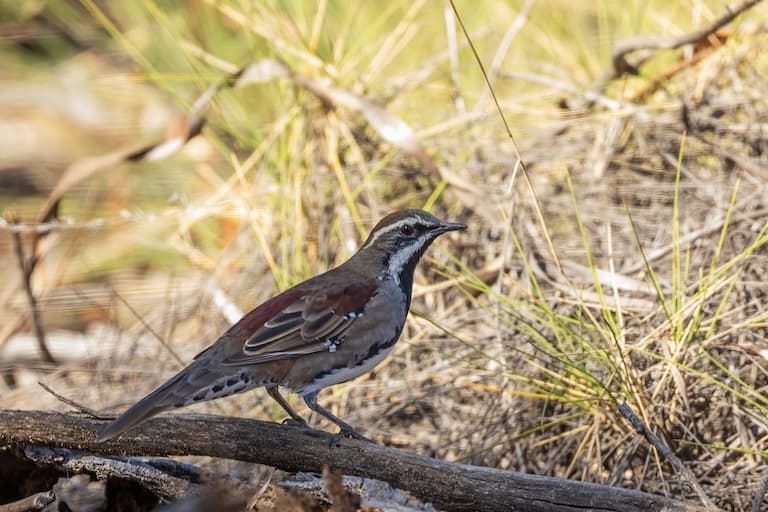
In fact, the quail thrush is closer to a crow than either of its namesakes.
2. Jewel Babblers
Corvoides is a clade of birds in the Passerine order, and one that has colonised all continents except Antarctica. There are thirty families in this clade, including Corvidae, where we find the magpies, crows, jays and jackdaws.
Despite being a closer tie to the quail-thrush than either quails or thrushes, this is still quite a distant relation, and the closest family members to this species are other Australian birds like the pretty little Jewel babblers, who have a much better name and wiggle their bums happily like a wagtail, hence the name.
At least, that’s what a lot of the old literature says, but there is some controversy here. Eupetidae is the family now proposed for the jewel-babblers, and Cinclosomatidae, the one for our quail-thrushes. Both of these families have existed for a long time; it’s just their contents that have shifted, so the literature is awash with outdated information as a result.
Regardless, the two are relatives, and while the jewel babblers went bold with their colouration, the quail-thrushes have chosen a more camouflaged approach.
3. They’re ground birds
The name quail-thrush comes, presumably, from this species’ behaviour and appearance, respectively. This is mostly a ground bird (though it can fly substantially better than a quail can), and it looks a bit like a thrush.
They’re weak flyers nonetheless, and when threatened, will choose to squat and hide as their primary line of defence.
So, these fun little birds spend most of their time on the ground, in regions where there aren’t all that many trees anyway, and this has proven a very viable strategy, as there are now multiple species spread out all over the enormous country.

4. There are around seven species
The quail-thrush makes up a single genus in the family, one which contains between five and eight species, depending on who you ask.
They all look quite distinctively similar, with some variation in colour and pattern, and each species occupies its own range in Australia, pretty much everywhere dry, or where there’s just a little water nearby. Like thrushes, they can be seen running around the rocks, picking at invertebrates, sometimes turning over rocks, but these birds will nest on the ground.
It’s believed that these species evolved from a common, camouflaged forest ancestor who lived in Australia when it was covered in trees. As the continent dried, populations retained this camouflage as they became desert species, and a few developed their own snazzy colouration, independently.
This has led to an interesting evolutionary “Leapfrogging” phenomenon, in which two camouflaged species, A and C, are punctuated by a more colourful species, B. B looks totally different from its neighbours, but it is in fact more closely related to either of them than they are to one another.
Still, they’re not very bright to look at, even in the most dolled-up species, as this is a cryptic bird by nature, and hides, rather than flying away
1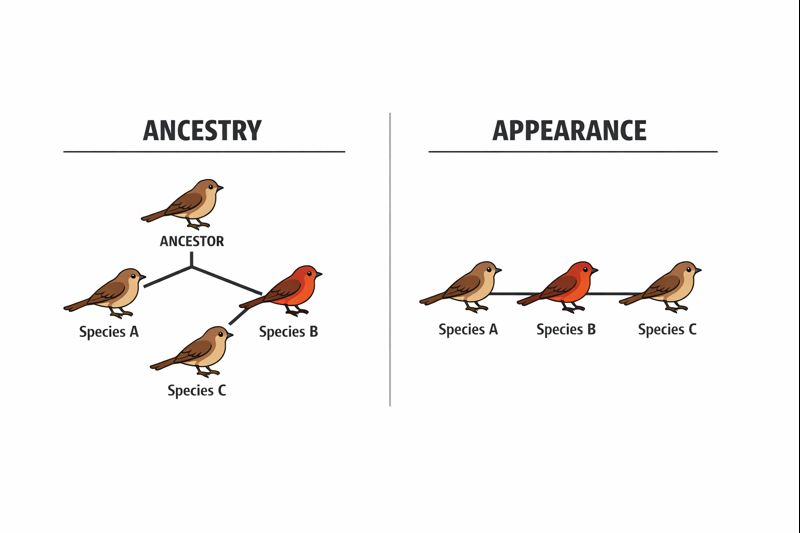
5. They are very vigilant
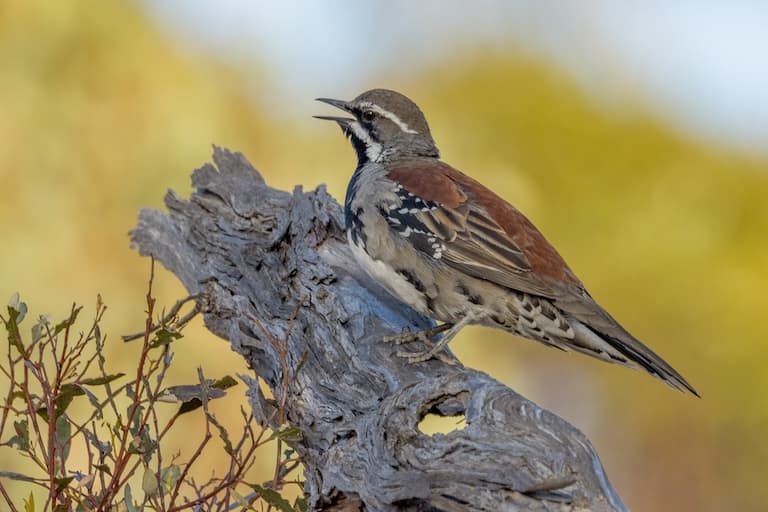
Quail-thrushes are well adapted to terrestrial life, with long, powerful legs, camouflaged plumage and exceptional eyesight.
Their strategy to avoid danger is to hide, and this is one species that hasn’t been negatively affected by the introduced rabbits. In fact, rabbit burrows are a great refuge for the quail-thrushes.
Being an arid region specialist, this keeps them away from the resident apes, who need to stay very close to water. As such, they’re doing really quite well.
6. They’re Doing OK
It’s thought that quail thrush populations are fragmented in parts of their ranges, but these birds can thrive thousands of kilometres from human habitations, and this keeps them safe for the most part.
The Western quail-thrush, for example, occupies a tremendous range within Western Australia, in a region that contains less than 10% of the human population.
Despite this, they’re thought to be in decline, but this isn’t enough to worry the IUCN, at least when they were assessed in 20242.
Similarly, other species are either stable or declining at a rate that keeps the global population above the threshold for concern.
Quail-thrush Fact-File Summary
Scientific Classification
| Kingdom | Animalia |
| Phylum | Chordata |
| Class | Aves |
| Order | Passeriformes |
| Family | Cinclosomatidae |
| Genus | Cinclosoma |
| Species | At least 7 |
Fact Sources & References
- Alicia et al (2012), “Evolution of arid zone birds in Australia: Leapfrog distribution patterns and mesic-arid connections in quail-thrush (Cinclosoma, Cinclosomatidae)”, ScienceDirect.
- (2024), “Spotted Quail-thrush”, The IUCN Red List of Threatened Species.