
Queen Coris Profile
Rainbow wrasses are exceptional among wrasses in several ways. First, some are very large! The bulbous-headed Coris bubifrons is a beast at over a metre long. But it’s an ugly fish; some, however, are stunning! The Yellowtail Coris is a brightly neon-coloured fish with spots and stripes, and is truly incredible to look at.
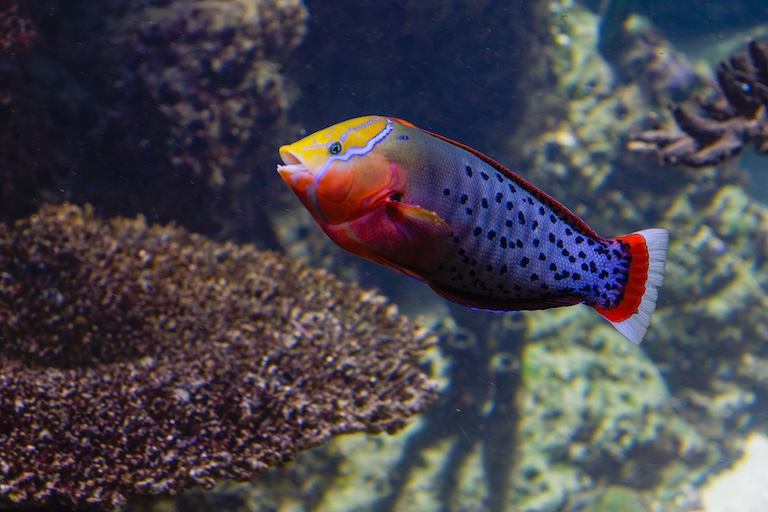
And Coris formosa, despite having a very boring scientific name, is both: this is the Queen Coris – a large and beautiful reef fish with royal teeth.
Queen Coris Facts Overview
| Habitat: | Coral reefs, sandy reef margins |
| Location: | Indo-Pacific |
| Lifespan: | Possibly up to 10 years |
| Size: | Up to 60 cm (23 in) |
| Weight: | Unknown |
| Colour: | Green-blue adult; orange juvenile |
| Diet: | Crustaceans, molluscs, echinoderms |
| Predators: | Large reef fish, sharks |
| Top Speed: | Unknown |
| No. of Species: | 1 |
| Conservation Status: | Least Concern |
The queen coris is a large wrasse from the genus Coris, a group of colourful reef fish found across the Indo-Pacific.
It lives on coral reefs, where juveniles begin life with bright, clown-like colours before maturing into blue-green adults adapted for open reef life. It’s energetic, territorial, and often aggressive, which makes it difficult to keep ethically in aquaria, and in the wild, it’s an unrelenting destroyer of shelled animals.
Interesting Queen Coris Facts
1. They’re Wrasses
The Labridae family is a large group of fish, with over 80 genera and 600+ species between them. These are mostly small marine fish, under 20 cm in length, known commonly as wrasses.
One genus, Coris, belongs to the Atlantic, Pacific, and Indian Oceans, and are sometime called rainbow wrasses. There are 28 species described, and they are typically of a large size, with many species crossing the half-metre mark in length.
The Queen Coris is among them, and while not the largest Coris species, settles as a respectable 60 cm or so when fully grown.
2. They’re coral specialists
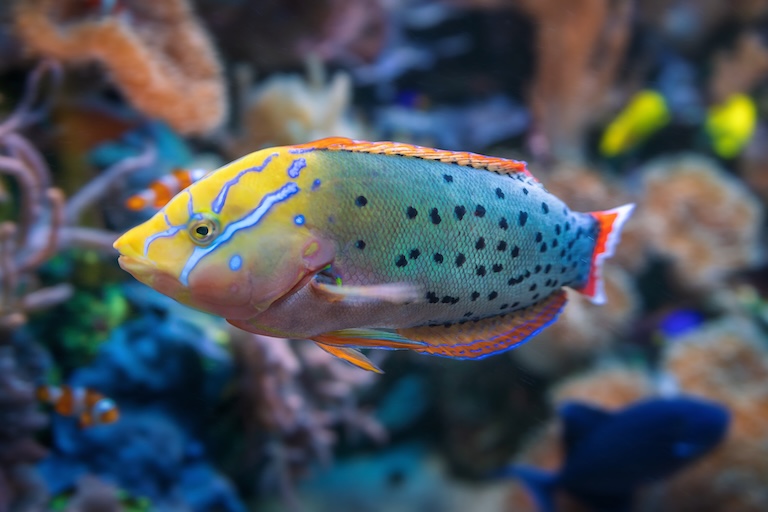
As the name suggests, many rainbow wrasses are very colourful fish, and the reef is where most colourful marine fish can be found. Queen Corises inhabit coral reefs up to 50 metres deep, spanning warm shallow waters all the way down the Eastern side of Africa and as far east as Sri Lanka.
And so, they stay near the surface, in the bright sunlight of the reef biomes. In this well-lit, diurnal domain, it pays to be colourful. And queen coris are some of the most colourful animals in the world!
But they have to earn this title.
3. They grow into their colours
When this species is young, it looks notably different from its parents. There are some accounts of this species being referred to as a Clown coris, and this is a misnomer, as the clown coris is a different species in the genus, but it likely comes from the fact that juvenile queen corises have very clownfish colouration.
The clownfish made popular by the Nemo franchise are ocellaris clownfish, and are from an entirely unrelated order of marine fishes. They also look entirely different from queen coris juvenile, but for the fact that both have very similar orange and white markings.
Juveniles begin life looking clowny and grow into their regal blue and green patterned colouration with maturity. This change in colour over time reflects the ecological priorities shifting from one of hiding and eating as a juvenile to going out on the town to get their end away with the adults, later on.
It’s hypothesised that they also change sex as they grow, which is something quite common in wrasses, but this hasn’t been backed up in the primary literature yet. 1.
4. They’re goofy
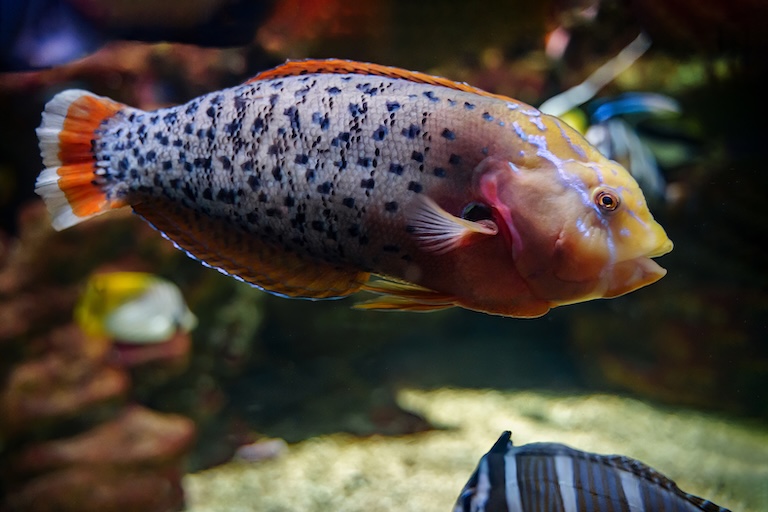
The primary source of calories for this species is the wealth of crunchy reef snacks available. Crustaceans, molluscs, urchins, and other hard-shelled mouthfuls are the chosen foodstuffs of the queen coris, and she ingests them by way of a set of protruding front teeth, which happens to give her the look of the British upper classes from which she gets her name.
Much like the royals, these unelected wrasses have no qualms about lording over urchins and are efficient at wiping out vast swathes of anything they deem fit for removal. This efficiency can translate to a difficult animal to handle.
5. But aggressive
The Queen coris is a stunning creature, and so it’s not surprising that marine aquarists want to keep them in their homes. But these are fast-moving, medium-distance, high-energy fish, and so not only do they have a voracious appetite, but they must also be given plenty of room for swimming.
Mating is polygamous, with males courting harems of females and aggressively defending territories. This is sustainable in the reef, but in captivity makes them difficult to keep with company.
6. They are hard to keep ethically
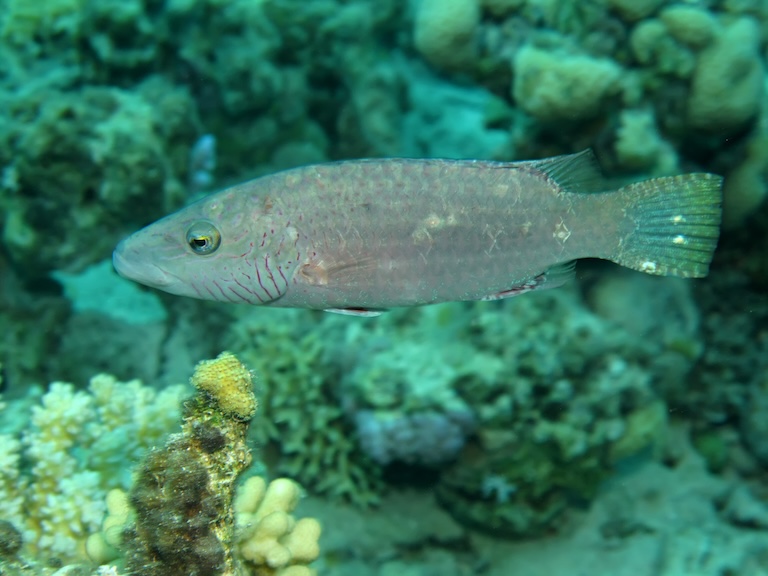
These are also large fish, so all factors combined, they are not an easy addition to a marine aquarium in the home. Captive animals are seen to dig into the sand, and this might be a breeding behaviour, or could also be a stress response to being kept in small enclosures.
Aside from during mating, queen corises are solitary animals, and as they grow to a large size, they can be extremely aggressive, stressed out and destructive to a marine aquarium.
When they are stressed, they will try to hide between rocks or bury themselves in the sand, and should be moved to a larger tank. 2
7. They’re doing ok in the wild
While this is a troubled species in captivity, the queen coris appears to be doing quite fine in the wild. Its difficulty to keep makes it a low-priority in the pet trade, despite being pretty, and wild-caught aren’t thought to be putting much of a dent in their native populations.
For now, they’re listed as of Least Concern by the IUCN, though their population trend hasn’t been established. 3
Queen Coris Fact-File Summary
Scientific Classification
| Kingdom | Animalia |
| Phylum | Chordata |
| Class | Actinopterygii |
| Order | Perciformes |
| Family | Labridae |
| Genus | Coris |
| Species | formosa |
Fact Sources & References
- Alan Sutton (2018), “Queen Wrasse- Facts and Photographs”, Seauseen.
- Pappa Wrasse (2013), “Queen Wrasse”, Ultimate Reef.
- (2009), “Coris formosa”, IUCN Red List.