
Queen Snake Profile
Human Monarchs are notoriously lavish in their feeding habits. Premium meats, exotic spices, sugar sculptures and chocolate, perhaps even human flesh, if you believe the grottier corners of the internet. But in the snake world, the rules are quite different. King snakes, for example, are often known for eating only other snakes.
And this king’s other half is even more fussy. Here is a docile, non-venomous colubrid with a name like a Harry Potter spell: Regina septemvittata – The Queen Snake. And she only eats freshly peeled crayfish.
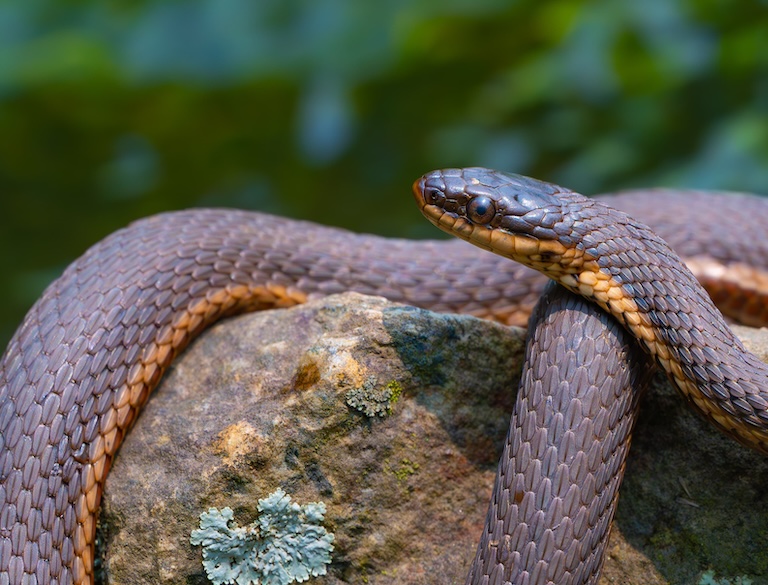
Queen Snake Facts Overview
| Habitat: | Clear, rocky streams and rivers |
| Location: | Eastern United States |
| Lifespan: | 19 years |
| Size: | Up to 90 cm (35.4 in), usually 1/3 smaller than this |
| Weight: | Unknown |
| Colour: | Brown-olive with pale stripes |
| Diet: | Crayfish |
| Predators: | Birds, mammals, and larger snakes |
| Top Speed: | Unknown |
| No. of Species: | 1 |
| Conservation Status: | Least Concern |
Queen snakes are not related to king snakes all that closely, being that king snakes are 20+ species in a different genus, but they are both Colubrids – a family of snakes that is widely distributed and generally harmless, with a few exceptions. The Queen snake isn’t one of those exceptions – these are easy to handle, nonvenomous, and don’t even threaten the local wildlife, unless that wildlife is a crayfish.
Queen snakes are extreme dietary specialists, and so their role in the ecosystem is as significant as it is fragile. Fortunately, they’re as-yet unthreatened as a species.
Interesting Queen Snake Facts
1. They’re Colubrids
There are around 30 or 40 families of snakes around the world, and Colubridae is the largest, followed by the elapids (cobras and mambas) and the vipers, whose venoms are a strong talking point, but Colubrids are generally not venomous. When they are, the venom is generally not dangerous, and when it is, the snake is generally too shy and arboreal to bite people unless they’re extremely unlucky.
So, despite being the largest family, it’s one that people know about less. And queen snakes are a great example of why.
This is a shy animal that spends its time hiding in and around water. It doesn’t bite people, it doesn’t bite very much at all – in fact, the only thing it does bite, lives in the water.
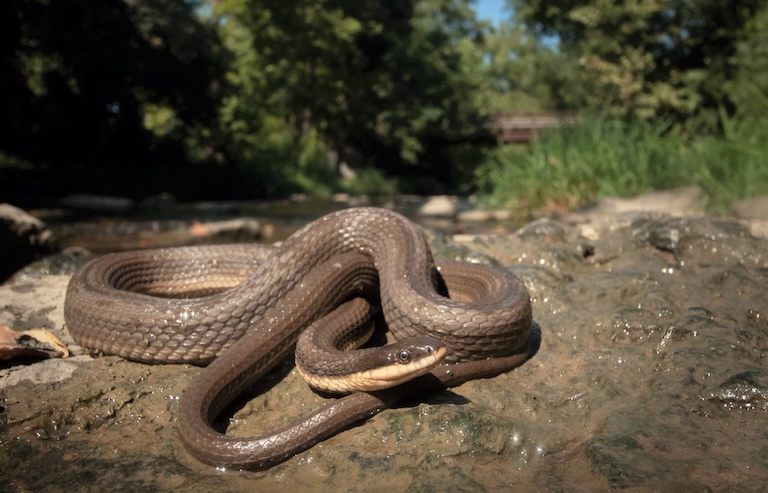
2. They’re semi-aquatic
Queen snakes mostly hunt in the daytime, but will move around at night, too. They are commonly found on rocks near rivers in the Eastern part of the US, warming themselves near their watery hunting grounds.
They are agile swimmers, and given the time they spend in the water and their reliance upon it, they are considered semiaquatic animals.
Like many freshwater snake species, they release a fantastic aroma from their anal glands when caught, as they don’t really offer much else to put a person off.
3. They’re harmless (to humans)
As mentioned, this is a nonvenomous colubrid. It rarely even bites, too. When cornered, they might strike a threatening pose and lunge in a half-assed manner towards the threat, but they really aren’t going to commit to the kind of aggressive, multi-bite and thrashing behaviour of their cousins, the racer snakes, for example.
That said, their butt juice is not something you’ll be able to wash off easily, and is best factored into the equation.
Still, as far as harmless snakes go, this one is so much to one end of the spectrum that even a mouse or a baby bird would likely be safe in its presence. This snake doesn’t even eat things that it could eat – it prefers one prey animal, and one alone.
4. They’re particular
This snake is never found in areas of the planet where clean, running water is absent. That’s because it is so focused on eating crayfish that it literally can’t survive anywhere else.
But crayfish come with a formidable pair of problems at the front end, and the general palatability of an uncracked brazil nut, and the snake, with no fingers to hold a nut cracker, has to instead wait for its prey to moult.
Crayfish, as crustaceans, have an exoskeleton that doesn’t grow, but instead gets tighter and tighter until it splits, and the crayfish has to evacuate and harden a new, larger one to replace it.
During this brief period when the crayfish armour is not yet hard, the unassuming little snake dips into the water, sniffs out its victim and swallows it down like an oyster.
Crayfish make up over 90% of their diet, the rest being supplements of tadpoles, frogs, newts and shrimp, though whether these are eaten deliberately or just collateral damage from the snake’s reptilian mindset, is unknown. 1
5. This makes them highly specialised
So, being so single-minded allows the snake to put all of its character points into crayfish hunting, and this unlocks traits such as an incredible sense of smell and the ability to hibernate through cold snaps.
But suddenly, the tables have turned, as the crayfish, who (unlike the snake) eat pretty much anything and everything, are now stronger than their major predator and can, in some cases, take advantage of the sleepy snake to flip the script and hunt one.
Other predators are raccoons, otters, mink, raptors and water birds, and of course, frogs, as they will stuff anything into their mouths, whether it fits or not.
So, being highly specialised makes them incredibly limited in what they can get away with, and this here is the ecological tradeoff.
6. They are sensitive
One trait that comes with the Crayfish Assassin perk is an astounding sensitivity to the smell of freshly moulted crayfish. This is not something we generalists can ever know, but presumably it’s like that fresh milky baby smell, but fishier.
During a moulting cycle, a crayfish undergoes not only physical changes, but a host of chemical ones, too. Like most biological events, moulting is governed strongly by hormones, and hormones have smells. The Queen snake is fine-tuned to pick up these smells, and once it does, the crayfish is a goner.
But being this sensitive is a blessing and a curse, and specialist animals, while the best at what they do, rarely adapt well to changes in their routines.
Thankfully, this species is so far still listed as of least concern, but in some populations, habitat alterations have reduced their prey abundance and caused them significant losses.
Some local populations have disappeared entirely, and others are significantly reduced, as freshwater systems are very commonly affected by agricultural runoff, acid rain and other pollutive factors.
The IUCN has the species listed as of Least Concern, but this assessment dates back almost 20 years to 2007, so new information is well overdue. 2
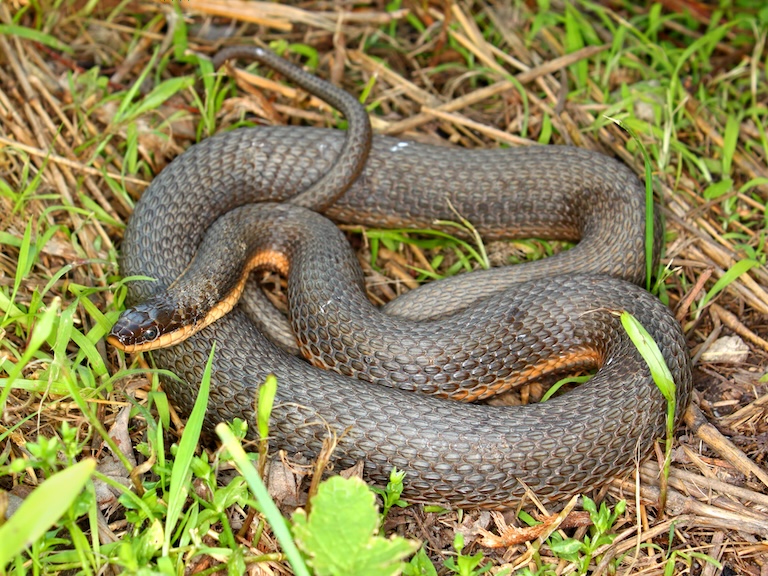
Queen Snake Fact-File Summary
Scientific Classification
| Kingdom | Animalia |
| Phylum | Chordata |
| Class | Reptilia |
| Order | Squamata |
| Family | Colubridae |
| Genus | Regina |
| Species | septemvittata |
Fact Sources & References
- (2004), “Queen Snake (Regina septemvittata)”, Wisconcin Department of natural Resources.
- (2007), “Regina septemvittata”, IUCN Red List.